om-The Groom Stood The Moment He Saw Me Sitting At The Worst Seat In The Room. For years, my mother had dismissed my Navy career as “little,” so when Ryan straightened and said, “Ma’am,” she laughed. “You don’t have to be formal with Nora.” His face changed. “You didn’t know? She’s Commander Hayes. She chaired my readiness assessment before my promotion.” The table went silent. But later, Ryan found me alone and lowered his voice. “There’s something else.” I frowned. “What?” He glanced toward my stepfather. “Alan asked whether your position could help his company land a federal contract.”
PART 1
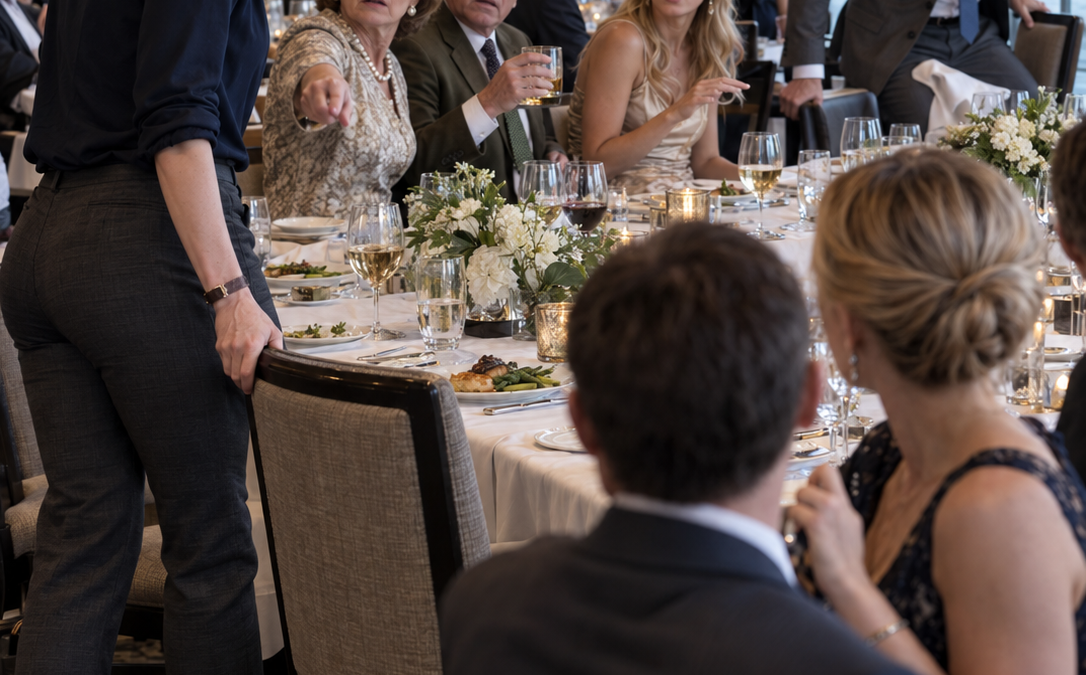
My mother seated me at the far end of my sister’s rehearsal dinner like I was an extra chair she had forgotten to remove.
I had been inside the private dining room for less than thirty seconds when Diane Brooks looked at my boots, then at the cocktail dresses and tailored suits around us, and sighed loudly enough for three people nearby to hear.
“Nora. Seriously?”
I looked down.
Dark slacks.
Navy blouse.
Black leather boots.
Nothing dirty. Nothing inappropriate.
Just clothes selected at five that morning for an airport, not for a rehearsal dinner at an expensive restaurant overlooking the Elizabeth River.
“My flight sat on the runway for almost two hours,” I said. “I came straight from the airport.”
Mom gave me the expression she had been using since I was sixteen.
Disappointment masquerading as patience.
“You always have an explanation.”
Behind her, my stepfather, Alan Brooks, lifted his bourbon.
“Some people just aren’t built for social occasions.”
He chuckled.
So did Martin Cole, one of his business friends.
There it was.
The family joke.
Nora was too serious.
Too practical.
Too absent.
Too military.
Too difficult.
My younger sister Lily was everything I supposedly was not.
Warm.
Pretty in photographs.
Easy to talk to.
Good at remembering birthdays.
Good at making people feel included.
Tomorrow she was marrying Ryan Walker, a Navy officer she had been dating for two years.
I had met him once on a video call for perhaps six minutes.
That was it.
Deployments, temporary duty, exercises, and one training cycle that ran straight through Thanksgiving had kept me away from most family events where he was present.
I knew Lily loved him.
I knew Ryan treated her well.
I thought that was enough.
“Your seat is down there,” Mom said.
She pointed toward the opposite end of the long table.
The head section included Lily and Ryan, his parents, the wedding party, two senior Navy officers I vaguely recognized, Alan’s favorite business contacts, and Mom’s oldest friends.
My place card was beside Aunt Ruth, who had lost her husband the previous winter, and a man dating one of my cousins who explained cryptocurrency to me before I had even unfolded my napkin.
I sat.
I did not argue.
For years I had believed this was maturity.
Do not correct every insult.
Do not demand recognition.
Do not turn a family dinner into a rank-and-status discussion.
My name is Nora Hayes.
I was thirty-five years old.
I had been in the United States Navy since I was eighteen.
I enlisted first.
Finished college while serving.
Earned a commission.
Built a career in logistics, readiness, and operational planning.
By the night of Lily’s rehearsal dinner, I was a commander.
My mother still called it:
“Nora’s Navy thing.”
Alan liked:
“Still doing that government work?”
Lily knew my rank.
Technically.
But if you had asked her what I actually did, she probably would have said something about ships and supply chains.
That was partly my fault.
After enough years of watching my family’s eyes glaze over, I stopped volunteering explanations.
At first, that was self-protection.
Later, it became another form of resentment.
If they did not ask, I did not tell.
Then I quietly collected every omission as evidence that they did not care.
Not especially healthy.
Dinner had barely begun when Ryan looked toward the far end of the table.
His eyes moved over the guests.
Then stopped on me.
The change in his face was immediate.
He stood.
Straight.
Not exaggerated.
Just instinctive military posture.
“Commander Hayes.”
The cryptocurrency lecture stopped.
So did three conversations around us.
My mother laughed lightly.
“Ryan, sweetheart, you don’t have to be formal with Nora.”
Ryan did not look at her.
He looked at me.
I nodded once.
“At ease, Walker.”
That made everything worse.
“It’s a rehearsal dinner.”
A few people smiled uncertainly.
Ryan sat, but the room did not return to normal.
Lily stared between us.
“You two know each other?”
Ryan looked genuinely confused.
“You didn’t know?”
“Know what?”
He glanced toward me.
“That Nora is Commander Hayes.”
Alan repeated:
“Commander?”
Mom gave a brittle laugh.
“We know she’s in the Navy.”
Then she added:
“She’s always been very private about her little career.”
Little.
Ryan’s expression changed.
Not dramatically.
Enough.
He looked at Lily, then at my mother.
“With respect, ma’am, Commander Hayes served on a readiness and leadership review panel I appeared before last year.”
Lily stared at me.
“You evaluated Ryan?”
“I was one member of a panel.”
Ryan smiled.
“She chaired it.”
“Ryan.”
He stopped immediately.
That small thing told the room more than I wanted it to.
I did not command him.
He was not in my current chain of command.
But he knew how I operated professionally.
He knew when I meant enough.
Mom looked around the table.
“Well.”
She smiled.
“Clearly Nora and Ryan have crossed paths.”
Crossed paths.
Eight months earlier, Ryan had spent nearly two hours answering questions from a panel of senior officers about judgment, readiness, leadership, and his suitability for increased responsibility.
I remembered him because he had given one answer I liked and one I did not.
The answer I disliked concerned a junior officer who had made a significant training error.
Ryan had described the corrective documentation clearly.
Accountability.
Remediation.
Record.
I asked:
“What did you do after the mistake became useful only as a lesson?”
He paused.
Then admitted he had spent more time documenting failure than rebuilding the junior officer’s confidence.
Good answer.
Not flattering.
Honest.
That mattered to me.
Apparently it mattered to him too.
Lily whispered:
“You really didn’t know it was Ryan?”
“No.”
“He talked about you.”
“That sounds ominous.”
“He called you terrifying.”
Ryan said from across the table:
“In a positive sense.”
I looked at him.
“That sentence has never existed.”
A few people laughed.
Even Lily.
For a moment, everything relaxed.
Then Alan’s friend Martin leaned across the table.
“So, Commander, what kind of intelligence work do you do?”
“I don’t work in intelligence.”
“Oh.”
He seemed disappointed.
“What do you do?”
“Operational logistics and readiness.”
“That sounds classified.”
“It mostly sounds classified to people who find maintenance schedules boring.”
Ryan’s father laughed.
He introduced himself as Tom Walker, retired Coast Guard.
We began talking about readiness cycles, supply constraints, maintenance backlogs, and the endless problem of making organizations distinguish between what exists on paper and what actually works.
Nothing sensitive.
Nothing dramatic.
For the first time that evening, I forgot where Mom had seated me.
Then she cut in.
“Nora, don’t bore everyone with work.”
Tom Walker looked surprised.
“She isn’t.”
Mom smiled tightly.
“I’m teasing.”
Of course.
Always teasing.
Something became clear then.
My mother had not failed to understand my career because the military was incomprehensible.
Understanding me would have disrupted a story she had been telling for years.
Lily stayed.
Nora left.
Lily was warm.
Nora was difficult.
Lily built relationships.
Nora chose work.
Families like simple roles because roles eliminate questions.
Once the responsible child becomes “cold,” nobody has to ask why she stopped sharing.
Once the nearby child becomes “loving,” nobody has to ask what she receives in return.
Ryan had broken the frame accidentally simply by recognizing me.
Dinner continued.
People who had barely looked at me twenty minutes earlier now wanted to know where I had been stationed.
How long I had served.
Whether I had been overseas.
What commanding sailors was like.
Status had made me interesting.
I disliked how much that satisfied me.
Halfway through dinner, Lily disappeared.
I found her near the restrooms, standing beside a decorative mirror with her arms folded.
“Are you okay?”
“No.”
Good start.
“Wedding nerves?”
“You.”
“Less traditional.”
She looked at me.
“Ryan talked about Commander Hayes for months.”
“I’m sorry?”
“After that board.”
I waited.
“He told me about the question you asked him.”
“The junior officer?”
“Yes.”
“He said it changed how he handled one of his division officers afterward.”
I looked down.
“He was receptive.”
“You remember him.”
“I remember the answer.”
Lily’s eyes filled.
“And you never once connected him with me.”
“I knew your Ryan was a Navy officer. There are quite a few.”
“That’s not what bothers me.”
“What does?”
She swallowed.
“Why did I know so little about your life that I never connected anything either?”
There it was.
I could have blamed Mom.
Alan.
Deployments.
Distance.
Instead:
“Because you didn’t ask much.”
She flinched.
I continued.
“And because I stopped telling you.”
“That sounds like blame with a disclaimer.”
“Probably.”
She leaned against the wall.
“Mom told Ryan’s parents something about you.”
My stomach tightened.
“What?”
“A few months ago.”
“What did she say?”
Lily looked ashamed.
“That you never really advanced because you chose a less demanding career track.”
I stared.
“What?”
“She said you had opportunities but preferred administrative work because you didn’t want the pressure.”
For several seconds, I could not speak.
I had spent eighteen years in uniform.
Multiple moves.
Long deployments.
Missed holidays.
Operational billets.
Leadership responsibilities.
Promotion boards.
Evaluations.
And somehow my mother had reduced it to:
Less demanding.
“Did you correct her?”
Lily looked down.
“I didn’t know she was wrong.”
“You knew my rank.”
“I knew you were a commander. I didn’t know what that meant.”
“That’s the problem.”
“I know.”
“When were you going to tell me?”
“I wasn’t.”
At least honest.
“Why?”
She wiped under one eye.
“Because I didn’t think it mattered.”
I nodded slowly.
“That’s also the problem.”
Lily started crying.
I did not hug her immediately.
That would have been our family habit.
Truth.
Pain.
Then quick comfort so nobody had to sit with what happened.
Eventually I put one hand on her shoulder.
“I’m still coming tomorrow.”
She looked up.
“You are?”
“You’re my sister.”
“You’re angry.”
“Yes.”
“Enough to skip?”
“No.”
She gave a wet laugh.
“Comforting.”
“Doing my best.”
When we returned to the dining room, Ryan caught my eye but did not ask questions.
Good judgment.
Toward the end of the evening, he found me near the coat check.
“Commander.”
“Nora.”
“Right.”
He looked nervous.
That was new.
“I owe you an apology.”
“For recognizing me?”
“For saying as much as I did.”
“You didn’t disclose anything sensitive.”
“No.”
He hesitated.
“What?”
“There’s something else.”
My posture changed before I could stop it.
Ryan noticed.
“Your stepfather asked me about you a few weeks ago.”
“Alan?”
“Yes.”
“What did he ask?”
Ryan glanced toward the dining room.
“Whether your position could help his company get visibility with people involved in federal logistics contracts.”
Every instinct in me went cold.
Alan owned Brooks Logistics Solutions.
Regional warehousing.
Freight coordination.
Government subcontracting.
Mostly commercial work, but he had spent years trying to grow the public-sector side.
“What exactly did he say?”
“He said you had influence in Navy logistics.”
“He used that word?”
“Something close.”
“What did you tell him?”
“To speak with you directly.”
“And?”
“He said there wasn’t much point because you were basically administrative.”
I almost laughed.
Of course.
Useless until useful.
“What else?”
“He asked whether I knew anyone involved in contracting.”
“Did you give him names?”
“No.”
“Good.”
Ryan looked uncomfortable.
“I may have told him he should not use a family relationship as part of a pitch.”
“Also good.”
“I’m sorry.”
“You didn’t do anything wrong.”
“He’s your family.”
“That doesn’t change procurement rules.”
“No.”
“Or ethics rules.”
“No.”
“And you’re marrying my sister tomorrow.”
“Yes, ma’am.”
“Stop.”
He smiled.
“Nora.”
“Better.”
I looked through the doorway.
Alan stood with Martin Cole.
Laughing.
Two hours earlier, Martin had said:
“So you’re still doing the Navy thing?”
Now he was watching me with interest.
That was when the evening changed from family humiliation into something I could not ignore professionally.
My family had spent years treating my work like an eccentricity.
The moment they understood it had possible commercial value, they were already trying to borrow it.
At the hotel, I had nine messages from Mom.
I ignored all of them.
Then Lily texted.
Please answer me.
Then:
Not Mom. Me.
I called.
“Are you leaving?” she asked.
“No.”
“I thought maybe you’d skip the wedding.”
“I’m angry at you.”
“I know.”
“I’m not punishing you with your wedding.”
“Thank you.”
“That is a depressing sentence.”
She laughed weakly.
Then:
“Mom and Alan are fighting downstairs.”
“About me?”
“Alan wants you to meet Martin for coffee tomorrow morning.”
“No.”
“I know.”
“I mean absolutely not.”
“I told him.”
I sat on the edge of the hotel bed.
“Listen carefully. If Alan or Martin says my name in connection with any business proposal, bid, contract, government relationship, or implied access, they do not have my permission.”
“Okay.”
“I have never reviewed Brooks Logistics for government work.”
“Okay.”
“I have never endorsed them.”
“Okay.”
“I have never arranged introductions.”
“Okay.”
“And do not repeat anything else about my job because you’re trying to defend me.”
She went quiet.
“Why?”
“Because my career is not ammunition for this family argument.”
That took her a second.
“Okay.”
“Good.”
Then Lily said:
“I’m starting to remember things.”
“What things?”
“Times you came home and I talked for two hours about myself.”
I smiled despite myself.
“You were twenty-three.”
“I’m not talking about once.”
I waited.
“The promotion dinner you missed because you were overseas.”
“What about it?”
“You called afterward.”
“I remember.”
“You tried to tell us you’d been selected for something.”
“Command screening.”
“Mom interrupted because my engagement to Tyler had ended.”
I had forgotten.
Lily had not.
“I never asked again.”
“No.”
“I’m sorry.”
That apology landed more deeply than the rank issue.
Because it was specific.
“I’ll see you tomorrow.”
“Love you.”
“Love you too.”
At seven the next morning, Mom knocked on my hotel door.
I opened it wearing a robe.
She looked at me and immediately frowned.
“You need breakfast.”
“Good morning.”
“You always eat terribly when you travel.”
“Why are you here?”
She stepped inside.
Uninvited.
Then seemed to remember the previous evening and stopped near the door.
Progress by accident.
“What happened last night was unnecessary.”
“What part?”
“Ryan making a spectacle.”
“He recognized me.”
“You encouraged it.”
“How?”
“You know exactly how.”
I sat.
“Explain.”
That always irritated her.
She liked implications more than definitions.
“You could have told us.”
“Told you what?”
“Your position.”
“I did.”
“No, you didn’t.”
“I told you when I promoted.”
“You said commander. How am I supposed to understand every title?”
“You could have asked.”
She crossed her arms.
“You always make everything my fault.”
“No.”
“You’re doing it right now.”
I took a breath.
Old Nora would become perfectly calm.
Precise.
Cold.
Then Mom would become emotional and I would silently congratulate myself for winning.
Not today.
“You have hurt me for years by acting as though my work is unimportant.”
Her expression changed.
Actual feeling.
Good.
“And I helped it happen by eventually deciding you weren’t worth explaining it to.”
Mom stared.
“That’s cruel.”
“Yes.”
There.
No moral high ground.
“I stopped sharing because being ignored hurt.”
She looked away.
“That does not mean I hid it to embarrass you.”
Silence.
Then she sat.
For a moment, I thought we might actually talk.
She said:
“Alan has one small request.”
I laughed.
Could not help it.
Mom’s face hardened.
“There. That attitude.”
“What request?”
“He wants you to have coffee with Martin.”
“No.”
“You haven’t even heard why.”
“I know why.”
“You could help this family for once.”
That sentence ended the conversation.
Not because I had never helped.
Because she believed help counted only when it entered the ledger she cared about.
I thought of flights.
Emergency leave.
Money quietly sent after Dad—my biological father—stopped contributing to certain expenses when I was younger.
Mom’s medical appointment I flew home for.
The roof repair I split with Lily after Alan said cash was tight.
None of it counted because it was not commercially useful today.
“Leave.”
Mom stared.
“Nora.”
“Please leave my room.”
“You are going to make your sister’s wedding miserable because you need to prove something.”
“No.”
I stood.
“For the next several hours, I am going to be Lily’s sister.”
“And after?”
“We deal with after, after.”
She left.
At ten-thirty, I received a message from Lily.
Come to the bridal suite when you’re ready.
I went.
She was sitting in front of a mirror while a stylist pinned small white flowers into her hair.
She looked beautiful.
Also furious.
“Did Mom ask you about Alan?”
“Yes.”
“I told her not to.”
“I know.”
Then Lily dismissed the stylist for five minutes.
When the door closed, she turned.
“There’s more.”
Of course.
“What?”
“Alan already used your name.”
My stomach tightened.
“How?”
“Last month he told Martin that his stepdaughter had influence in Navy logistics and understood procurement priorities.”
“His exact words?”
“I wasn’t there. Gregory heard it and told me yesterday after dinner.”
“Who’s Gregory?”
“Ryan’s friend. He works for Martin’s company.”
Good.
Secondhand.
Not enough for conclusions.
“Anything written?”
“I don’t know.”
“Okay.”
“You’re not angry?”
“I’m extremely angry.”
“You look calm.”
“That is not the same thing.”
I took out my phone.
Not to call Alan’s customer.
Not to threaten anyone.
I contacted my command ethics advisor.
Short message.
Potential unauthorized use of my name/rank by family member in connection with commercial federal business. Request guidance/documentation.
Then I emailed myself a contemporaneous note.
What Ryan had told me.
What Lily had told me.
Who said what.
No conclusions.
Facts.
That was it.
No revenge.
No dramatic phone call to kill a contract.
My job was not procurement enforcement.
My job was to protect my own integrity and report possible misuse through the correct channel.
I put the phone away.
Lily watched.
“That’s all?”
“For now.”
“You’re not calling Alan?”
“No.”
“Why?”
“Because I’m not going to turn your wedding morning into an investigation.”
She almost cried.
Then Mom entered without knocking.
Of course.
She looked from Lily to me.
“I need a minute with Nora.”
Lily said:
“No.”
Mom stopped.
“What?”
“No.”
“This is between your sister and me.”
“It became my business when Alan started using my wedding weekend to network around her name.”
Mom stared.
“Who told you that?”
“Doesn’t matter.”
“It absolutely matters.”
Lily stood.
Wedding robe.
Half-finished hair.
Bare feet.
And for once she did not look like the easy daughter.
“For the next six hours, Nora is my sister.”
She looked at me.
“That’s what you said, right?”
“Yes.”
She turned back to Mom.
“So that is the only role anybody gets to ask her to perform.”
Mom’s face changed.
Not anger first.
Shock.
Lily had stepped outside her assigned role.
That was harder for Mom than anything I could have said.
“What happens after six hours?”
I picked up my purse.
“We deal with after, after.”
The wedding happened.
Real life is rude that way.
Flowers still arrive while families fracture.
Photographers still ask people to turn toward the light.
Guests still complain about parking.
At four o’clock, Lily walked down the aisle toward Ryan.
He cried immediately.
Then straightened his shoulders as if posture could erase tears.
It could not.
I liked him more for that.
I stood beside Lily with the other attendants.
Not in uniform.
Not as Commander Hayes.
Just Nora.
At the reception, Ryan found me near the terrace.
“Commander.”
“Try again.”
“Nora.”
“Better.”
He grinned.
Then became serious.
“I never thanked you.”
“For?”
“The board.”
“No need.”
“I almost withdrew my package before that review.”
I looked at him.
“Why?”
“My dad had the stroke.”
I remembered that from his record.
“I was considering leaving active duty.”
“And?”
“You asked why I kept describing family and duty like they were opposing forces.”
I did remember.
He had framed every possible choice as betrayal of someone.
Stay in.
Fail family.
Leave.
Fail Navy.
I had asked:
“What choice would you make if nobody else were allowed to call it selfish?”
He had gone silent for almost a minute.
“What changed?”
Ryan looked through the terrace doors toward Lily.
“I realized I was less afraid of choosing wrong than I was of choosing something that disappointed somebody.”
That sentence hit harder than he knew.
“Useful lesson.”
“I’m still bad at it.”
“Most people are.”
Then:
“Your stepfather’s looking for you.”
“Of course.”
Alan found me near the coatroom twenty minutes later.
No greeting.
“You created a serious problem.”
“What did I create?”
“Martin called someone this morning. Now people are asking what exactly I meant about you.”
“If you described our relationship accurately, answer accurately.”
His jaw tightened.
“I said my stepdaughter is a senior Navy officer.”
“True.”
“And that you understand federal logistics.”
“Broadly true.”
“And that being family gives us insight into defense-sector needs.”
“There it is.”
“That’s how business works.”
“No.”
I looked at him.
“That’s how you decided your business works.”
His face reddened.
“I did not say you influenced contracts.”
“Good.”
“I never said you got us anything.”
“Good.”
“Then why are people acting like I committed some crime?”
“I did not tell anyone you committed a crime.”
“What did you tell them?”
“That I have never endorsed your company, reviewed your bids, arranged introductions, provided nonpublic information, or authorized you to use my position commercially.”
He stared.
“You documented that?”
“Yes.”
“You could damage me.”
“No.”
“If somebody starts asking questions—”
“That is not damage caused by me.”
Mom appeared.
“Not here.”
She said it to Alan.
Interesting.
He walked away.
Mom stayed.
For the first time all weekend, she looked tired.
Not polished.
Not controlled.
Just tired.
“He’s scared.”
“I know.”
“He wasn’t trying to get you in trouble.”
“I know.”
“He thought your position might open a conversation.”
“That is the problem.”
She nodded.
For one beautiful second, I thought she understood.
Then:
“You could make this easier.”
There it was.
Again.
“What do you want me to do?”
“Call Martin.”
“And say?”
“That Alan exaggerated because he was proud.”
I almost laughed.
“Was he?”
Mom looked away.
“You know what I mean.”
There it was too.
Always.
You know what I mean.
A phrase that asks the listener to convert an inconvenient truth into a kinder one.
“No.”
“Nora.”
“No.”
“If you don’t help, this family may never recover.”
I looked at her.
“There is no version of this family to recover.”
Her face went still.
“That’s a horrible thing to say.”
“No.”
My voice shook now.
Good.
Honest.
“We had a system where everybody called things fine because I stopped objecting.”
I looked toward the ballroom.
“That isn’t a healthy family. That is silence with holiday plans.”
Mom’s eyes filled.
“What do you want from me?”
“Honesty.”
“I’m being honest.”
“No.”
I shook my head.
“Not honesty about Alan. Yours.”
She stared.
I left after the cake.
Outside, rain had started.
Before I reached my rental car, an unfamiliar Virginia number called.
The man identified himself as counsel for a private logistics company that had been in preliminary discussions with Brooks Logistics.
He had heard my name had been referenced.
He wanted to verify whether I had any formal or informal advisory role.
“No.”
Whether I had made introductions.
“No.”
Whether I had access to procurement decisions affecting the contemplated work.
“No.”
Whether I had authorized Alan to imply otherwise.
“No.”
I documented the call.
Sent the note to my ethics advisor.
Then drove back to the hotel.
That was the entire intervention.
No contract cancellation by me.
No threat.
No uniform.
No speech.
Just:
No.
Accurately documented.
Sometimes that is enough.
PART 2
Alan’s company did not collapse.
Nobody arrested him.
No federal agents arrived.
Nothing cinematic happened.
One potential business relationship cooled.
Another party delayed discussions while Alan clarified exactly what he had represented.
Martin Cole stopped returning his calls for several weeks.
According to Lily, Alan blamed me immediately.
Three voicemails.
First:
“You embarrassed me.”
Second:
“You don’t understand business.”
Third:
“You have always wanted to prove you’re better than this family.”
I blocked his number after that.
Not because he was forbidden from ever speaking to me again.
Because I did not need his anger delivered directly into my pocket.
Mom switched to email.
Nearly two thousand words.
Childhood.
My father.
Divorce.
Her loneliness after I enlisted.
How terrified she had been when I first deployed.
How painful it was to watch other mothers know where their daughters lived while she sometimes did not.
Some of it was true.
That made it harder.
People who hurt us are rarely wrong about everything.
Then I reached the sentence that stopped me.
Maybe I made you small because accepting how large your life had become meant admitting how little of it I knew.
I read it three times.
Then came the final paragraph.
She wanted me to call Alan.
Help repair his professional relationships.
Explain that he had “spoken imprecisely.”
Same pattern.
Insight.
Emotion.
Invoice.
I did not answer.
Lily called that night.
“Mom thinks you’re punishing her.”
“I’m not.”
“I know.”
Then she said:
“I think she doesn’t understand the difference between losing access to you and being punished by you.”
I sat down.
“That is possibly the smartest thing you’ve ever said.”
“Rude.”
“Accurate.”
Then Lily apologized.
Properly.
Not for Mom.
For herself.
“I didn’t treat you the way Mom did.”
“No.”
“But I benefited from it.”
I listened.
“I got to be the easy daughter because you were the difficult one.”
Her voice shook.
“I got to be the family person because you were the one who left.”
“You stayed closer.”
“I know.”
“That matters.”
“But every time she compared us, I told myself I wasn’t participating because I didn’t say anything.”
Silence.
“Silence is participation when it always benefits the same person.”
That was the sentence.
Not:
I’m sorry I didn’t ask more.
Larger.
She saw the structure.
I said:
“I participated too.”
“How?”
“I made being underestimated part of my identity.”
“What does that mean?”
“I liked being the person nobody understood.”
She laughed.
“That is the most Nora sentence possible.”
“I know.”
But it was true.
If I explained nothing, then every family misunderstanding became proof they had failed me.
Sometimes they had.
Sometimes I simply refused to give them a new version of me because I was still angry about the old one.
Both things could be true.
Lily and I changed first because we had something immediate worth saving.
We actually liked each other.
Underneath Mom’s comparisons.
Underneath distance.
We did.
She started calling without opening every conversation with wedding updates, marriage problems, or Mom.
At first it was awkward.
“Hi.”
“Hi.”
“What are you doing?”
“Working.”
“Okay.”
“You?”
“Laundry.”
Excellent sisterhood.
Then better.
She asked where I was traveling.
Remembered a training exercise.
Sent me photographs that were not requests.
When Ryan received a new assignment, she asked me what I thought.
I said:
“Do you want Navy analysis or sister analysis?”
“Both.”
That distinction became useful.
Ryan and I developed exactly the relationship two naval officers accidentally made family should probably have.
Respectful.
Competitive.
Irritating on purpose.
He continued calling me Commander at holidays when he wanted to annoy Lily.
She threatened divorce twice over it.
Never seriously.
Professionally, I stayed far away from anything involving Brooks Logistics.
My ethics office documented my disclosure.
Because my duties did not involve Alan’s company or the specific contracting activity, there was no grand investigation into me.
The concern was simple:
Do not let family imply access.
Correct the record where necessary.
Recuse if an actual matter ever intersected.
It never did.
Alan’s difficulties were commercial rather than criminal.
One company decided his representations had made them uncomfortable.
Another continued doing limited business with him after getting clarification.
He lost an opportunity.
Not his livelihood.
That mattered.
The story my mother told later was:
“Nora cost Alan a contract.”
The reality was less convenient.
Alan made claims about family access.
Other businesspeople asked questions.
I answered accurately.
They made their own decisions.
Adults dislike consequences that cannot be assigned cleanly to an enemy.
Four months after Lily’s wedding, Mom asked me to lunch.
Neutral restaurant.
No Alan.
That was my condition.
She agreed.
When I arrived, she was already there.
No polished speech.
No folder.
No email printout.
She looked older.
For the first ten minutes, we discussed nothing important.
Traffic.
Food.
Lily.
Then Mom put down her fork.
“I owe you an apology without a request attached.”
I looked at her.
“Okay.”
“I practiced that sentence.”
“I can tell.”
She almost smiled.
Then:
“When you enlisted, I was angry.”
“I know.”
“No.”
She looked at me.
“I was angry that you left me.”
I stared.
“I was eighteen.”
“I know.”
“You encouraged me to join.”
“I did.”
“You came to graduation.”
“Yes.”
“But afterward, every new assignment felt like you were choosing something away from me.”
There.
Not career confusion.
Abandonment.
“And Lily?”
“She stayed.”
“She was fourteen.”
“I know.”
Mom’s eyes filled.
“When she stayed close as an adult, I rewarded her for making me feel needed.”
I thought about the head table.
The compliments.
The assumption that Lily was family and I was almost a visitor.
“Yes.”
“I made her easier to love because she was easier for me to reach.”
That was honest.
“And me?”
Mom swallowed.
“I made your independence into a character flaw.”
There.
I did not speak.
She continued.
“If I admitted you were successful, then I also had to admit you had built something enormous without me knowing much about it.”
Her voice broke.
“So I decided it wasn’t important.”
That hurt.
Not because it was new.
Because she said it plainly.
“I’m sorry.”
I looked at her.
“Thank you.”
She waited.
I realized she expected nothing else.
No call Alan.
No:
But you should understand.
No request.
That mattered more than forgiveness language.
“I’m still angry.”
“I know.”
“I’m not coming to the house if Alan is going to corner me about business.”
“I understand.”
“I don’t want you giving people career summaries about me.”
She almost laughed.
“I don’t know enough.”
“You can say that.”
Her face changed.
“I could have said that years ago.”
“Yes.”
We finished lunch.
No hug until the parking lot.
She asked.
“Can I?”
I nodded.
Small.
Clear.
That was how we began again.
Alan was harder.
For almost a year, we barely spoke.
He never apologized for the business issue because he did not believe he had done anything wrong.
Eventually he did acknowledge one piece.
At a family birthday, he said:
“I shouldn’t have represented you as connected to my company.”
“Correct.”
“I still think you overreacted.”
“Then we’re halfway there.”
He did not appreciate that.
Fine.
Not every relationship repairs at the same depth.
Alan remained my stepfather.
We were civil.
He stopped using my name professionally.
That was the boundary I needed.
I did not require him to understand my childhood.
Mom did something more difficult.
She started learning my work.
Not all of it.
She would never care about readiness metrics.
Reasonable.
But she asked.
“What does your assignment actually involve?”
“What does a commander do?”
“Are these deployments or temporary trips?”
The first few times, I answered too much.
Years of pent-up explanation.
Then adjusted.
One Christmas, she introduced me to a neighbor.
“This is my daughter Nora. She’s a Navy commander working in operational logistics and readiness.”
I waited.
No:
Little career.
No:
Military paperwork.
Then she said:
“She’s very good at it.”
I looked at her.
She looked immediately self-conscious.
“Too much?”
“No.”
“Okay.”
Praise can feel almost as dangerous as dismissal when you have wanted it too long.
My career changed too.
Not because of the wedding.
Time.
Assignments.
Promotion.
Eventually I advanced again.
This time, I called Mom myself.
Not a group text.
“Mom.”
“Yes?”
“I got selected.”
“For?”
I explained.
There was a pause.
Then:
“I don’t completely understand what that means.”
I smiled.
“Good start.”
“Is it important to you?”
“Yes.”
“Then I’m proud of you.”
That was enough.
No rank comparison.
No pretending expertise.
She did not need to understand the institution to understand me.
PART 3
Two Christmases after Lily’s wedding, we all gathered at her house.
Ryan was stationed nearby.
Lily had planned dinner without a seating chart, which I considered evidence of maturity.
Mom came alone.
Alan had “other plans.”
Nobody asked.
That was also maturity.
Rain tapped against the windows.
Ryan stood at the counter with a carving knife.
Then looked at me.
“Commander, guidance?”
Lily groaned.
“Do not start.”
I raised my wineglass.
“I evaluated you once, Walker. I’m off duty.”
Ryan saluted with the carving fork.
Mom laughed.
A real laugh.
Not the thin sound she used to smooth over tension.
For several seconds, I looked around the room.
Lily arguing with Ryan about how thin turkey should be sliced.
Mom carrying potatoes.
My niece coloring at the table.
Nobody asking what my rank meant.
Nobody interested in what my career could do for them.
Nobody performing awe.
That mattered.
For years, I had imagined the satisfying version of this story ended at the rehearsal dinner.
Ryan stands.
The room goes silent.
Mom finally realizes who her daughter really is.
That was never the real victory.
Being underestimated and then publicly recognized still leaves your worth dependent on the audience’s reaction.
I had spent too long doing that already.
First negatively.
Then positively.
The deeper repair was quieter.
My family had to learn that I mattered before anyone impressive verified it.
And I had to learn to stop requiring their ignorance so I could feel morally superior to them.
Lily understood this fastest.
Maybe because she had lived inside the opposite role.
One summer we took a weekend trip together.
Just us.
First time since we were teenagers.
At dinner, she asked:
“Did you resent me?”
I thought.
“Yes.”
She nodded.
“How much?”
“Enough.”
“For staying?”
“For being rewarded for staying.”
She looked down.
“I resented you too.”
That surprised me.
“For what?”
“Leaving.”
There it was.
“Mom always talked about you like you were difficult.”
“Yes.”
“But she also talked about you.”
I frowned.
“What do you mean?”
“She worried when you deployed.”
“Okay.”
“She saved every postcard.”
I stared.
“What postcards?”
“The ones you sent from overseas.”
I had forgotten.
“She kept your promotion announcements.”
“Seriously?”
“Yes.”
“In a drawer.”
I laughed.
“Very on brand.”
Lily smiled.
“I think she diminished your life when talking to other people because she felt excluded from it.”
“I know.”
“But growing up, I heard Nora, Nora, Nora.”
That was new.
“You were the one doing interesting things.”
“I thought you were the favorite.”
“I was.”
She smiled sadly.
“Different problem.”
We sat quietly.
Sibling roles rarely feel as flattering from inside as they look from outside.
Lily had been loved for staying.
Then quietly obligated to continue staying.
I had been criticized for leaving.
Then allowed to build a life without caregiving expectations.
Both of us paid.
Different currencies.
That weekend helped more than years of comparison.
Ryan’s relationship with me changed after he promoted.
Not because I controlled anything.
I did not.
He occasionally called for career advice.
Only after confirming there was no conflict.
I respected that.
Once he said:
“I think I finally understand why you were so hard on my answer about that junior officer.”
“Why?”
“Because I was using accountability to avoid mentorship.”
“Better late than never.”
“Lily says you do the same thing emotionally.”
I stared.
“What?”
“She says you document everyone’s failures.”
Traitor.
“What else does my sister say?”
“Privileged communication.”
“Incorrect legal concept.”
“Noted.”
He laughed.
Then:
“She’s not entirely wrong.”
Neither was he.
I had spent years building internal case files.
Mom forgot this.
Alan said that.
Lily did not ask.
Every incident catalogued.
Some deserved remembering.
The problem came when memory became prosecution.
Therapy helped.
Yes.
Eventually.
My counselor asked:
“What outcome would make the evidence unnecessary?”
I said:
“Changed behavior.”
“Are you allowing yourself to notice it?”
Annoying question.
Mom had changed.
Not perfectly.
Alan had changed less.
Lily substantially.
Dad—my biological father—was mostly outside the family by then and had his own separate relationship with me.
The old evidence remained true.
It was no longer the only admissible material.
So I began updating the record.
Mom asked.
Lily called.
Alan did not use my name.
Ryan respected boundaries.
Small things.
New evidence.
Five years after Lily’s wedding, Mom visited me near my duty station.
Her idea.
She stayed at a hotel.
Also her idea.
We had dinner.
The next morning, I showed her around the public portions of the installation where visitors were permitted.
Nothing sensitive.
Nothing dramatic.
Conference rooms.
Administrative spaces.
A pier from a distance.
She looked at the buildings.
Then:
“This is where you work?”
“Partly.”
“I imagined something more…”
She stopped.
“What?”
“Movie-like.”
I laughed.
“Mostly email.”
She smiled.
Then became quiet.
“I should have come sooner.”
“Yes.”
“Would you have wanted me?”
I thought.
“At twenty-five? Probably.”
“At thirty?”
“Less.”
“At thirty-five?”
I smiled.
“You’re here.”
She nodded.
Then:
“I’m sorry I made you prove you didn’t need me.”
That sentence landed harder than rank ever had.
I looked away.
Because that was the old family test.
If I needed them, I risked disappointment.
If I did not need them, they called me distant.
No winning.
Unless we stopped playing.
“Thank you.”
Mom touched my arm.
No speech.
We continued walking.
Alan’s company eventually stabilized.
He never became a major defense contractor.
Brooks Logistics remained what it had always been good at:
regional freight.
Warehouse coordination.
Commercial distribution.
The lost federal opportunity became family folklore from two incompatible perspectives.
Alan:
“Nora cost me a major partnership.”
Me:
“Alan oversold a connection he did not have.”
Reality:
A prospective partner became uncomfortable with how he had characterized family access and reconsidered.
Nobody needed a villain for that.
Years later, Alan admitted over coffee:
“I thought everybody used relationships that way.”
“Many people do.”
“And you don’t?”
“I use relationships all the time.”
He looked surprised.
“For advice. Referrals that are appropriate. Introductions where there’s no conflict.”
I smiled.
“The difference is I don’t describe somebody else’s public office as an asset belonging to me.”
He looked down.
“Fair.”
Closest thing to an apology I ever got.
I accepted it.
Not everything needs a ceremonial reconciliation.
At my forty-third birthday, Mom gave me a framed photograph from Lily’s wedding.
Not the ceremony.
Rehearsal dinner.
Taken before Ryan recognized me.
I was sitting at the far end of the table beside Aunt Ruth, listening to the cryptocurrency boyfriend.
I looked tired.
Boots visible.
Mom had written on the back:
I wish I had asked you to sit closer.
I stared.
Then called her.
“You sent me emotional evidence.”
She laughed.
“Did it work?”
“Yes.”
“I’m sorry.”
“I know.”
“Would you rather have the original?”
“What original?”
“The seating chart.”
“No.”
“Good. I threw it away.”
Excellent.
The seat stopped mattering.
That was important.
For years, I thought the insult was placement.
Far end.
Bad table.
Wrong clothes.
But a seat cannot diminish a person unless everyone agrees it describes them.
I had agreed too often.
That was what changed.
At work, I started noticing the same pattern from the opposite direction.
There were junior officers who were quiet.
Dependable.
Never asked for credit.
I rewarded them with more work because they were reliable.
Then praised louder people for visible leadership.
One afternoon, I caught myself giving an especially competent lieutenant another assignment because:
“She won’t complain.”
The thought stopped me.
That was my family.
Competence taxed because it tolerates taxation.
I redistributed the work.
Later, I told the lieutenant why.
She stared.
“Ma’am, you didn’t have to tell me.”
“I know.”
Accountability after the lesson becomes useful.
Ryan would have appreciated the callback.
Lily and I became closer without pretending the previous distance had been entirely Mom’s fault.
I had missed things.
Not always because of orders.
Once I skipped her birthday weekend because I could technically have flown but did not want to deal with family.
I had told myself:
Work.
The truth was:
Exhaustion.
Resentment.
Choice.
I admitted that.
Lily said:
“I knew.”
Of course.
“You could have called me out.”
“I was busy being the good daughter.”
Fair.
We laughed.
Our family got smaller in some ways.
Some cousins drifted.
Alan and I never became close.
Mom no longer hosted every holiday.
Lily and Ryan moved twice.
I transferred again.
Fewer people.
More deliberate contact.
It was better.
Not because small families are inherently healthier.
Because ours stopped confusing compulsory access with closeness.
The last Christmas before Mom sold the old family house, she asked both daughters what we wanted.
Not inheritance.
Objects.
Lily chose Dad’s old cedar chest.
I chose a framed map Mom had once complained was “too Navy” for the living room.
She laughed.
“Of course.”
Then:
“Anything else?”
“No.”
“What about the silver?”
“No.”
“China?”
“No.”
“Furniture?”
“No.”
She looked almost disappointed.
“I thought you’d want more.”
“I have enough.”
At one time she would have heard that as rejection.
Now she nodded.
“Okay.”
Then she asked:
“Do you want the rehearsal-dinner photograph?”
“I already have it.”
“The one with Ryan standing?”
“No.”
“Why?”
I thought.
“Because that isn’t the moment I care about anymore.”
“What is?”
“The Christmas turkey.”
She stared.
“What?”
“The one where nobody cared what I did for work.”
Mom smiled.
“I like that too.”
That photograph became the one on my desk.
Ryan holding the carving knife.
Lily annoyed.
Mom laughing.
Me with a wineglass.
No uniforms.
No rank.
No recognition.
Just people.
That was the life I had wanted beneath all the anger.
Not admiration.
Belonging without reduction.
Mom died years later.
Not suddenly.
Cancer.
Enough time for complicated goodbyes.
During one hospital visit, she looked at me and said:
“You know what I hated most about your career?”
“What?”
“That I couldn’t tell whether you still needed me.”
My throat tightened.
“I did.”
She started crying.
“I know now.”
I took her hand.
“I also worked very hard to make sure you couldn’t tell.”
She smiled.
“So we were both difficult.”
“Apparently.”
“Lily always was easier.”
“Don’t ruin the ending.”
She laughed.
That was one of our last real conversations.
After her death, Lily and I cleared the house together.
No Alan—he had died two years earlier.
We found boxes.
Photographs.
Receipts.
Christmas decorations.
Then a folder labeled:
NORA
I opened it.
Every promotion notice I had sent.
Printed emails.
Newspaper clipping from an award.
A photograph of my commissioning.
A program from a change-of-command ceremony Mom had not attended but apparently ordered online afterward.
I sat on the floor.
Lily sat beside me.
“She kept all of it.”
“Yes.”
I cried.
Then became angry.
Again.
Because grief can resurrect old arguments.
“She could have told me.”
Lily nodded.
“Yes.”
“She could have come.”
“Yes.”
“She could have asked.”
“Yes.”
No defense.
That helped.
Then Lily said:
“She loved you badly in some places.”
I looked at her.
“That’s a strange sentence.”
“Accurate?”
“Yes.”
“And better in others.”
“Yes.”
Both.
That was adulthood.
Not deciding whether Mom had loved me.
Understanding love did not make every expression of it sufficient.
I kept three items.
The commissioning photograph.
One promotion notice.
The rehearsal-dinner picture of me at the far end.
Not because I still needed proof.
Because by then I could look at it and see something different.
Thirty-five-year-old Nora looked exhausted.
Guarded.
Boots under the table.
Sitting exactly where Mom put her.
But I no longer saw the least important person in the room.
I saw a woman who already knew who she was professionally and still had no idea she was allowed to require her family to know her too.
That changed.
Not because Ryan stood.
That was simply the disruption.
The real change came afterward.
Lily asking.
Mom apologizing without an invoice.
Alan losing access to my name.
Me admitting silence could also be control.
Years of smaller corrections.
I still remember Ryan standing at the rehearsal dinner.
Of course.
The room going quiet.
Mom’s face.
Alan repeating:
“Commander?”
There is satisfaction in being recognized by someone important enough to force people who dismissed you to reconsider.
I would be lying if I said otherwise.
But satisfaction is not healing.
If my worth required Ryan’s recognition, then I was still letting the room decide.
The important moment came after everyone sat back down.
Mom still minimized.
Alan still wanted access.
Guests suddenly became curious.
Nothing external had actually changed.
Same boots.
Same seat.
Same career.
Same woman.
Only their information had changed.
For the first time, I refused to shrink myself back into the version that made everybody comfortable.
That was the beginning.
Years later, Lily asked me whether I would change anything about that night.
“Yes.”
“What?”
“I would have changed clothes.”
She stared.
Then laughed so hard she nearly spilled her drink.
“Seriously?”
“My feet hurt.”
“That’s your lesson?”
“No.”
I smiled.
“The lesson is I would wear different boots because I wanted different boots.”
Not because Mom sighed.
Not because the room was expensive.
Not because a future groom might recognize my rank.
Choice for its own sake.
Small thing.
Big difference.
My mother seated me at the far end because she thought she already understood who I was.
For years, I sat there metaphorically even when there was no table.
The difficult daughter.
The absent one.
The military one.
The one who did not need anybody.
Then one evening a Navy officer recognized me, and the family story cracked.
What replaced it was not:
Nora was secretly more important all along.
That would simply be another hierarchy.
What replaced it was something harder and more useful.
Lily was allowed to be loved without being “the good one.”
Mom was allowed to miss me without turning my independence into betrayal.
Alan was allowed to think my career was boring without being allowed to use it.
And I was allowed to be accomplished, angry, needy, distant, loving, wrong, loyal, and complicated without reducing myself to whatever role made the dinner easier.
For fifteen years, I thought keeping peace meant absorbing the correction.
Ignoring the joke.
Accepting the bad seat.
Saying:
It doesn’t matter.
Then quietly remembering every time it did.
I was wrong.
Sometimes peace is just conflict one person has agreed to carry alone.
I don’t carry it that way anymore.
That is what changed at the end of the table.
Not my rank.
My size.
THE END
