OM-My Water Broke Across The Marble Floor While My Father Dragged Me Toward The Door Of The House My Late Husband Built For Me. Eleven days after Ethan died, Dad arrived with forged trust papers, his twenty-four-year-old wife wearing my robe, and one demand: “You’ve got ten minutes. Then you’re gone.” He thought grief had made me helpless. I didn’t argue. I reached into my coat and called my attorney. “It’s happening,” I said. She asked one question: “Has he presented the trust paperwork?” “Yes.” There was a pause. Then her voice turned cold. “Good. Don’t leave the property. Federal investigators are three minutes away.”
PART 1
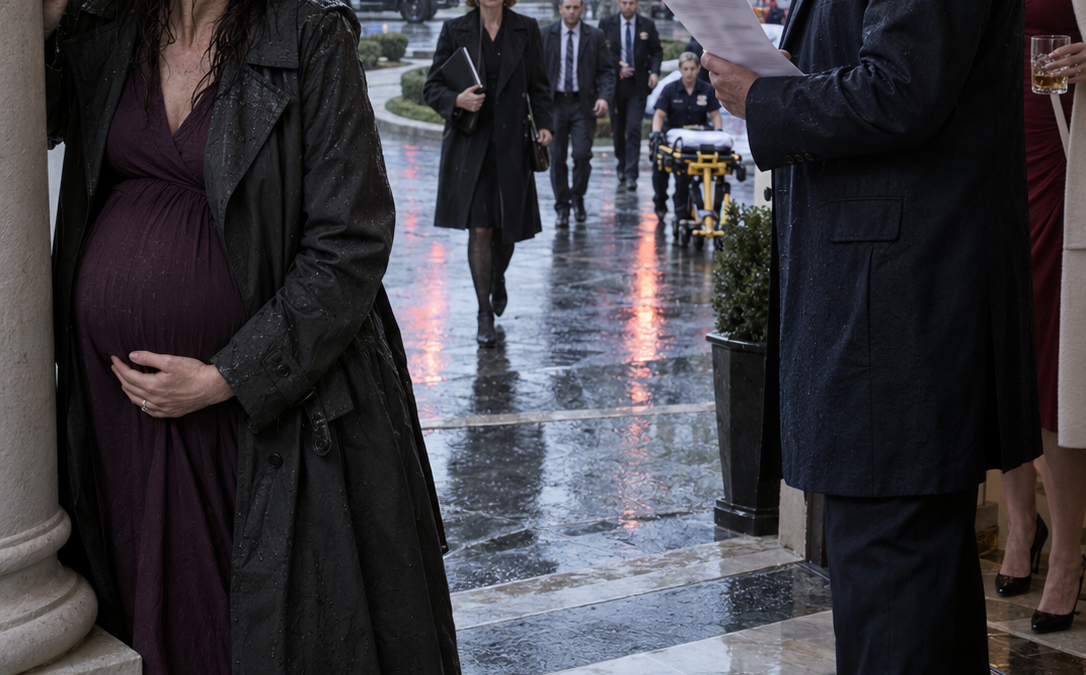
My father had one hand twisted into my hair when my water broke across the marble floor of the house my husband had built for me.
I was thirty-one years old.
Thirty-six weeks pregnant.
Widowed for eleven days.
And standing barefoot in my own foyer while my twenty-four-year-old stepmother watched water spread beneath me and said:
“Well. That solves one problem.”
I looked at her.
Vanessa was wearing my silk robe.
My robe.
Inside my house.
In one hand she held a glass containing what I recognized as Ethan’s twenty-year-old Scotch.
“Now she can go to the hospital,” Vanessa said, “and we can sort this place out properly.”
I turned toward my father.
“Dad.”
Richard Vale tightened his grip.
“Don’t call me that after what you’ve done to this family.”
My scalp burned.
One contraction was already tightening low across my abdomen, although whether it had begun before the confrontation or because of it, I could not tell.
“Let go of me.”
Richard’s face was inches from mine.
“You always thought you were smarter than everyone.”
“Let go.”
“You married that man and suddenly your own father became embarrassing.”
“Richard.”
Vanessa said his name lazily from behind him.
“Watch the rug.”
That was the detail I remembered afterward.
Not because it mattered.
Because shock chooses strange things.
My father was dragging his pregnant daughter toward the front door eleven days after her husband’s funeral, and Vanessa was worried about an antique runner.
Richard released my hair only to shove me toward the doorway.
I caught the edge of the console table.
A silver picture frame fell over.
Ethan and me at the construction site four years earlier.
Hard hats.
Mud.
Both laughing.
Outside, January rain struck the stone steps.
“You have ten minutes,” Richard said.
I turned slowly.
“Ten minutes for what?”
“To pack.”
“This is my house.”
His smile came immediately.
He had been waiting for me to say that.
“No.”
He reached inside his jacket and removed several folded pages.
“Not anymore.”
My name is Claire Caldwell.
Before I married Ethan, I was Claire Vale.
For years, that last name had functioned like an unpaid invoice.
My father believed raising me created a permanent obligation.
Need an introduction?
Claire knew someone.
A lender wanted better documentation?
Claire worked in corporate compliance.
A client was nervous?
Could Claire make a call?
A business quarter was bad?
Could Claire lend him something until cash flow improved?
It was rarely huge.
Five thousand.
Eight.
Twelve.
A favor.
An introduction.
A letter reviewed late at night.
Nothing individually large enough to justify admitting there was a pattern.
Then I met Ethan Caldwell.
He noticed the pattern before I did.
Ethan was forty when we met.
I was twenty-six.
He had founded a technology-and-industrial-services company in his twenties, sold part of it, kept controlling interests in several subsidiaries, and accumulated enough wealth that business publications occasionally estimated numbers he refused to discuss.
Richard hated him almost immediately.
I used to tell myself it was the age difference.
It wasn’t.
Ethan had the irritating habit of asking one additional question.
When Richard requested $25,000 for what he called a short-term bridge:
“What specifically is bridging what?”
When Richard wanted me to introduce him to one of Ethan’s portfolio executives:
“What would Claire receive for arranging that?”
When my father said:
“Family helps family,”
Ethan asked:
“Does the helping run in both directions?”
Richard never forgave him.
The house made things worse.
Ethan had it built for me before our wedding.
Not as a surprise palace.
I chose the neighborhood.
Floor plan.
Kitchen.
The ridiculous deep porch.
The marble foyer I later complained was impossible to keep clean.
Before we married, Ethan’s attorney insisted the deed be placed directly in my individual name as a completed gift and that both of us document it carefully in our prenuptial agreement.
At the closing, Ethan slid the house key across the conference table.
“Yours.”
I laughed.
“Ours.”
“Emotionally, yes.”
He pushed the key another inch.
“Legally, yours.”
“Romantic.”
“I contain multitudes.”
That key sat on my ring for four years.
Richard knew the house was mine.
Apparently he had decided grief might make facts negotiable.
Eleven days before the confrontation, Ethan died from a ruptured cerebral aneurysm.
No warning.
No long illness.
He kissed me before work.
Complained that I had bought the wrong coffee.
Texted me at eleven-fifteen:
Baby kicking?
At twelve-forty, I was in an ambulance behind his.
By three in the afternoon, a neurosurgeon was explaining words I understood individually but could not arrange into a future.
Ethan never came home.
I buried him eight days later.
Richard was magnificent at the funeral.
That is another thing I remember.
He held me while photographers from business publications stood outside.
Helped me into the car.
Pressed his cheek to mine.
Said:
“You don’t have to worry about anything now. Dad’s here.”
Three days after the funeral, he asked:
“What happens to Ethan’s companies?”
I should have understood immediately.
Instead:
“What?”
“His estate.”
“I don’t know yet.”
That was partly true.
I knew the broad plan.
Not every detail.
Ethan had trusts.
Business entities.
Insurance.
An independent corporate fiduciary for certain assets.
I had my own counsel.
He had insisted.
Richard said:
“You need somebody who understands business beside you.”
“I have Maya.”
“Maya Chen is a lawyer.”
“Yes.”
“I mean family.”
There it was.
Then he began showing up.
First with groceries.
Then Vanessa.
Then overnight bags.
“I don’t think you should be alone.”
I did not want them there.
I also had not slept more than three hours at a time since Ethan died.
So I let them stay.
Again:
Compassion becoming agreement.
By the fourth night, Vanessa had moved toiletries into the upstairs guest bath.
By the sixth, Richard was taking calls from my late husband’s study.
I told him to stop.
He said:
“I need privacy.”
“It is Ethan’s office.”
“He isn’t using it.”
I almost threw him out then.
Instead, I cried.
Richard apologized.
Then stayed.
On the eleventh morning, I found Vanessa wearing my robe.
“Why are you wearing that?”
She looked down.
“Oh.”
Like she had forgotten.
“I spilled coffee on my shirt.”
“There are towels.”
She smiled.
“You’ve always been territorial.”
I stared.
“Take it off.”
Richard entered behind me carrying papers.
“Claire, we need to talk.”
“No.”
“You haven’t heard what it is.”
“I want both of you out today.”
Vanessa laughed.
Richard did not.
He unfolded the document.
It purported to be a Certification of Successor Trustee Authority for something called the Caldwell Family Holdings Trust.
It claimed Ethan had amended the trust shortly before death.
It claimed Richard had been appointed “temporary successor trustee and estate administrator” for certain residential and investment assets.
It referenced my house.
The terminology was wrong.
The signature was wrong.
The letterhead was almost right.
Almost.
That was the dangerous part.
I worked in corporate compliance.
For nine years, my job had involved reading documents designed to look uninteresting.
Authorization certificates.
Board resolutions.
Delegations.
Vendor attestations.
Signature authorities.
I knew how fraud often dressed.
Not like a ransom note.
Like office paperwork.
I took one look at the signature page.
Ethan’s signature had been copied from an older shareholder consent.
I knew because of the way the final d in Caldwell tilted upward.
He had stopped signing that way after injuring his hand two years earlier.
I looked at Richard.
“Where did you get this?”
His mouth tightened.
“Ethan handled things you didn’t know about.”
“No.”
“You really think he told you everything?”
“No.”
That answer surprised him.
Marriages have privacy.
That was not the same as believing the paper in his hand.
I said:
“This document is false.”
That was when his temper changed.
The argument moved.
His voice rose.
Vanessa joined.
I told them to leave.
Richard told me I no longer had authority to order anything.
I reached for my phone.
He grabbed it.
I grabbed it back.
He caught my hair.
Then my water broke.
Now we were standing in the foyer.
Rain outside.
Water beneath me.
Forged paper in Richard’s hand.
I reached into my coat pocket.
Not for a secret federal hotline.
For my phone.
I dialed Maya Chen.
She answered immediately because she had told me after Ethan’s death:
“If your father puts anything in front of you, call me before you sign.”
“Claire?”
“It happened.”
Her voice sharpened.
“What happened?”
“Richard has a document claiming Ethan made him successor trustee.”
Pause.
“Do not give it back if you can safely keep a copy.”
“He still has it.”
“Are you safe?”
“No.”
That changed everything.
“What do you mean no?”
“He grabbed me.”
Another contraction tightened.
I breathed through it.
“My water broke.”
“Claire, hang up and call 911.”
“I—”
“Now.”
Richard laughed.
“For God’s sake.”
Maya continued:
“I’m calling your estate counsel and the private bank’s fraud team. You call emergency services.”
I looked at my father.
He was still holding the forged paper as though it were authority.
“Claire?”
“Yes.”
“Call.”
I ended the call.
Dialed 911.
The dispatcher asked what was happening.
“My father assaulted me. I’m thirty-six weeks pregnant. My water has broken.”
That got the response it should have.
Not federal agents.
Paramedics.
Police.
People whose job it actually was to respond.
Richard’s face changed when he realized I had genuinely called.
“You’re going to have me arrested over a family argument?”
“You pulled me by my hair.”
“I was trying to stop you from walking away.”
“You shoved me.”
“You were hysterical.”
Vanessa said:
“She was.”
I looked at her.
She held the Scotch glass with both hands now.
“You may want to stop talking.”
She went quiet.
Sirens became audible within minutes.
Not four black SUVs.
An ambulance.
A patrol car.
Then another.
The first officer entered through the open door, separated Richard from me, and asked the simple questions that revenge fantasies usually skip.
Who lives here?
Who touched whom?
Any weapons?
Any injuries?
What happened first?
I answered.
A paramedic took my blood pressure.
Another helped me onto a stretcher.
Richard kept talking.
He should not have.
He told the officer he had legal authority over the property.
Produced the document.
The officer did not decide trust law in my foyer.
He photographed it.
Noted the claim.
Told Richard that whatever civil rights he believed he had did not authorize assault.
Then Maya arrived.
Not with marshals.
Alone.
Umbrella.
Hair wet anyway.
She came directly to the stretcher.
“You okay?”
“No.”
“Good answer.”
I almost laughed.
Richard pointed toward her.
“This is private family business.”
Maya looked at him.
“Then stop handing banks documents with my client’s name on them.”
Silence.
Richard’s face changed.
That was the first moment he understood there were facts I knew that he did not.
Four months before Ethan died, two financial institutions had contacted us after receiving unusual inquiries.
Not transactions.
Inquiries.
Someone had asked how authority could be established over certain Caldwell-linked accounts if Ethan became incapacitated.
Another request sought copies of trust-certification forms.
One inquiry came from an email domain associated with Richard’s consulting office.
Ethan wanted to confront him.
I did not.
My compliance instincts won.
“First we find out what happened.”
Maya coordinated with Ethan’s estate counsel and the banks.
Access was tightened.
Transaction alerts were added.
Richard was removed from every informal contact list where Ethan had ever allowed him to be copied.
No fake decoy trust.
No bait accounts.
Just controls.
Then Ethan died before we ever resolved what Richard had been trying to do.
Now he had walked into my house holding the next piece himself.
Maya looked at the paper in the officer’s hand.
“I’d like a copy preserved.”
The officer nodded.
Richard said:
“You set me up.”
I looked at him from the stretcher.
“No.”
Another contraction hit.
I waited until it passed.
Then:
“We locked the doors.”
My voice was quieter than I expected.
“You made your own key.”
That was the last thing I said before the paramedics took me out.
My daughter was born seven hours later.
Late preterm.
Five pounds, twelve ounces.
Tiny.
Furious.
Perfect.
We had already chosen her name before Ethan died.
Evelyn Rose Caldwell.
Evelyn for Ethan’s mother.
Rose because Ethan had argued that every family needed at least one name that could not be turned into a corporate entity.
She spent two nights under observation because she had arrived early.
I spent most of those two nights holding her and answering calls from lawyers I never wanted to know.
My father was not arrested for stealing a ninety-million-dollar company that afternoon.
Reality was slower.
He was arrested on the immediate assault allegation after officers reviewed the hallway security footage.
Yes.
There was footage.
Ethan had installed cameras after a burglary attempt two years earlier.
Richard knew exterior cameras existed.
He apparently forgot about the entry hall.
The video showed him grabbing my hair.
The shove.
My body striking the console.
Vanessa laughing after I said my water had broken.
That was enough for the immediate criminal matter.
The financial case took much longer.
And what investigators eventually found was worse than the document he waved in my face.
Not because it was larger.
Because it had been happening for months.
PART 2
Three days after Evelyn was born, Maya came to my hospital room with a legal pad and the expression she used when she wanted me to stop being a daughter and start being a client.
“Your father contacted Caldwell Private Bank forty-one hours after Ethan died.”
I stared.
“For what?”
“Information about three accounts.”
My hand tightened around Evelyn’s blanket.
“Did he get anything?”
“No.”
“Why?”
“Because he had no authority.”
Good.
Then:
“He followed up with the forged trustee certification.”
My stomach turned.
“When?”
“The day before he came to your house.”
So the paper had not been theater.
It was part of an attempt.
“What did he ask the bank to do?”
“Liquidate two positions and transfer cash into an estate administration account.”
“What estate administration account?”
Maya looked at me.
“An account opened by Richard Vale.”
There it was.
Not a secret mastermind stealing millions.
A desperate man creating paperwork and hoping grief would slow everyone else down.
“How much?”
“No funds moved.”
“I asked how much he requested.”
“About $640,000.”
I closed my eyes.
Evelyn made a small sound against my chest.
Maya continued.
“There are also two older loan guarantees carrying what appears to be your signature.”
My eyes opened.
“What loans?”
“Your father’s company.”
Of course.
Amount:
$180,000 total exposure.
Some already repaid.
One still outstanding.
I whispered:
“I never signed anything.”
“I know.”
“Does the lender?”
“They do now.”
Then Maya put down the pad.
“Claire.”
“What?”
“You do not have to solve this from a hospital bed.”
I laughed once.
“Apparently Richard tried to solve it from my living room.”
“I’m serious.”
“So am I.”
She looked at Evelyn.
Then back at me.
“Your job is the baby.”
“No.”
I surprised both of us.
“My job is me.”
That was new.
“The baby is part of that.”
Maya smiled faintly.
“Better.”
For the first time in eleven days, I understood something Ethan had tried to teach me.
Being protected did not mean being passive.
And being capable did not mean handling everything alone.
PART 3
The investigation took fourteen months.
That is the first fact I tell people who prefer the dramatic version.
No investigator walked into my foyer and announced that my father had been caught by an elaborate trap.
No judge froze his entire life before my contractions were five minutes apart.
No $90 million empire transferred into my hands while Vanessa screamed.
Fraud is mostly paperwork.
Emails.
Metadata.
Bank logs.
Signature comparisons.
Phone records.
Statements from people who wish they had asked one more question.
Richard’s consulting business had been deteriorating for almost two years.
I knew he had cash-flow problems.
I did not know the scale.
He had lost two clients.
Borrowed heavily.
Guaranteed office debt personally.
Then invested in a commercial project with a partner who walked away when costs rose.
By the time Ethan died, Richard’s company owed banks, vendors, and private creditors nearly $900,000.
Not an impossible number for a business.
An impossible number for Richard’s pride.
He had spent his adult life believing image was part of solvency.
Ethan’s wealth became a solution Richard felt morally entitled to access.
That was how he justified the first small breach.
An email to a banker:
As Ethan Caldwell’s father-in-law, I am assisting with family continuity planning.
Technically not a lie that he was my father.
False implication that he was authorized.
Then:
A request for trust forms.
Then:
A copied signature.
Then:
A guarantee.
Each step small enough to be explained by the previous one.
That is how people cross lines.
Rarely one leap.
Usually stairs.
Vanessa knew more than she initially admitted.
Not everything.
She had married Richard eleven months earlier.
Twenty-four.
He was fifty-eight.
My age difference with Ethan had made Richard furious.
His own apparently required no comment.
I had disliked Vanessa from the beginning.
That made me cautious later.
It is easy to make someone you dislike responsible for every bad thing.
The evidence did not support that.
Vanessa had not created the initial bank inquiries.
She did not forge my signature on the older loan guarantee.
She did, however, help Richard open the estate-administration account.
She sent two emails from her laptop attaching the false trustee certificate.
And she entered Ethan’s office after his funeral looking for what Richard described in a text as:
the black binder with the private-bank contacts.
Security footage showed her inside the study.
That was why she wore my robe that morning.
She had been staying in my house and behaving as though access had become ownership.
The prosecution later made much of the phrase Richard and Vanessa used in text messages.
The widow window.
Maya hated that phrase.
So did I.
Richard wrote:
She won’t be functioning normally for a while. If we get the authority documented quickly, she’ll sign whatever cleans it up later.
Vanessa replied:
What if she doesn’t?
Richard:
Claire hates confrontation. She always settles once things get ugly.
That line hurt more than the money.
Because he knew me.
Or thought he did.
At nineteen, I gave him my savings after he told me his business was going under.
At twenty-three, I signed a small equipment guarantee because he said:
“Banks respect married people more than divorced fathers.”
At twenty-seven, I introduced him to one of Ethan’s executives after promising Ethan it was only a conversation.
Each time Richard pushed far enough, I chose peace.
He interpreted pattern as character.
Claire will settle.
The first time I read the message, I forwarded it to Maya and typed:
Apparently I have no stomach for a fight.
She replied:
Good. Courts prefer documents anyway.
That made me laugh.
Ethan’s estate turned out to be less dramatic and more thoughtful than Richard imagined.
There was no single $90 million trust I suddenly controlled.
Ethan owned interests through several entities.
Some passed into long-term trusts.
Some interests were subject to shareholder agreements.
Some assets came to me outright.
A professional co-trustee administered major investment holdings with me under a structure Ethan had created years earlier.
The house was already mine.
My own investment accounts were already mine.
Ethan had left enough that Evelyn and I would never face ordinary financial insecurity.
That did not make me queen of a conglomerate.
Nor did I want to be.
I remained in compliance.
Eventually.
First, maternity leave.
Grief.
A newborn who treated sleep as an ideological enemy.
At night I sat beside her crib and replayed conversations with Ethan.
Not the profound ones.
The stupid ones.
He believed bath towels should be folded in thirds.
Wrong.
He put hot sauce on eggs.
Unforgivable.
He pronounced “caramel” with two syllables and defended it as regional heritage.
At three in the morning, these became reasons to cry.
My anger toward him surprised me.
Why had he not confronted Richard?
Why had we spent four months gathering information instead of ending the relationship?
Then I remembered.
I had been the one asking for time.
“He’s still my father.”
“I want to know for sure.”
“Don’t accuse him before we understand.”
Ethan had respected that.
Dead people become dangerously easy to edit.
I refused to turn him into the flawless husband who saw everything.
He had worried.
I delayed.
We both made the best decisions we could with information we had.
The assault case resolved first.
Richard pleaded to a domestic-battery-related charge and an unlawful-entry-related offense associated with refusing to leave after I revoked permission for him to remain in the house.
The exact legal mechanics were negotiated by lawyers.
He received jail time measured in months, followed by probation and a no-contact order.
The financial case took longer because state and federal authorities had overlapping interests.
The forged guarantees involved interstate communications and a federally insured bank.
The false trustee materials involved investment accounts and wire communications.
Eventually prosecutors brought a combination of fraud-related charges.
Richard pleaded rather than go to trial.
Vanessa cooperated earlier.
That mattered.
Her deal required her to admit helping transmit documents she knew had not been legitimately authorized.
She received probation, restitution obligations, and community service.
No prison.
Richard’s sentence was substantially harsher.
A little over three years in federal custody after credit calculations, followed by supervised release.
Not life.
Not four decades.
Enough to remove him from the business he had spent years trying to preserve.
His company did not collapse because I personally canceled every contract.
That would have been another kind of abuse of power.
Several Caldwell-affiliated companies reviewed their vendor relationships independently once the fraud became known.
Two terminated Richard’s consulting contracts for cause under existing provisions.
Another chose not to renew.
Other customers left because leadership had become unstable.
The business eventually entered liquidation.
Twenty-one employees lost jobs or had to find new ones.
I felt terrible about that.
Richard blamed me.
For a while, so did I.
Then Maya asked:
“Would you have preferred the contracts continue regardless of fraud because employees existed?”
“No.”
“Then stop pretending every downstream consequence is a choice you made.”
Hard lesson.
Necessary.
I provided severance assistance through a small transition fund only for employees who had worked on Caldwell-related projects and lost positions suddenly.
Not to rescue Richard.
To acknowledge innocent people existed around his wrongdoing.
My father wrote from prison.
First through his lawyer.
Then directly after permitted channels were established.
The first letter began:
Claire, no matter what happens, I am your father.
I read one paragraph.
Stopped.
Put it in a drawer.
The second said he had panicked.
The third blamed Vanessa.
The fourth blamed Ethan.
According to Richard, Ethan had humiliated him for years and created financial pressure by withholding opportunities.
I almost answered that one.
Maya asked:
“What would you say?”
“That Ethan didn’t owe him contracts.”
“Does Richard not know that?”
“He knows.”
“Then who is the letter for?”
Me.
Of course.
Not information.
A request to resume my old role.
Explain.
Soften.
Understand.
Rescue the relationship from consequence.
I did not reply.
People thought becoming a mother would make that harder.
It made it simpler.
When Evelyn was four months old, I was sitting on the nursery floor folding clothes when I found myself thinking:
What would I tell her if someone did this?
Easy.
You can love a person and stop giving them access to you.
Then why was I treating myself differently?
I stopped reading Richard’s letters.
Not forever as a grand moral declaration.
At that point in my life, I did not want them.
That was enough.
Vanessa divorced him while he was awaiting sentencing.
Their marriage lasted fifteen months.
I felt no satisfaction.
At one point she requested permission through counsel to send me an apology.
I agreed.
Her letter was four pages.
The first two were explanations.
She was young.
Richard was convincing.
He told her I was cruel.
He said Ethan had isolated me from my real family.
All possibly true from her perspective.
Then she wrote:
I wore your robe because I wanted to know what it felt like to live in a house like that.
I stopped.
Read again.
At least honest.
I had spent almost a year listening to Richard say you had everything because you had married well, and I started believing whatever you owned had come easily. That made taking small things feel less like taking.
There.
The psychology of entitlement.
If the target has too much, theft starts feeling like correction.
Then:
I knew the trust paper was false before I came to your house. I did not know everything Richard had done before that, but I knew enough.
That mattered.
When your water broke, I laughed because I was frightened and cruel and because I had spent months trying to become the kind of woman Richard approved of. That explanation is not an excuse.
I cried.
Not for her.
For myself.
Because a good apology cannot restore the morning it describes.
I wrote one response.
Thank you for telling the truth. I do not want contact beyond what legal matters require. I wish you well.
She answered:
I understand.
No second appeal.
That mattered too.
The house became difficult after the assault.
I thought owning it outright would make it feel safe immediately.
It did not.
For months, I could not stand in the foyer without feeling Richard’s hand in my hair.
The marble was cleaned the same day Evelyn was born.
The rug was professionally treated.
The console frame repaired.
Nothing visibly remained.
My body remembered anyway.
I considered selling.
Maya said:
“Do you want to move?”
“I don’t know.”
“Then don’t turn staying into proof of strength.”
That irritated me.
“What does that mean?”
“It means selling would not let Richard win.”
Apparently every lawyer in my life existed to deny me satisfying metaphors.
I stayed another year.
Not because I was reclaiming territory.
Because moving with an infant sounded terrible.
Practicality sometimes heals more efficiently than symbolism.
I changed the nursery first.
Ethan and I had designed it together in pale green.
After he died, everyone kept saying:
“Don’t change anything.”
Why?
One night at two in the morning, I hated the curtains.
Too dark.
I ordered yellow ones.
Then cried because Liam would never see them.
Then laughed because he hated yellow.
Grief contains no consistency requirements.
Evelyn grew.
At eight months, she crawled toward the foyer.
I froze.
She slapped both hands against the marble and laughed at the echo.
That was the beginning of the floor becoming a floor again.
At one, she learned to walk by holding the console table I had gripped when my water broke.
I almost moved it.
Then stopped.
Why should Richard own the meaning of furniture?
Evelyn took three steps.
Fell.
Laughed.
Stood again.
My father’s crime did not deserve every object.
Neither did my grief.
Maya became an aunt in every way except title.
Evelyn called her “May-May” when she was two.
Maya pretended to hate it.
Then had it engraved on a mug.
One afternoon, when Evelyn was almost three, Maya brought another letter from Richard.
“He asked that this be forwarded after his transfer.”
I looked at it.
Same handwriting.
Older.
I did not burn it.
That would have been more drama than the paper deserved.
“Can you return it?”
“Yes.”
“Unopened?”
“Yes.”
Maya studied me.
“You sure?”
“Yes.”
“What if it’s the perfect apology?”
I looked at Evelyn drawing chalk circles on the patio.
“Then he can become a person capable of making the perfect apology without controlling whether I receive it.”
Maya smiled.
“That’s annoyingly healthy.”
“Expensive therapy.”
I returned the letter.
Years passed.
Richard was released.
He did not come to my house.
The no-contact order had expired by then, but my attorneys had made my boundary clear.
He sent one request through a mediator asking whether I would consider meeting.
I declined.
Not because I believed people never change.
Because reconciliation is not a parole condition.
He could become better without me witnessing it.
I later learned he found work bookkeeping for a small manufacturing company.
Nothing prestigious.
No consulting empire.
No magazine photographs.
Apparently he attended therapy.
Joined a financial-accountability group through his probation program.
Made restitution payments.
I was glad.
From far away.
At forty, I reconsidered contact.
That surprised me.
Evelyn was eight.
Old enough to know I had a father.
Not old enough for every detail.
She asked:
“Is Grandpa Richard dead?”
“No.”
“Why don’t we see him?”
Because he assaulted me while I was pregnant with you and tried to commit financial fraud after your father died was not an eight-year-old answer.
So I said:
“He did some serious things that made it unsafe for us to be close.”
“Did he say sorry?”
“Yes.”
“Then why isn’t it fixed?”
Children ask the entire question in one sentence.
“Because sorry and safe are different.”
She considered.
“Can people get safe again?”
“Yes.”
“Did he?”
“I don’t know.”
“Why?”
“Because I haven’t chosen to find out.”
She accepted that.
I did not.
The question stayed.
Six months later, I asked Maya whether a mediator could get an update without opening direct contact.
She could.
Richard had complied with probation.
Paid restitution regularly.
No new charges.
Stable job.
Continued counseling voluntarily after supervision ended.
No attempts to contact me outside the agreed channels.
Behavior.
Not promises.
That mattered.
I agreed to one mediated meeting.
No Evelyn.
Neutral office.
Maya nearby.
Richard walked in.
He looked old.
Not ruined.
Just older than the father in my memory.
He did not try to hug me.
Good.
“Claire.”
“Richard.”
He swallowed.
Not Dad.
He noticed.
We sat.
The mediator asked him to begin.
Richard said:
“I have spent years trying to write an apology that would make you answer me.”
My body tightened.
Then:
“That was part of the problem.”
I looked at him.
“I kept thinking if I found the right words, I could get access again.”
There.
Same pattern.
“So I’m not asking for access.”
Better.
He took a breath.
“I grabbed you.”
“Yes.”
“I shoved you.”
“Yes.”
“I tried to use false documents to control property that was yours.”
“Yes.”
“I used your signature on guarantees.”
“Yes.”
“I treated Ethan’s death as an opportunity.”
My throat closed.
“Yes.”
“And I taught myself that all of it was justified because I was your father and because Ethan had more than I did.”
He looked down.
“No explanation I have makes that less ugly.”
I said nothing.
Then:
“Vanessa did terrible things with me, but I recruited her into the story.”
That surprised me.
“I told her you were spoiled.”
He continued.
“I told everybody Ethan controlled you because that made it easier not to admit he had simply helped you stop doing things for me.”
There.
That was the deepest one.
Not money.
Ethan’s real offense had been interrupting Richard’s access.
“I hated him for that.”
Tears filled Richard’s eyes.
“And then he died, and instead of seeing what you lost, I saw the person who had been standing between me and what I thought I was owed.”
I cried.
Quietly.
Richard did too.
“I’m sorry.”
I believed him.
That did not tell me what to do next.
Believing an apology and restoring a relationship are separate decisions.
I said:
“Thank you.”
He nodded.
“I don’t expect anything.”
Good.
We ended after forty minutes.
I did not call him Dad.
I did not hug him.
I went home.
Evelyn asked:
“Where were you?”
“Talking to someone.”
“Boring.”
“Yes.”
For another year, Richard and I communicated through occasional letters.
Real letters.
Not emotional ambushes.
He did not ask for money.
Did not ask about Ethan’s estate.
Did not ask to meet Evelyn.
That absence of demand slowly became evidence of its own.
Eventually I allowed a phone call.
Then coffee.
Then, when Evelyn was ten, I asked whether she wanted to meet him.
Only after explaining more truth in age-appropriate language.
“Grandpa Richard hurt me before you were born.”
Her face changed.
“Like hit?”
“Yes.”
“And stole?”
“Attempted to take money and control things that were not his.”
“Why are you talking to him?”
“Because he has spent years behaving differently.”
She thought.
“Do I have to?”
“No.”
“Can I once?”
“Yes.”
The first meeting was at a park.
Richard brought nothing.
No expensive gift.
Good.
Evelyn stared at him.
“You look like Mom.”
He laughed.
“I was here first.”
She looked at me.
“Is he allowed jokes?”
“Apparently.”
Richard asked her about school.
She told him about robotics.
He listened.
No Ethan comparisons.
No:
You have my eyes.
No claim.
At the end, he said:
“Thank you for meeting me.”
Not:
See you next week.
Again.
Behavior.
Richard never became Grandpa in the ordinary sense.
Not fully.
He attended some birthdays.
Public events.
Later family dinners.
Never stayed at my house.
Never received a key.
We built the relationship that his conduct could support.
Not the one biology advertised.
That was enough.
The house changed too.
At forty-four, I finally remodeled the foyer.
Not because of the assault.
The marble cracked near the entrance after a plumbing repair.
Contractor said replacing sections would look uneven.
So we replaced all of it.
Warm limestone.
Less slippery.
More forgiving.
During demolition, the contractor asked:
“Sentimental about any of this?”
I looked at the marble.
The place my water broke.
Where Richard shoved me.
Where Evelyn later learned to walk.
“Not really.”
Good answer.
The floor came up in broken squares.
No ceremony.
The console table stayed.
Ethan’s photograph stayed.
The house became ordinary again.
That mattered more than preserving it as a monument to survival.
Ethan’s companies evolved too.
I did not spend my life running them.
I served for several years as co-trustee with the professional fiduciary, then stepped back from active business oversight as structures matured.
I returned to compliance work part-time.
Eventually became an independent adviser.
Not because Ethan had left too little.
Because I missed competence.
Grief had turned me into:
The widow.
The heiress.
The mother.
The daughter attacked by her father.
I wanted to be Claire again.
Work helped.
Not as escape.
Identity.
Evelyn grew up knowing Ethan through stories.
Not wealth.
Not headlines.
I told her he cheated at cards.
Burned pancakes.
Refused to throw away T-shirts.
Sang terribly in the car.
At thirteen, she asked:
“How rich was Dad?”
I said:
“Very.”
“How very?”
“Enough that people behaved strangely around him.”
“Is that why Grandpa Richard did what he did?”
“Partly.”
She thought.
“Money makes people bad?”
“No.”
“Then what?”
“It makes some existing beliefs easier to act on.”
She frowned.
“That sounds like compliance.”
“Occupational damage.”
She rolled her eyes.
Good.
When Evelyn turned eighteen, she received information about the trusts established for her future.
Not control of everything.
Education.
Health.
Later staged access.
Professional trustees.
She looked offended.
“Dad didn’t trust me?”
“He did not know you.”
“That’s rude.”
“He knew newborns are unreliable.”
She laughed.
Then I explained something Ethan and I had discussed before his death.
Money should provide choices without becoming identity.
Richard had spent his life treating money as proof of worth.
I had spent years treating financial competence as proof I could not be controlled.
Different expressions of the same disease.
Evelyn needed neither.
She went to college.
Studied environmental engineering.
Changed to urban planning.
Then changed again.
Her trust did not complain.
I did not either.
When I was fifty-seven, Richard died.
Heart failure.
He had been back in my life for nearly a decade by then.
Limited.
Real.
Complicated.
I visited him in hospice.
Alone.
Evelyn came later.
On my last private visit, Richard said:
“I’m afraid.”
That was the most honest sentence my father ever gave me.
“I know.”
“Do you forgive me?”
I thought.
“I forgave parts at different times.”
He smiled weakly.
“That sounds like you.”
“I don’t know what total forgiveness is supposed to feel like.”
“Neither do I.”
Then:
“Did Ethan hate me?”
There.
All those years.
Still.
“No.”
Richard looked surprised.
“He understood you too well to make you simple enough to hate.”
Tears filled his eyes.
“I hated him.”
“I know.”
“He was good to you.”
“Yes.”
“I’m glad.”
That was enough.
When he died, I grieved.
Not the father I wished I had.
The one I actually did.
Charming.
Entitled.
Generous sometimes.
Manipulative often.
Capable of violence.
Capable, eventually, of accountability.
People become inconvenient when you insist on remembering all of them.
Vanessa contacted me after the funeral.
We had not spoken in twenty-five years.
She was almost fifty.
I barely recognized her.
She wrote:
I heard Richard died. I’m sorry. I’m also sorry for the last morning I was in your house. I have never forgotten laughing.
I answered:
Thank you. I hope you are well.
That was all.
Some relationships need no sequel.
Maya retired before I did.
At her retirement dinner, Evelyn stood and gave a toast.
“Maya helped my mother during the week I was born.”
Maya called:
“Understatement.”
Evelyn continued:
“My mother says Maya’s greatest legal contribution was repeatedly telling her not to do dramatic things.”
True.
Everyone laughed.
Then Evelyn said:
“She also taught Mom that being strong and doing everything yourself are not the same thing.”
That one made me cry.
Afterward, Maya handed me a small object.
My old house key.
The original.
The one Ethan slid toward me before we married.
I had given Maya a spare during the criminal case and forgotten she kept it.
“You still have this?”
“I’m a lawyer. We never throw out potentially meaningful clutter.”
I turned it in my hand.
Brass.
Scratched.
The locks had been changed after Richard’s arrest.
It opened nothing.
“Keep it?” she asked.
I thought about Ethan.
Richard.
The forged trust certificate.
The house.
All the years.
Then handed it back.
“No.”
“What do you want me to do with it?”
“Whatever people do with old keys.”
She smiled.
“Very disappointing ending.”
Exactly.
The key had finished its job.
Years later, when I sold the house, Evelyn asked whether that felt strange.
She was thirty.
Married.
Pregnant with her first child.
We stood in the empty foyer.
New limestone floor.
No console.
No rug.
Ethan’s photograph packed.
She said:
“Dad built this for you.”
“Yes.”
“Grandpa tried to take it.”
“Yes.”
“I was born because your water broke right there.”
“Your timing was terrible.”
She smiled.
“Are you sure you want to sell?”
I looked around.
For decades, people had treated the house like the center of the story.
Ethan’s gift.
Richard’s target.
My proof.
Evelyn’s beginning.
But houses are not supposed to carry that much emotional employment forever.
“I’m sure.”
The buyers were a family with three boys.
One immediately ran through the foyer in socks and almost fell.
His mother apologized.
I laughed.
“Less slippery than it used to be.”
They had no idea what I meant.
Good.
At closing, I signed the deed.
My signature.
Mine.
No one copied it.
No one represented me.
No one needed to protect me.
I simply chose.
That night Evelyn and I sat in my smaller home eating takeout.
She rested one hand on her pregnant stomach.
“Were you scared when your water broke?”
“Yes.”
“About me?”
“Everything.”
“Did Grandpa cause it?”
I had been asked that before.
Doctors could never say.
Labor can begin for many reasons.
Stress and physical trauma were part of that morning, but certainty would have been dishonest.
“We don’t know.”
She nodded.
Then:
“I used to think the story was about you beating him.”
“I never beat him.”
“You know what I mean.”
I gave her a look.
“Dangerous phrase in this family.”
She laughed.
Then became serious.
“I mean winning.”
I thought.
“For a while, I did too.”
“What is it about now?”
I looked at my daughter.
Ethan’s daughter.
Entirely herself.
“Authority.”
“What kind?”
“The kind people assume they have because you love them.”
She listened.
“Grandpa thought being my father gave him access.”
“To your money.”
“My money. My home. My patience. My forgiveness.”
I paused.
“And I helped teach him that because for years I made access easier than conflict.”
Evelyn frowned.
“That doesn’t make what he did your fault.”
“No.”
“Good.”
“I raised you well.”
“Debatable.”
I smiled.
“The lesson isn’t that I should have stopped him from becoming violent.”
I looked at her.
“The lesson is that I should have believed smaller violations mattered before the largest one forced me to.”
Borrowed money that never returned.
Introductions.
Keys.
Private offices.
You know what I mean.
Family helps family.
Words accumulate.
So do permissions.
My father thought grief had finally made me weak enough to take from.
He was wrong.
But not because I had secret investigators waiting.
Not because Ethan left me millions.
Not because I worked in compliance.
Not even because the house was legally mine.
He was wrong because loss had changed the question.
Before Ethan died, I kept asking:
How do I preserve a relationship with my father?
After Richard dragged me through the foyer, the question became:
What kind of relationship would require me to accept this?
None.
That answer saved more than the house.
The legal system dealt with documents.
Banks protected accounts.
Lawyers untangled trusts.
Courts imposed consequences.
Time did the rest.
But none of those things could give me the one authority I had spent years surrendering voluntarily.
The right to decide who gets access to me.
Richard eventually earned a small part of that access back.
Not because he was my father.
Because his behavior supported it.
Ethan had understood that distinction long before I did.
At the closing of the house, years earlier, he pushed a brass key across the table and said:
“Yours.”
I thought he meant the property.
Maybe he did.
Now I think about it differently.
Not the house.
The choice.
Who enters.
Who stays.
Who leaves.
Who gets trusted again.
That was always mine.
I just needed a long time to understand that ownership.
THE END
