om-At my thirty-first birthday celebration, my mother-in-law handed me divorce papers in the middle of an Army Ball while my husband recorded, waiting for me to break. She announced that the house would finally stay in the Keller family. What she didn’t know was that the Raleigh house was mine before I ever met Barron — and three weeks earlier, I had already uncovered the forged deed, the revoked power of attorney, and the $186,000 loan they took against it. By the time the ballroom doors opened, Wake County Financial Crimes was walking straight toward them.
Part 1
My mother-in-law handed me divorce papers at my thirty-first birthday celebration and smiled as if she had personally arranged both the marriage and its funeral.
What she did not know was that three weeks earlier, a bank fraud investigator had called me about a $186,000 loan secured against a house my husband did not own.
By the time Celina Keller crossed the ballroom carrying that cream-colored envelope, I already knew the signature on the deed was not mine.
I knew the power of attorney used to support it had been revoked two years earlier.
And I knew that $94,000 from the loan proceeds had ended up in an account controlled by Celina.
She thought she was surprising me.
In reality, the only thing I did not know yet was how much she would say in public.
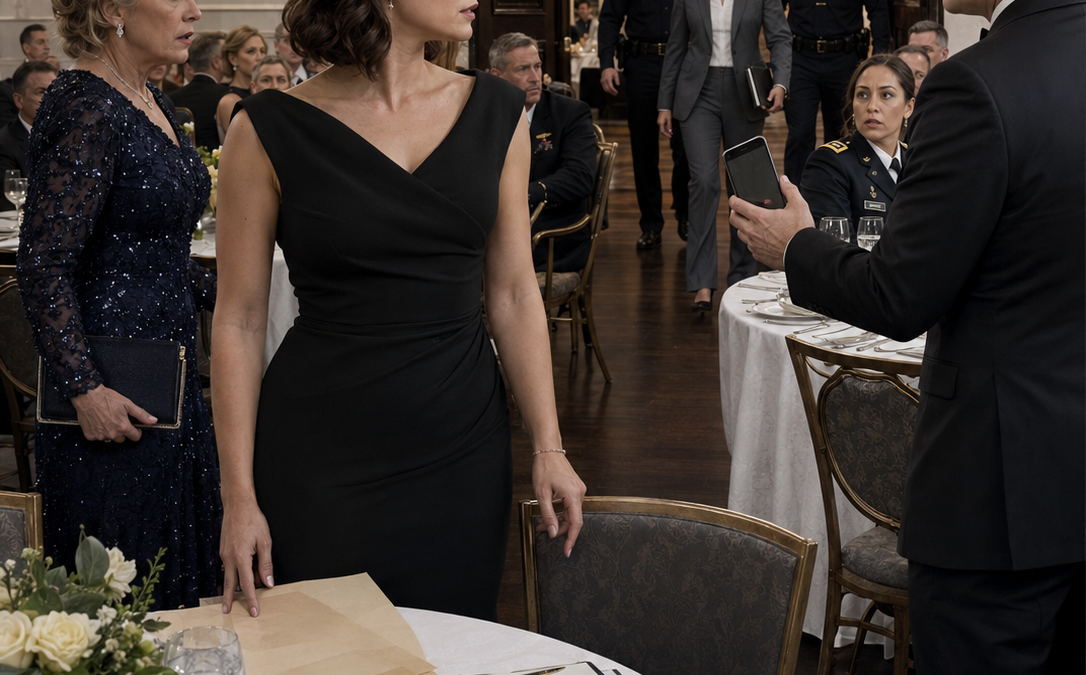
The ballroom at the Army Ball in Fayetteville glowed beneath chandeliers and soft amber uplighting.
Dress uniforms.
Formal gowns.
Polished silver.
White linen.
A jazz ensemble had just finished a swing arrangement, and people were returning to their tables when Celina stood.
She wore a dark blue sequined gown and walked toward me with the deliberate grace of a woman who believed attention was something she could summon on command.
My husband, Barron, was standing ten feet away.
Phone raised.
Recording.
That told me more than the envelope did.
He wanted evidence of my humiliation.
My battalion commander, Colonel Marcus Hale, sat two seats away.
Captain Sofia Reyes was across from me.
Neither knew the details of my marriage.
That was intentional.
My private life had never belonged to the Army unless it affected my duties.
Barron had spent three years accusing me of caring more about the uniform than him.
I had spent three years trying to prove otherwise.
That was one reason the marriage had lasted as long as it did.
Celina stopped beside my chair.
“Happy birthday, Adela.”
Her voice was sweet enough to make several people turn.
She placed the envelope beside my plate.
“Barron decided it was time you stopped pretending this marriage still exists.”
There was no dramatic gasp.
Real rooms do not behave that way.
There was simply a subtle change in sound.
Conversations softened.
A fork stopped moving.
Someone at the next table looked down quickly, embarrassed on behalf of everyone involved.
Barron smiled behind his phone.
“Go ahead.”
I picked up the envelope.
Inside was a petition for dissolution.
A motion regarding temporary use of our marital residence.
Property schedules.
A list of reimbursement claims.
And a proposed acknowledgment confirming I had received the papers.
I read slowly.
Barron’s filing claimed a marital interest in the Raleigh house.
That did not surprise me.
Marriage can create complicated property claims even when title began separately.
What interested me was the language.
Substantial capital improvements made to jointly owned marital residence.
Jointly owned.
That was the lie underneath everything else.
The Raleigh house had belonged to my grandfather.
He transferred it to me before I ever met Barron.
I was twenty-four.
He was dying.
The house was a brick Colonial built in the 1980s, nothing glamorous, but it sat on almost an acre beneath enormous oak trees and carried thirty years of family memory.
My grandfather, Samuel Voss, had bought it after retiring from the Army.
He left me the house because I was the only grandchild who visited often enough to know where he kept the spare furnace filters.
At least that was the joke.
Legally, it was a gift to me alone.
Deed recorded in my name.
No mortgage.
Barron moved in after we married.
We renovated the kitchen from joint funds.
Replaced a deck.
Added built-in shelves.
Those facts could matter financially in divorce.
They did not make a forged deed legitimate.
Three weeks earlier, I had been walking out of a logistics briefing at Fort Liberty when my phone rang.
Unknown Raleigh number.
“Major Voss?”
“Yes.”
“This is Renee Talbot with Carolina Federal Bank’s home-lending fraud team. I’m trying to verify a recent equity transaction involving your property.”
I stopped in the corridor.
“What transaction?”
A pause.
“The $186,000 home-equity line.”
I remember staring at a bulletin board covered with inspection schedules.
Everything around me remained ordinary.
That made the sentence stranger.
“I don’t have a home-equity line.”
Another pause.
Different now.
Careful.
“Ma’am, our file reflects a recent deed adjustment and executed loan documents.”
“What deed adjustment?”
“The file shows Barron Keller added as a fifty-percent owner.”
I did not speak.
“Major Voss?”
“I never signed a deed transferring ownership.”
Silence.
Then:
“I need to escalate this call.”
Twenty-four hours later, I was sitting in a bank conference room with copies of documents.
A quitclaim deed.
My purported signature.
A notarization.
A loan application.
A copy of a power of attorney Barron had once legitimately held.
That power of attorney came from a deployment six years earlier.
At the time, Barron and I were newly married.
I was leaving for nine months.
The document gave him limited authority to handle household, banking, insurance, and property matters if something required my signature while I was overseas.
I trusted him.
When I returned, my JAG legal-assistance office advised me to revoke it.
I did.
Written revocation.
Delivered to Barron.
Copies sent to our primary bank.
I stored the original with my estate documents.
Two years later, when we updated wills, I executed an entirely different limited power for medical emergencies.
The old deployment POA was dead.
Barron had used a copy anyway.
The deed bore a signature that resembled mine.
Not enough to fool me.
Maybe enough to fool someone who saw hundreds a week.
“What happens now?” I asked.
Renee Talbot did not give me a movie answer.
She did not say we are arresting your husband.
She said:
“We freeze further advances while we investigate.”
Good.
“What about the deed?”
“That is separate. The bank did not create the recorded instrument. You need counsel immediately.”
I called a civilian real-estate attorney first.
Then a family-law attorney.
Then, because the bank believed forged documents may have been used to obtain credit, I made a police report in Wake County.
A financial-crimes detective named Lena Shaw took the initial statement.
She was forty-something, calm, and unimpressed by my rank.
I liked her immediately.
“Do not confront him yet,” she said.
“Why?”
“Because we don’t know whether this is fraud, misunderstanding, unauthorized use of an old power, or some combination.”
“The signature is not mine.”
“I believe you.”
She tapped the file.
“My job is to prove what happened, not believe it fastest.”
That sentence stayed with me.
So I became quiet.
That part was easy professionally.
Hard personally.
Barron came home each night.
Ate dinner.
Complained about work.
Kissed me.
Asked whether I wanted to watch television.
I looked at the man sleeping beside me and wondered how long ago he had stopped believing my informed consent was necessary.
The investigation moved faster once the bank traced disbursements.
The $186,000 line had not been fully drawn.
$112,000 had moved.
About $94,000 went into an account belonging to Keller Event Holdings.
Celina owned it.
Barron described the transfer on the bank file as repayment for “family renovation advances.”
There had been no $94,000 in renovation advances.
My attorney reviewed our records.
Kitchen remodel: $31,400 from joint savings.
Deck: $17,600 from a joint account.
Shelving: less than $8,000.
Celina had contributed exactly $4,200 years earlier toward landscaping after insisting on buying mature magnolias as an anniversary gift.
A gift.
Not ninety-four thousand dollars.
Detective Shaw subpoenaed records through proper process.
The bank retained handwriting and document experts.
My lawyer prepared to challenge the deed instrument in civil court and protect title.
Nothing happened instantly.
That was the hardest part.
Barron behaved normally.
Celina called twice to discuss what gown I was wearing to the Army Ball.
I answered both calls.
That was almost funny.
Then Barron informed me he wanted a divorce.
Not privately.
He said we should “talk after the ball.”
I understood immediately.
The envelope was coming.
My family-law attorney, Claire Benton, reviewed the petition electronically once Barron’s counsel filed it.
“He can serve you there if he wants to make a spectacle,” she said.
“Can I refuse?”
“You can avoid service temporarily. That accomplishes nothing. If the papers are validly served, receive them.”
“What if they put something in front of me to sign?”
“Read it.”
“I know.”
“I am legally required to tell clients obvious things because anger lowers reading comprehension.”
Fair.
She continued.
“Signing acknowledgment of receipt is not agreeing to his property claims.”
“I know.”
“Good.”
That was why, at the birthday table, I signed only the acknowledgment confirming service.
Nothing else.
Barron saw my signature and smiled.
Celina rested one manicured hand on the back of my chair.
“There. That wasn’t so difficult.”
I placed the pen down.
She should have stopped.
Instead she turned slightly toward the nearby tables.
“Now at least the Raleigh house can stay where Robert always said it belonged.”
Barron’s late father.
“The Keller family.”
Colonel Hale’s eyes moved toward me.
Captain Reyes went very still.
Barron continued recording.
I looked at his phone.
Then at Celina.
“What do you mean by that?”
She smiled.
“You know exactly what I mean.”
“I’d like to hear you say it.”
Barron frowned.
“Adela.”
Celina did not notice his warning.
“The house should have been Barron’s the moment you married him.”
I nodded.
“And the loan?”
Her face changed.
Barely.
“What loan?”
There it was.
Barron lowered the phone a fraction.
I stood.
Not dramatically.
My chair scraped against the ballroom floor.
“Thank you.”
Barron stared.
“For what?”
“For serving me in front of witnesses.”
I looked at his phone.
“And for recording this conversation.”
His smile disappeared.
Celina’s hand left my chair.
“Adela, what are you talking about?”
I looked directly at her.
“The ninety-four thousand dollars.”
She went pale.
Not movie pale.
Human pale.
Eyes first.
Then mouth.
Barron looked at his mother.
“Mom?”
That was interesting.
He knew about the loan.
He apparently did not know I knew exactly where part of the money went.
I said nothing else.
Because Detective Shaw had made one thing absolutely clear.
Do not perform the investigation yourself.
At that moment, the ballroom doors opened.
Not with uniformed officers storming in.
With Evelyn Carr, an investigator from the bank’s special-assets unit, and a process server working for my civil attorney.
Detective Shaw was not coming to arrest anyone at my birthday.
She was outside.
Waiting to speak with Barron pursuant to an already arranged interview request that his attorney had been notified about earlier that afternoon.
Barron did not know because his attorney had been unable to reach him.
The process server approached.
“Mr. Keller?”
Barron stared.
“Yes.”
“You’ve been served.”
Civil papers.
Petition to declare the disputed deed void.
Request for injunctive relief preventing further encumbrance or transfer of the Raleigh property.
Notice concerning preservation of financial records.
Barron looked at me.
Then down at the documents.
“What did you do?”
The entire ballroom seemed to disappear from my awareness.
I did not hear the other tables.
Did not see phones.
Only him.
“The same thing you did.”
His face tightened.
“I hired a lawyer.”
Part 2
Barron did not leave the Army Ball in handcuffs.
That would have been a cleaner story.
Instead, he left with his mother, a civil complaint in his hand, and a voicemail from his attorney telling him not to speak to investigators without counsel.
Detective Shaw interviewed him two days later.
Celina retained her own lawyer.
The bank froze further advances on the line.
My title attorney recorded a notice related to the dispute so that no buyer or new lender could pretend not to know ownership was contested.
The Army did not applaud me.
Colonel Hale did something more useful.
He pulled me aside the next morning.
“Do you need time?”
“No, sir.”
“That wasn’t the question.”
I stopped.
My commander had served twenty-eight years.
He knew the difference between composure and capacity.
“Yes, sir. Probably.”
“You have leave.”
“I can manage.”
“I know.”
That sentence almost broke me.
People had said versions of it my whole career.
You can manage.
This time it was not being used to deny me help.
It was being used to justify giving it.
I took three days.
Then I went back to work.
Meanwhile, the investigation followed documents rather than drama.
The bank’s forensic review concluded that my signature on the deed and loan documents did not match known exemplars.
The notary acknowledged she had never personally witnessed me sign the deed.
She had notarized Barron’s certification because he presented the old power of attorney and claimed he possessed authority to execute on my behalf.
That created its own problems.
The deed itself listed my signature rather than Barron signing as attorney-in-fact.
Sloppy.
Important.
My revocation records proved the old POA had been terminated years earlier.
The bank also found email traffic in which Barron told a loan officer:
My wife is deployed frequently and leaves property administration to me.
I had not been deployed in more than three years.
The $94,000 transfer to Celina was supported by a document labeled:
Reimbursement — prior residential capital contribution.
My attorney asked for proof.
Celina produced spreadsheets.
They listed supposed improvements she claimed to have financed.
Roof work.
Kitchen work.
Landscaping.
Electrical updates.
The records collapsed under basic examination.
Roof invoice paid from my grandfather’s estate account before Barron and I married.
Kitchen paid from our joint account.
Electrical contractor never received money from Celina.
One landscaping payment was real.
Four thousand two hundred dollars.
Not ninety-four thousand.
What happened to the rest?
That took longer.
Celina had debt.
More than Barron knew.
Credit cards.
A personal loan.
A failed boutique investment.
Property-tax arrears on a rental condo.
The $94,000 had been used mostly to stabilize her finances.
When Barron finally admitted what happened, we were in mediation eight months later.
By then, I knew almost everything.
Still, hearing it from him mattered.
“My mother said she was going to lose the condo.”
We sat across from each other in a small conference room with both attorneys present.
“So you gave her money from a loan secured by my house.”
He closed his eyes.
“I thought it was our house.”
“That is not an answer.”
“I thought it should be.”
There it was.
The belief beneath the forged paperwork.
“Why didn’t you ask me?”
“Because you would have said no.”
I stared.
He continued.
“You never trusted Mom.”
“She asked us for money three times.”
“And you always wanted documents.”
“Yes.”
“You made her feel like a criminal.”
“No.”
I stayed calm.
“I made her feel like someone asking for money.”
Barron looked down.
“I knew you’d say no.”
“So you found a way around my answer.”
“Yes.”
That was the end.
Not legally.
Emotionally.
My marriage did not end because Barron wanted to help his mother.
I might have helped.
Not ninety-four thousand dollars.
Maybe something.
A structured loan.
A financial counselor.
A sale of her rental condo.
There were options.
Barron never gave me the chance to choose.
He decided my informed refusal was the problem to solve.
That was not partnership.
That was circumvention.
Part 3
The criminal case moved much more slowly than the divorce.
That frustrated almost everyone except Detective Shaw.
“Financial cases are paper,” she told me.
“Paper does not get more persuasive because people are angry.”
Barron was eventually charged with offenses related to the fraudulent loan documents and use of the revoked power of attorney.
Not every possible charge survived review.
The prosecutor did not treat my Army status as a magical federal enhancement.
The loan was issued by a federally insured institution, but jurisdiction and charging decisions depended on the actual statutes and evidence.
Celina was investigated separately.
The question was not whether she received money.
She did.
The question was what she knew about how Barron obtained it.
Her attorney initially maintained she believed the money represented Barron’s lawful share of marital property and reimbursement for family contributions.
Then investigators recovered text messages.
One from Celina to Barron:
If Adela finds out before the deed is recorded she will stop everything. Handle title first. Then tell her after the money is safe.
I read that message in Claire’s office.
That was the first time I became truly angry at Celina.
Not because she wanted money.
Because she understood my consent would stop the plan and explicitly designed around it.
Another message:
You have that deployment document. There has to be something useful in it.
Another:
Once your name is on the house, she cannot treat it like her private inheritance anymore.
Private inheritance.
As though marriage transformed ownership into moral defect.
Celina eventually faced charges related to her participation in the scheme.
No ballroom arrest.
No sequined gown in handcuffs.
She surrendered through counsel on a weekday morning.
That felt almost anticlimactic.
Real accountability often does.
Barron accepted a negotiated plea more than a year after the Army Ball.
He admitted using invalid authority and false documents to obtain credit secured by the property.
Sentencing reflected his lack of prior record, restitution, cooperation, and the seriousness of the conduct.
He was not sent away for twenty years.
He received a combination of probation, restitution obligations, and conditions that made his professional life much more complicated.
His architecture license did not disappear automatically.
The licensing board reviewed the matter separately.
His firm placed him on leave.
Eventually he resigned.
Celina’s case resolved later.
She agreed to restitution and other conditions.
She sold her rental condo.
Not because I took it.
Because debt and repayment required money.
The Raleigh house remained mine.
The forged deed was invalidated through court order and corrective recording.
The fraudulent home-equity line was unwound after litigation among the bank, insurers, and involved parties.
I was not required to repay money I had never borrowed simply because someone had tried to attach it to my house.
But the process was not painless.
Legal fees.
Title work.
Hours of document review.
Credit monitoring.
Affidavits.
Depositions.
The house had survived.
My trust in paperwork had not.
For months, every letter from a bank made my heart race.
That surprised me.
I was a major.
I could coordinate convoys, personnel, logistics, inventories, and inspections involving millions of dollars of government property.
Yet an envelope from a county recorder could make my hands cold.
Trauma is often embarrassingly specific.
The divorce itself was less dramatic.
Barron had legitimate claims to portions of marital property.
Retirement contributions earned during marriage.
Joint accounts.
Furniture.
Vehicles.
Potential reimbursement or marital-interest arguments regarding improvements made to the Raleigh property.
We negotiated.
My separate ownership of the underlying house remained protected.
The kitchen remodel and deck did not magically make him half-owner.
But we accounted for contributions realistically.
I paid an agreed equalization amount reflecting portions of marital funds used to improve my separate property.
He kept his retirement accounts subject to the marital division.
We divided savings.
He kept his car.
I kept mine.
Nobody was financially annihilated.
That mattered to me.
When friends heard the details, several reacted with anger.
“He tried to steal your house. Why should he get anything?”
Because divorce law is not revenge law.
Because property acquired during a marriage does not become morally radioactive because one spouse commits fraud elsewhere.
Because if I wanted law to protect me accurately, I had to respect it when accuracy did not produce maximum punishment.
That was harder than slogans.
Worth it.
My relationship with the Army survived.
So did my career.
I had been terrified the public scene at the ball would define me professionally.
It did not.
Most people were more discreet than Barron had been.
Colonel Hale never mentioned the spectacle again after confirming I had legal support.
Captain Reyes brought me coffee the Monday I returned.
No questions.
Eventually, she said:
“If you ever want to talk, I can listen.”
I looked at her.
“About the divorce?”
“About your mother-in-law’s dress.”
I laughed for the first time in days.
Friendship sometimes arrives through restraint.
Celina blamed me for everything during the first year.
Through Barron.
Through mutual acquaintances.
Through one six-page letter I never finished.
According to her, I had destroyed the Keller family.
Ruined Barron’s career.
Taken away a home “he helped build.”
Humiliated her publicly.
What struck me was how completely she misunderstood sequence.
She believed exposure caused consequences.
Not conduct.
That is common.
People focus on the moment a secret becomes visible because the secret itself had been manageable while hidden.
I did not answer.
Eventually, silence stopped being tactical.
It became peaceful.
Barron contacted me eighteen months after the divorce became final.
He asked to meet.
My attorney said there was no legal reason not to.
My therapist asked whether I wanted to.
Those were different questions.
I decided yes.
We met at a coffee shop in Raleigh.
He looked older.
Not dramatically.
More ordinary.
That was what I noticed.
Without the confidence I had once found attractive, Barron seemed less like a man who commanded rooms and more like someone who had spent a year learning he could not.
He stirred coffee.
Then said:
“I’m sorry.”
I waited.
“I know that’s useless.”
“No.”
He looked up.
“It isn’t useless.”
His face changed.
“It just isn’t restorative.”
He nodded.
We sat quietly.
Then I asked:
“Why the Army Ball?”
He closed his eyes.
“That’s the part I’m most ashamed of.”
“Not the forged deed?”
“That’s different.”
I raised an eyebrow.
“Excellent start.”
He almost smiled.
“The deed was fear and entitlement.”
“And the ball?”
“Cruelty.”
There it was.
He looked at me.
“I wanted you embarrassed.”
“Why?”
“Because I thought you embarrassed me every day.”
I stared.
“How?”
“You were Major Voss.”
“Keller.”
“Exactly.”
I became still.
He continued.
“In every room, you were the impressive one. Officers respected you. People asked about your career. Your house came from your grandfather. You had your own money.”
He looked down.
“I felt like I was living inside your life.”
That hurt.
Not because I agreed.
Because part of me could see how he had reached that feeling.
Barron had been successful when we met.
Architect.
Smart.
Charming.
But my military career had accelerated.
His firm struggled.
The Raleigh house remained legally mine.
His mother constantly told him a husband should have “something of his own.”
Instead of telling me he felt insecure, he converted insecurity into entitlement.
He decided title would make him equal.
Then money would make his mother safe.
Then public divorce would make him powerful again.
None of that excused him.
It explained the shape.
“You could have told me you felt like a guest.”
“I know.”
“Did you?”
“Once.”
I thought.
He had.
Years earlier, after I refused to add him to the deed because I wanted to preserve Grandpa’s gift separately.
Barron said:
“Sometimes it feels like I live in your house.”
I had answered:
“You do.”
Technically accurate.
Emotionally terrible.
I sat back.
“I should have heard that better.”
His eyes filled.
“No.”
“Both things can be true.”
I had learned that in therapy.
Annoyingly useful.
“I could have listened better. You could have not forged my signature.”
He laughed once through tears.
“That seems weighted.”
“It is.”
We talked for nearly two hours.
He did not ask to reconcile.
Thank God.
I did not want to reject him again.
He told me he was working for a smaller architectural firm.
No management role.
More drafting and project coordination.
He liked it.
“I don’t have to pretend I understand payroll.”
“That sounds healthy.”
“It is humiliating.”
“Both can be true.”
“Your therapist?”
“Yes.”
He nodded.
Before leaving, he said:
“I’m sorry I recorded you.”
That surprised me.
“Why that specifically?”
“Because I wanted a video of you breaking.”
I looked at him.
“And?”
“You didn’t.”
“No.”
“I thought for a long time that meant you never cared.”
I swallowed.
“I cried after you left.”
His eyes closed.
“Good.”
I stared.
He opened them quickly.
“Not good. I mean—”
“I know.”
He meant he wanted evidence the marriage mattered.
Humans are messy.
“I cared.”
“I know now.”
That was enough.
Celina took longer to change.
Maybe she never fully did.
Three years after everything, she sent one Christmas card.
Inside:
I believed that because Barron was your husband, what belonged to you should become available to him. I taught him that. I am sorry.
I read it several times.
Then:
I also believed helping my son justified accepting money I knew you had not agreed to risk. That was wrong.
No dramatic plea.
No request for forgiveness.
I wrote back:
Thank you for saying it plainly. I wish you well.
We never became family again.
That was appropriate.
My house changed after the divorce.
For nearly a year, I avoided altering anything because I was exhausted by the idea of property.
Then one spring morning, I walked into the kitchen and realized I hated the gray cabinets Barron had chosen.
Not because he chose them.
Because they were gray.
So I painted them deep green.
Poorly.
Captain Reyes helped.
We got paint on the floor.
A professional fixed our mistakes.
The house looked warmer.
I replaced the dining table.
Not as a symbol.
The old one was too large.
I planted gardenias near the porch because Grandpa used to complain they were fussy plants.
He was right.
I kept them alive anyway.
The most important change was the deed.
After the corrective order, my attorney handed me a certified copy showing the property restored cleanly in my name.
I expected triumph.
Instead, I ran my thumb over Grandpa’s old parcel description and cried.
Not because I had defeated Barron.
Because I realized how close I had come to letting someone else’s belief about marriage rewrite something my grandfather had deliberately given me.
Grandpa had been married fifty-three years.
He loved my grandmother deeply.
Their accounts were mostly joint.
Their house was jointly owned.
Yet when he gave me Raleigh, he said:
“This is yours.”
At twenty-four, I thought he meant an asset.
At thirty-three, I understood he also meant authority.
Ownership is not a moral ranking.
Sharing can be loving.
Keeping something separate can also be loving.
Consent is what turns one into the other.
Without consent, sharing is just taking with nicer vocabulary.
I eventually remarried.
Not quickly.
Five years later.
His name is Daniel Price.
Civilian.
Emergency physician.
Divorced once.
He owned a small house when we met.
I owned Raleigh.
Before engagement, we discussed money.
Unromantically.
Thoroughly.
Separate assets.
Future purchases.
Retirement.
Debt.
He disclosed medical-school loans down to the dollar.
I showed him the entire history of the Raleigh title problem.
He read it.
Then said:
“I would prefer never to be on this deed.”
I laughed.
“Why?”
“Too haunted.”
Fair.
We bought a different house together after marriage.
Raleigh became a rental for several years, then a place my niece used during graduate school.
Later, I considered selling.
I did not experience that as betrayal of Grandpa.
He had given me ownership, not an obligation to preserve wallpaper forever.
Eventually, I kept it.
Not because of Barron.
Because I liked the oak trees.
The Army Ball photograph still exists somewhere.
Not the video Barron recorded.
That became evidence and later disappeared into old case files.
I mean the official event photograph.
Me in a black formal gown.
Colonel Hale nearby.
Captain Reyes laughing at something outside the frame.
You cannot see the envelope.
Cannot see Barron.
Cannot see Celina.
If you knew nothing, you would think it was simply a thirty-first birthday celebrated among colleagues.
I prefer that photograph.
The dramatic moment is not always the one worth preserving.
Years later, Colonel Hale retired.
At his ceremony, he saw me and said:
“Still reading documents before signing them?”
I laughed.
“Yes, sir.”
“Good.”
He never asked whether I regretted that night.
I do not.
I regret that it happened at all.
Different thing.
For a while, I told myself I had built a trap.
That I had outmaneuvered Barron and Celina.
That version made me feel powerful during a period when my private life felt humiliating.
Now I see it differently.
I did not build a trap.
I built a record.
The bank built its record.
Detective Shaw built hers.
My lawyers protected title.
Barron and Celina made their own decisions inside those facts.
Celina chose to say the house belonged in the Keller family.
Barron chose to record it.
Neither statement convicted them.
Neither created the case.
They simply revealed the entitlement underneath documents already being investigated.
That distinction matters.
Because revenge depends on the other person falling.
Protection does not.
If Barron had walked away without criminal charges, I still would have divorced him.
If Celina had repaid every dollar immediately, I still would have removed her from my life.
If the bank had corrected everything quietly, I still would have changed the locks after lawful occupancy ended, updated my estate plan, and never again given someone broad financial authority simply because marriage made refusal feel unromantic.
The boundary was valid before the punishment.
That was the lesson.
Barron once told me during mediation:
“You looked so calm at the ball.”
I was not.
My pulse was around 120.
I know because my watch recorded it.
My hands remained steady because training works even when emotions do not cooperate.
Calm is not absence of fear.
Sometimes it is simply fear given instructions.
Read.
Sign only what you understand.
Do not argue facts before counsel advises you.
Do not touch him.
Do not threaten her.
Do not make your commander part of your marriage.
Breathe.
Those instructions carried me through ten minutes.
Then the bathroom door closed behind me and I cried until Captain Reyes knocked softly and asked whether I needed help with my zipper.
I told her:
“No.”
She answered:
“That wasn’t what I asked.”
I think about that often.
I had spent years being proud that I needed no one.
Then I learned another distinction.
Independence is not refusing support.
It is choosing it.
Barron tried to turn my silence into authority for himself.
Celina tried to turn marriage into ownership.
I responded by becoming more deliberate, not more isolated.
Lawyers.
Friends.
Command.
Therapy.
Eventually love again.
The house survived because documents mattered.
I survived because people did.
I am thirty-eight now.
Promoted.
Still serving.
Still own the Raleigh house.
Still receive property-fraud monitoring alerts because apparently anxiety can be automated.
Every December, I get a birthday reminder from Captain Reyes:
CHECK YOUR DEEDS.
I reply:
CHECK YOUR FRIENDS.
She sends something obscene.
Tradition.
Barron remarried too.
I heard through Evelyn, who remained friendly with one of my former neighbors.
I felt almost nothing.
Then felt guilty for feeling almost nothing.
Then stopped grading myself.
Celina lives in a smaller townhouse outside Raleigh.
She completed restitution.
Barron completed his obligations.
Their lives continued.
That is important.
Consequences are not endings.
People do not disappear once they have served their role in your betrayal.
They buy groceries.
Change jobs.
Age.
Love other people.
So do you.
The Army Ball did not give me my freedom.
Neither did the court order.
Neither did the criminal case.
Freedom came later.
The first morning I woke in the Raleigh house after everything was finally resolved, sunlight came through the bedroom blinds.
No dramatic music.
No champagne.
I walked downstairs.
Made coffee.
Found a cardboard box Barron had left months earlier with kitchen items neither of us wanted.
Inside was an old wooden spoon, two travel mugs, and the spare key to the back door.
I held the key.
Then laughed.
For years I had thought security was knowing who had a key.
It wasn’t.
Security was knowing that access could be given without giving away authority.
I put the spare key in the drawer.
Later Daniel would use one.
Then return it.
Then have another because I chose that.
That is what consent looks like in ordinary life.
Nothing cinematic.
A key.
A deed.
A question.
An answer respected the first time.
My mother-in-law thought she was ending my marriage when she placed divorce papers beside my birthday plate.
In truth, the marriage had ended weeks earlier in a bank conference room when I saw my name written by someone else.
The Army Ball merely made the ending visible.
Barron thought recording me would preserve the moment I broke.
Instead, it preserved the moment he misunderstood me.
I was not calm because I knew revenge was coming.
I was calm because I had finally stopped needing to convince him of anything.
The house was mine.
The signature was false.
The loan was unauthorized.
The rest belonged to evidence.
And the marriage?
That belonged to me too.
So I ended it.
Not with a trap.
With a decision.
The end
