OM-I came home early and heard my husband, his parents, and his sister calmly planning how to get his name onto my Lake Norman house without making me suspicious. They called it estate planning, family renovations, shared future — anything except what it was. My house was supposed to become collateral for Ethan’s secret $400,000 debt. Then his sister brought me old documents from his first marriage, and his ex-wife revealed the same script had been used before. The real proof was hidden under a felt pad on a wooden “family lake house” sign his mother had recycled from wife number one.
Part 1
The first time I realized my husband might be trying to get an ownership interest in my house, he was sitting twenty feet away from me calmly discussing how to make the idea sound like mine.
“The important thing,” my mother-in-law said, “is not to start with the deed.”
I stopped in the mudroom with my hand still wrapped around the doorknob.
Judith Mercer’s voice carried clearly from the sunroom.
“Start with estate planning. Probate. Protection. Something responsible. Nora gets defensive when she thinks people are telling her what to do with the lake house.”
I did not move.
My husband answered.
“Exactly.”
One word.
That was enough.
My name is Nora Langley. I was forty-three years old, six years into my marriage to Ethan Mercer, and standing inside a Lake Norman house I had bought before I ever knew he existed.
The house was mine.
Not metaphorically.
Not because I had decorated it.
Legally.
I bought it eight years before that afternoon with money from the branding and communications firm I had built from nothing but two clients, a secondhand laptop, and an unreasonable belief that exhaustion eventually turned into success if you survived long enough.
The house sat outside Mooresville, North Carolina, in a quiet cove where the water was usually glassy before eight in the morning.
Three bedrooms.
Cedar siding.
Screened porch.
Old kitchen.
A narrow dock that needed two boards replaced.
No marble foyer.
No infinity pool.
No private gate.
It had cost me $612,000 when I bought it, which had felt terrifying at the time.
A realtor had recently estimated it was worth somewhere around $1.1 million.
I had no mortgage.
That mattered more than anyone in the sunroom seemed to appreciate.
Or perhaps it mattered exactly as much as they appreciated.
My client presentation in Greensboro had ended early that Monday, and rather than return to Charlotte, I decided to spend the evening at the lake.
Ethan had mentioned driving up to inspect the dock.
I thought I would surprise him with dinner.
Then I pulled into the gravel driveway and saw four vehicles.
His SUV.
His parents’ Lexus.
His sister Melissa’s white crossover.
I almost went through the front entrance.
Instead, I used the side mudroom because I was carrying my computer bag and wanted to put it down.
That small choice changed my marriage.
Ray Mercer, my father-in-law, was speaking now.
“If Ethan is actually on the property, your mother and I can justify putting serious money into improvements.”
Melissa said, “How serious?”
“Sixty, maybe seventy.”
My stomach tightened.
Seventy thousand dollars.
I had discussed replacing dock boards.
Nothing else.
Ray continued.
“Dock. Lower-level storage conversion. Maybe redo the bath. If we’re going to spend more time here, it makes sense.”
Melissa sounded surprised.
“Spend more time here?”
Judith answered.
“Your father and I aren’t staying in that townhouse forever.”
“Are you talking about moving here?”
“Part of the year.”
“In Nora’s house?”
Judith corrected her immediately.
“In Ethan and Nora’s family home.”
I stared at the floor.
For six years, I had encouraged Ethan’s family to use the lake house.
I gave them the smart-lock code.
I told Ray he could store fishing gear in the garage.
I cleared a dresser for Judith because she hated packing toiletries.
Melissa’s children had life jackets hanging beside my own.
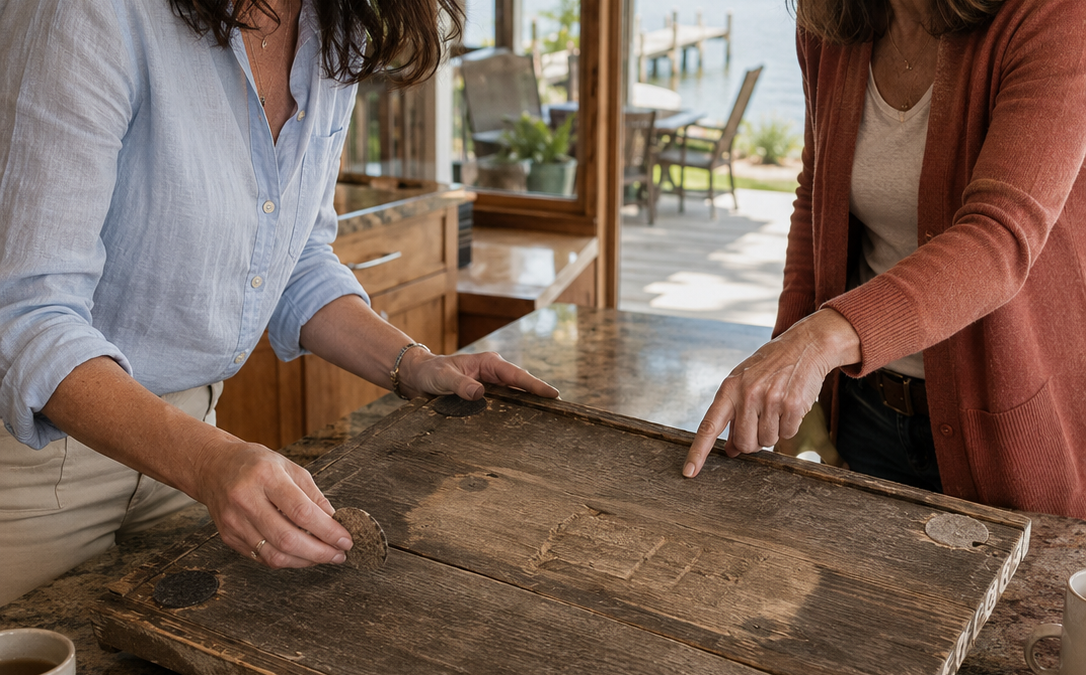
One Christmas, Judith gave me a rustic wooden sign painted in weathered white letters:
THE FAMILY LAKE HOUSE.
I hung it on the screened porch.
I thought it was affectionate.
Standing in the mudroom, I began to understand that generosity can look very different from the receiving side.
Melissa said, “Does Nora know you’re thinking about living here?”
A pause.
Then Judith:
“Not yet.”
My heart thudded.
Ethan spoke.
“I’m not trying to take anything away from her.”
Relief flashed through me so quickly I almost hated myself for it.
Then he continued.
“I just want her to stop treating the house like it exists outside our marriage.”
Judith murmured, “That’s exactly the problem.”
My throat went dry.
The house did exist outside our marriage.
I bought it five years before the wedding.
My name alone was on the deed.
I paid the taxes from an account funded by income from my company. Ethan contributed to normal household expenses when we stayed there, but he had never paid acquisition costs, principal, or debt because there was no debt.
We had never discussed changing ownership.
Not once.
Melissa asked, “How are you planning to convince her?”
“I’m not convincing her.”
Ethan sounded irritated.
“I made an appointment Thursday with an estate-planning attorney. We need updated wills anyway. I’ll bring up survivorship and what happens if one of us dies.”
“Then the deed comes up naturally,” Judith said.
“I’ll frame it around simplifying things.”
Frame it.
That word settled somewhere deep in me.
Not ask.
Not tell.
Frame.
Ray said, “Once the title is fixed, we can talk to the bank.”
The bank.
I forgot how to breathe.
Melissa asked the question I needed answered.
“Why would the bank care?”
Silence.
Then Ethan said, “Nothing’s decided.”
Judith interrupted.
“Melissa, don’t make this more complicated than it is.”
“I’m asking a question.”
“And we’re discussing options.”
I took one step backward.
The hardwood creaked.
Everyone went silent.
My pulse exploded.
I waited.
Ten seconds.
Twenty.
Then Ray resumed talking about contractors.
I backed out through the mudroom door.
For a moment I stood beside my own house feeling as though I were trespassing.
Then anger arrived.
Clean.
Useful.
Why was I leaving?
Four people were inside discussing my property as if I were the obstacle to its proper use.
I walked around the house and sat on the far end of the dock.
My hands shook so badly I had to put my phone down.
I stayed there almost forty minutes.
Eventually, car doors closed.
Engines started.
One by one, the vehicles disappeared.
Ethan left last.
He never saw me.
Inside, the house looked ordinary.
Four coffee mugs in the sink.
Judith’s cardigan over a chair.
A legal pad on the sunroom table.
And beside it, a blue folder.
Open.
I did not rummage through it.
I did not need to.
The first page was handwritten in Ethan’s unmistakable block printing.
Thursday — estate plan.
Will / POA.
Lake title.
Parents contribution.
Renovation.
Financing after transfer?
Family schedule.
I photographed the page.
Then stood there looking at the last two words.
After transfer.
For years, Ethan had told me he admired what I had built.
My business.
My independence.
The lake house.
Especially the lake house.
When we first started dating, he told me he loved that I did not need rescuing.
Now I wondered whether independence remained attractive only until it prevented access.
I walked through the rooms.
Ray’s fishing rods.
Judith’s expensive shampoo.
Melissa’s children’s bathing suits.
A drawer full of chargers none of which belonged to me.
None of those things had bothered me before.
Because I believed there was an understood sentence beneath every invitation:
You are welcome because I want you here.
Not:
You have acquired rights because I welcomed you often enough.
I took the wooden FAMILY LAKE HOUSE sign off the screened porch and put it in a hall closet.
Then I drove to Charlotte.
Ethan arrived home a little after eight.
He kissed my cheek.
“How was Greensboro?”
“Fine.”
“You staying at the lake tomorrow?”
“No.”
His hand paused at the refrigerator.
“You didn’t go up today?”
“I stopped there.”
There was a fractional hesitation.
Then he opened the refrigerator.
“Oh. Dad and I were looking at the dock.”
“Was Judith there?”
Another pause.
“And Melissa.”
I nodded.
We ate dinner.
He talked about a client renewal.
I talked about a packaging redesign.
Twenty minutes into the meal, he put down his fork.
“Oh, I almost forgot. I made us an appointment Thursday.”
“What kind?”
“Estate planning.”
I watched him begin the exact script Judith had suggested.
Updated wills.
Powers of attorney.
Beneficiaries.
Medical directives.
Then:
“And we should probably talk about the lake house. If something happened to you, probate could get messy.”
“That isn’t necessarily true.”
He blinked.
“Well, depending on how things are structured.”
“How do you want to structure them?”
He smiled carefully.
“I’m not saying I do. But putting both names on the property might be worth discussing.”
“Would that happen before or after your father puts seventy thousand dollars into the dock and downstairs guest room?”
His face emptied.
For several seconds he looked like a stranger trying to remember how my husband would respond.
“Nora.”
“I came home early.”
He leaned back.
“How much did you hear?”
“Enough.”
“This is not what you think.”
“Excellent.”
I stood.
“Tomorrow evening, your parents and Melissa can come here. You can explain what it is in front of everyone who helped plan it.”
“Nora, don’t turn this into some tribunal.”
“I’m not.”
I picked up my plate.
“I’m giving everyone the opportunity to tell the truth in the same room.”
The following morning, I called Caroline Price.
She was a real-estate attorney in Charlotte whose firm had handled the purchase of a small office condominium for my company.
By noon, I was sitting across from her.
Caroline was fifty-six, direct, and allergic to dramatic language.
I told her what I had heard.
Then I showed her the photograph of Ethan’s notes.
She studied it.
“The first thing you need to understand is that no one can simply put your husband on your deed without you signing a deed.”
“I know.”
“Good. Second, North Carolina property classification in a divorce can become complicated, but an asset acquired before marriage and kept titled in one spouse’s name generally begins as separate property.”
“Begins?”
“If marital money or labor has increased value, there can be arguments concerning marital interests in appreciation or reimbursement depending on the facts. That is why tracing matters.”
My stomach tightened.
“I’ve paid taxes and major improvements from my company distributions.”
“We’ll document that.”
“What if I added Ethan voluntarily?”
“Then you could be making a very significant gift of ownership.”
“How significant?”
“That depends on the deed.”
I stared at the photograph.
“And refinancing?”
“Also requires documents. A lender is not going to hand your husband several hundred thousand dollars against a property he doesn’t own. If you became co-owners and both agreed to mortgage the property, that would be a different situation.”
“So he needs me.”
Caroline looked at me.
“He needs your trust.”
That sentence landed harder.
Before I left, she asked if Ethan had disclosed any debts or pending litigation during the marriage.
“No.”
“Business investments?”
“He sells commercial insurance. He has retirement accounts. A few private investments.”
“Do you file jointly?”
“Yes.”
“Bring me the last five years of returns.”
“Why?”
“Because if you are concerned someone is trying to obtain an ownership interest in a separate asset for financing purposes, I would like to know what financial pressure exists.”
I almost laughed.
“Ethan isn’t running some criminal scheme.”
“I didn’t say he was.”
She handed the photograph back.
“People do not have to be criminals to betray each other financially.”
Then she added:
“Trust does most of the work.”
That evening, Ethan’s family sat around my dining-room table.
I placed a printed copy of his notes in the center.
Judith looked offended before anyone spoke.
Ray looked angry.
Melissa looked embarrassed.
Ethan looked tired.
I folded my hands.
“I’m listening.”
Judith sighed.
“Nora, this tone is unnecessary.”
“What tone?”
“You’re behaving as if we plotted against you.”
“You discussed transferring ownership of my house without me present.”
“We discussed estate planning.”
“Then explain financing after transfer.”
Nobody answered.
I looked at Ethan.
“What financing?”
He rubbed his forehead.
“There is no financing.”
“Then why did you write it?”
“It was an idea.”
“For what?”
Ray interrupted.
“The house needs work.”
“The dock needs boards.”
“The lower level is wasted space.”
“It is storage.”
“It could add enormous value.”
“Then I can decide to convert it.”
Judith leaned forward.
“This is what I mean. Everything is I, I, I.”
I stared at her.
“It is my property.”
“You’re married.”
“Yes.”
“So your life isn’t supposed to have private compartments your husband can be excluded from.”
Even Melissa looked uncomfortable.
I turned toward Ethan.
“Do you believe keeping premarital property in my name means I’m excluding you from our marriage?”
He hesitated.
Too long.
“Nora, marriage is supposed to be about building a shared life.”
“We did not build the lake house together.”
“That isn’t what I meant.”
“Then explain exactly what you meant.”
Silence.
I looked at Ray.
“What happens after Ethan gets an interest?”
“We renovate.”
“Then?”
“You use the house as a family.”
“I already do.”
“Then your problem is what, exactly?”
His jaw tightened.
“The problem is that everyone has invested years into that place and you can revoke access whenever you want.”
I almost smiled.
“Yes.”
He stared.
“That is exactly what ownership means.”
Judith said, “That is incredibly cold.”
“No. It is incredibly specific.”
Melissa shifted.
“Dad, why was the bank part of it?”
Ray looked at her sharply.
“I told you, stay out of the financing piece.”
Her eyebrows lifted.
“The financing piece?”
Ethan pushed back his chair.
“Enough.”
I looked at him.
“No. Not enough.”
My phone rang.
Caroline.
I would normally have ignored it.
Something made me answer.
“Excuse me.”
I walked into the kitchen.
Caroline’s voice was different.
“Nora, are you somewhere private?”
“Yes.”
“We found a civil filing involving Ethan.”
My hand tightened around the phone.
“What kind?”
“A private investment entity called Hawthorne Ridge Ventures. Ethan personally guaranteed part of its financing.”
“How much?”
“The guarantee appears to have been originally capped at approximately four hundred and twenty-five thousand dollars.”
I closed my eyes.
“Is there a judgment?”
“Not yet. Litigation is pending. He’s one of several guarantors.”
“What happens if they win?”
“That depends on the final judgment, his defenses, assets, settlement, a lot of things.”
I looked toward the dining room.
“What does this have to do with my house?”
“I cannot tell you what your husband intended.”
Caroline paused.
“But if someone facing a substantial personal guarantee acquires an interest in unencumbered real estate, that interest may become relevant to creditors and financing.”
My stomach dropped.
“He wanted to borrow against it.”
“I don’t know.”
But I did.
Or at least I understood why the possibility existed.
I walked back into the dining room.
Ethan saw my face.
“What happened?”
I remained standing.
“What is Hawthorne Ridge Ventures?”
All the color left his face.
Judith whispered:
“Oh, Ethan.”
Melissa stared at her.
“You knew?”
Nobody answered.
That was the moment the house stopped being the central betrayal.
The house was only where the secret debt had finally become visible.
Part 2
Ethan admitted the investment that night.
Three years earlier, he and two business contacts invested in a small commercial-development venture. Ethan personally guaranteed a portion of a loan.
The project failed.
Litigation followed.
He had been negotiating privately through counsel and convinced himself he could settle before I ever needed to know.
His parents knew because Ray had introduced him to one of the investors.
Melissa did not.
The lake-house plan, Ethan insisted, was not to “steal” the property.
He wanted me to add him to the deed, allow his parents to contribute to improvements, and later explore a home-equity loan or refinance if settlement negotiations required liquidity.
He planned to tell me about the debt only after I had agreed the house should be treated as a marital asset.
“You wanted me committed before I knew why,” I said.
He looked down.
“Yes.”
That was the sentence that ended our marriage, although it took months for me to admit it.
The next morning, I revoked the family’s smart-lock access to the lake house.
I canceled the estate-planning appointment.
Caroline sent written notice to the contractor Ray had contacted stating that I alone owned the property and had authorized no work.
Then I met with a family-law attorney.
I did not file immediately.
I still loved Ethan.
For three weeks, we lived in separate bedrooms and attended counseling.
He apologized.
Then explained.
Then apologized again.
Every explanation returned to the same place.
He had been afraid.
Afraid I would think less of him.
Afraid I would refuse to risk my property.
Afraid his father would lose money because Ray had invested in the same venture.
Afraid of failure.
All believable.
None sufficient.
Then his sister Melissa called.
“I found something at Mom’s house.”
“What?”
“Documents from Ethan’s first marriage.”
I almost told her I didn’t care.
Then she said:
“There was another house.”
Part 3
Ethan had been married before me.
I knew that.
Her name was Claire.
They married in their late twenties and divorced four years later.
The version I heard from Ethan was ordinary.
They were young.
Different goals.
She wanted Asheville.
He wanted Charlotte.
They argued about money.
Eventually they accepted they had made a mistake.
I never contacted her.
Why would I?
There is a particular arrogance in believing a person’s previous marriage is relevant only as background to the superior relationship they eventually found with you.
Melissa sent me photographs of the papers.
Most were unimportant.
Old tax documents.
A property-insurance declaration.
A letter from an attorney.
Then I saw the address.
Blowing Rock.
Property owner: Claire Harlan.
A handwritten note in Ray’s writing mentioned:
Deed structure.
Repairs.
Joint title.
Equity.
I stared at the photograph.
My first thought was coincidence.
My second was that I desperately wanted it to be coincidence.
“Where did you find these?” I asked Melissa.
“In a file box in Dad’s office.”
“Why were you looking?”
“Mom asked me to find old insurance policies.”
She sounded shaken.
“I swear, Nora, I didn’t know any of this.”
“I believe you.”
“I knew they wanted Ethan on your lake house. I thought that was entitled enough. But this…”
“Do you know Claire?”
“No.”
“Do your parents still speak to her?”
“Absolutely not.”
That told me almost nothing and still felt meaningful.
I searched her name.
Claire Harlan Whitmore had returned to her maiden name after the divorce. She owned a small interior-architecture studio in Asheville.
Her office number was public.
I stared at it for almost ten minutes.
Then called.
A receptionist answered.
I nearly hung up.
Instead I left my first name and number.
Claire called that evening.
“Is this Nora?”
“Yes.”
A pause.
“Ethan’s wife?”
Something about the way she said wife made my skin tighten.
“Yes.”
“Are you all right?”
Not hello.
Not why are you calling?
Are you all right?
I sat down.
“I think so.”
Another pause.
Then she said, “Tell me what happened.”
I did not tell her everything.
Only the lake house.
The proposed deed.
Ethan’s parents funding improvements.
The financial pressure.
Claire remained silent for several seconds.
Then she said:
“They used estate planning?”
I stopped breathing.
“What?”
“That was Judith’s phrase with me.”
We met four days later at a café in Hendersonville, almost halfway between us.
Claire was fifty-one, slim, with silver beginning at her temples and the composed manner of someone who had no desire to perform pain for a stranger.
She ordered tea.
I ordered coffee and barely touched it.
She started with a warning.
“I don’t know your marriage. I know mine.”
“That’s all I’m asking.”
“I also don’t think Ethan married me for property.”
“I don’t think he married me for mine.”
She nodded.
“Good. Because if we turn him into a cartoon, none of this will make sense.”
That was the first reason I trusted her.
Claire inherited a cabin near Blowing Rock from her grandmother during her engagement to Ethan.
Small.
Two bedrooms.
Mountain view.
No mortgage.
When they married, Claire kept the cabin in her name.
Nobody objected.
At first.
Then Ethan’s family began using it.
Judith kept toiletries there.
Ray repaired the deck.
Family Christmas happened there twice.
Claire liked it.
Until Ray offered to fund a large addition.
“I said no,” she told me.
“Why?”
“Because I didn’t want a large addition.”
I almost laughed.
Simple.
She continued.
“Then suddenly everyone was talking about how much sense joint ownership made if Ethan’s family was investing money.”
“Was Ethan in debt?”
Claire nodded.
“A private real-estate deal. Much smaller than what you’re describing.”
“How much?”
“About ninety thousand when I learned about it.”
My stomach tightened.
“What did he want?”
“He wanted his name on the cabin and then wanted us to refinance.”
“Did you?”
“No.”
“What happened?”
“Our marriage got ugly.”
Not because of one refusal.
The refusal exposed something.
Ethan believed Claire was treating him like a temporary member of her life.
Claire believed Ethan was making affection contingent on access to property.
Judith repeatedly told Claire that “real marriages combine things.”
Ray reminded her of every repair he had performed.
Then Claire found an email between Ethan and his father discussing possible loan proceeds if the property became jointly titled.
“I confronted him,” she said.
“What did he say?”
“That he was exploring options.”
I laughed bitterly.
Claire did too.
“Apparently that phrase survived.”
“Did his family plan all of it?”
She thought carefully.
“No.”
That answer surprised me.
“Judith pushed hardest on the emotional side. Ray pushed the numbers. Ethan hid the debt. I think each person told themselves a different story.”
“What story?”
“Judith thought she was making Ethan secure in his marriage. Ray thought every asset should be productive. Ethan thought he could solve a problem before admitting he had one.”
She lifted her tea.
“The result for me was the same.”
“Did the cabin cause your divorce?”
“No.”
She looked directly at me.
“The deception did.”
There it was.
The sentence I had been avoiding.
I asked why she never contacted me.
Claire smiled sadly.
“What was I supposed to say? Hello, your charming new boyfriend once tried to persuade me to put him on a deed?”
“I might have listened.”
“No, you wouldn’t.”
I wanted to argue.
Then stopped.
She was probably right.
“I certainly wouldn’t have listened to me when I was in love with him,” she said.
We talked for two hours.
Before leaving, I showed Claire photographs of the lake house.
Not evidence.
I simply wanted her to see it.
I swiped through the screened porch.
She touched my phone.
“Go back.”
I did.
“The sign.”
THE FAMILY LAKE HOUSE.
“What about it?”
Claire stared.
“Judith gave me one exactly like that.”
My skin prickled.
“Exactly?”
“Maybe not the same physical one. They sell them everywhere.”
I almost felt relieved.
Then Claire searched her phone.
A minute later, she found an old photograph.
Christmas morning, fourteen years earlier.
Claire standing on a mountain porch beside Ethan.
Behind them hung a weathered wooden sign.
THE FAMILY LAKE HOUSE.
The font looked identical.
The shape looked identical.
Probably the same manufacturer.
Maybe even the same store.
It did not prove anything.
It did not need to.
The ritual was enough.
Judith had given two women separate houses the same symbolic name.
Family.
As though naming something collectively could soften the boundary around individual ownership.
I drove to the lake house after meeting Claire.
The sign was still in the closet.
I carried it onto the porch.
I turned it over.
No hidden initials.
No secret carving.
No dramatic proof that Judith had physically recycled Claire’s gift.
For some reason, that made me feel better.
Real life did not need to provide a perfect artifact.
The pattern existed without one.
I left the sign facedown on the table.
Then I sat at the edge of the dock.
For almost an hour, I asked myself one question.
If Ethan had told me about Hawthorne Ridge the first day he knew the investment was in trouble, what would I have done?
I knew the answer.
I would have helped him think.
Maybe not with the house.
Maybe with lawyers.
Budgeting.
A settlement strategy.
Possibly money, depending on facts.
I loved him.
He never gave me the opportunity to choose.
That became the true injury.
Not that he needed something.
Not that he had failed financially.
Not even that he wanted my help.
He had decided my informed consent was the obstacle.
So he planned to obtain commitment first and disclosure second.
Three days later, I told him I wanted a formal separation.
We sat in our Charlotte kitchen.
No family present.
No lawyers.
Just us.
Ethan cried almost immediately.
“Nora, please.”
“I’m not filing for divorce today.”
“Then don’t.”
“I need financial disclosure.”
“I’ll give you everything.”
“Through attorneys.”
His face collapsed.
“You don’t trust me at all.”
“No.”
That was painful to say.
It was also true.
He wiped his face.
“I never meant to take the house.”
“I know.”
He looked surprised.
“I believe you didn’t think of it that way.”
“Because I didn’t.”
“You thought you were solving your debt.”
“Yes.”
“And protecting your parents’ investment.”
“Yes.”
“And eventually making the lake house more shared.”
He nodded.
“All of those goals required me to sign something.”
“Yes.”
“But you wanted me emotionally committed to the transfer before I understood the debt.”
He closed his eyes.
“Yes.”
“That is the part I cannot get around.”
“I was ashamed.”
“I know.”
“I thought you’d leave me.”
I looked at him.
“So you created the exact reason I might.”
He cried harder.
I wanted to hold him.
I did not.
Not because affection would have been wrong.
Because I had spent too much of our marriage confusing soothing him with resolving what he had done.
Our separation became financial very quickly.
Full disclosure showed Hawthorne Ridge was worse than Ethan had described but not catastrophic enough to require the lake house.
His maximum exposure under the personal guarantee was disputed.
The investment entity had some recoverable assets.
Several guarantors were negotiating.
Ethan had retirement funds, brokerage investments, and equity in a small commercial property he co-owned with a colleague.
He was not facing homelessness.
He was facing a painful financial loss and the humiliation of admitting it.
That distinction enraged me.
The lake house had not been his only possible solution.
It had been his preferred solution because it allowed him to preserve more of what was his by putting more of what was mine at risk.
Caroline coordinated with my divorce attorney to trace the lake property.
We collected the purchase settlement statement.
Bank records showing the down payment.
The deed.
Tax payments.
Invoices for roof work.
Dock repairs.
HVAC replacement.
Most major expenditures came from my premarital savings or separate business distributions.
There had been marital expenditures too.
Furniture.
Landscaping.
Routine maintenance.
A kitchen update paid partly from our joint account four years into the marriage.
My lawyer explained that those facts might matter to equitable-distribution arguments regarding marital contributions or increases in value.
I listened.
This was not a revenge fantasy where saying I bought it first made every later financial question disappear.
But the central fact remained strong.
I had acquired the property before marriage.
Title remained solely mine.
I never executed a deed transferring any ownership interest.
I never pledged it as collateral.
That mattered enormously.
Ethan’s lawyer did not seriously claim he owned half the house.
Instead, the negotiations focused on whether marital contributions had created a divisible interest in certain appreciation and how those issues should be offset against other marital assets.
It was dull.
Expensive.
Necessary.
Judith hated the lawyers.
She called me once.
I answered because part of me wanted to hear what she could possibly say.
“Nora, families do not handle marriages this way.”
“Which part?”
“Treating every dollar as evidence.”
“I didn’t start documenting because of a dollar.”
“You are destroying Ethan over one mistake.”
“One?”
“He made a bad investment.”
“And hid it.”
“He was embarrassed.”
“And planned around my property.”
“He was trying to protect the marriage.”
I closed my eyes.
“No.”
“What would you call it?”
“Protecting himself from my answer.”
She became quiet.
Then said, “You have always been very territorial about the lake house.”
There are moments when arguing becomes unnecessary because the other person finally says the thing underneath everything else.
“Yes,” I replied.
“I am territorial about property I own.”
She sighed sharply.
“That attitude is why Ethan never felt secure.”
“Then he should have married someone who believed marriage required joint title.”
“That is cruel.”
“No. Cruel would be pretending we agreed.”
She changed tactics.
“Ray and I treated you like a daughter.”
“I know.”
“We loved that house.”
“I know.”
“We put money into it.”
I sat up.
“How much?”
Silence.
“Judith.”
“Little things.”
“How much?”
“Patio furniture. Dock hardware. Groceries. Repairs.”
“Did I ask you to?”
“That isn’t the point.”
“It is legally and emotionally exactly the point.”
She started crying.
That affected me more than I wanted.
“I thought we were family.”
“We were.”
“Were?”
I paused.
I did not want anger deciding grammar for me.
“You were my family because I married Ethan. That never made you owners of everything I owned.”
She hung up.
Melissa remained in contact.
She gave both sides copies of messages relevant to the lake-house discussions when subpoenaed during financial discovery.
I hated that our private lives had reached that stage.
She hated it more.
“I feel like I betrayed my brother.”
We were sitting at a café in Davidson.
“You told the truth.”
“I still feel terrible.”
“Both can be true.”
She looked at me.
“Do you hate Mom?”
“No.”
“Dad?”
“No.”
“Ethan?”
That answer took longer.
“No.”
“What do you feel?”
I thought about it.
“Grief.”
That was the most accurate word.
Divorce, I discovered, can involve grieving a person who still exists.
The husband I loved had not vanished.
He still texted me on the anniversary of my company.
He still knew my coffee order.
When my senior designer’s mother died, Ethan sent flowers without putting his own name prominently on the card.
He remained funny.
Generous in some ways.
Patient with children.
A good uncle.
A man who had also deceived two wives about financial problems and tried twice to solve those problems by converting women’s separate real estate into shared leverage.
People wanted me to pick one version.
Good man or bad man.
Victim or manipulator.
The truth was less convenient.
He was a man who loved me and had a repeated character flaw serious enough to make staying married to him unsafe for me.
That was enough.
The Hawthorne Ridge case eventually settled.
Ethan paid far less than the maximum guarantee but still lost a substantial amount of money.
He sold his interest in the commercial property.
Liquidated part of a brokerage account.
His parents contributed some cash.
He established a payment arrangement for the rest.
No lake house required.
When I learned that, I laughed alone in my office.
Not because I enjoyed his loss.
Because the whole scheme had been unnecessary even by his own stated logic.
There had always been other options.
They were simply painful options.
And Ethan had decided that exposing my property was preferable to accepting his pain openly.
Claire became an unexpected presence in my life.
Not a best friend.
That would have felt absurd.
We spoke occasionally.
She helped me understand which Mercer family behaviors were old and which belonged specifically to my marriage.
I helped her see something too.
“You know,” I said during one call, “you talk about your divorce like you escaped because you were smarter than I was.”
She went quiet.
“I do?”
“A little.”
“I’m sorry.”
“I’m not offended.”
“I am.”
Then she laughed.
“I spent years believing I should have seen it sooner.”
“So did I.”
She sighed.
“Apparently we’re both geniuses after the fact.”
That became our joke.
She visited the lake once.
Only after asking three separate times whether I was certain.
We sat on the dock drinking wine.
Two ducks fought near the reeds.
I told her they had been fighting since I bought the house.
“Same ducks?”
“Generational feud.”
We laughed.
The FAMILY LAKE HOUSE sign was still stored inside.
Claire asked about it.
“What are you going to do with it?”
“I considered throwing it away.”
“Too easy.”
“Burn it?”
“Too dramatic.”
“What would you do?”
She thought.
“Change the meaning.”
The following weekend, I sanded the painted letters myself.
Not perfectly.
I left faint traces because complete erasure felt dishonest.
Then I painted new words.
WELCOME BY INVITATION.
It made me laugh.
I hung it on the screened porch.
Melissa saw it months later.
“Oh, God.”
“What?”
“Mom is going to hate that.”
“Your mother does not need to see it.”
Melissa laughed.
“That is somehow worse.”
The divorce took eleven months.
We settled most issues in mediation.
I kept the lake house.
I kept my company.
Ethan retained his business interests, retirement allocations, and other assets according to the final agreement.
We divided joint accounts.
Resolved reimbursement claims.
Allocated tax consequences.
Signed papers that turned thirteen years of financial interdependence into line items.
There was no winner.
Divorce produces paperwork, not trophies.
At the final mediation session, Ethan sat across from me with his attorney.
We had been in separate rooms most of the day.
Near the end, he asked to speak directly.
My lawyer looked at me.
I nodded.
Ethan came into the conference room alone.
He looked older.
So did I, probably.
For a while, he stared at the table.
Then said, “Claire talked to you.”
“Yes.”
“I figured.”
“Are you angry with Melissa?”
“No.”
That surprised me.
“I was.”
He rubbed his hands together.
“Then I realized being angry at her was easier than being embarrassed that there was something to find.”
I said nothing.
He looked up.
“I never thought I was trying to steal either house.”
“I know.”
“You keep saying that.”
“Because I believe it.”
“Then why does it feel like you think I’m a criminal?”
“I don’t.”
“What do you think I am?”
My first answer would have been cruel.
So I waited.
“A person who believes his fear justifies managing other people’s choices.”
His face changed.
I continued.
“With Claire, you were afraid of debt and afraid she would say no. With me, same thing.”
“I loved both of you.”
“I believe that too.”
He looked down.
“That somehow feels worse.”
“It was worse for me too.”
We sat silently.
Then Ethan said, “I’m sorry.”
He had said it many times.
This time he did not add because.
No explanation about his father.
No humiliation.
No childhood.
No market collapse.
Just:
“I’m sorry I tried to get your agreement before giving you the information you needed to make it.”
My throat tightened.
“That’s the apology I needed.”
“Does it change anything?”
“No.”
He nodded.
“I figured.”
That was painful.
But it was clean.
We signed the settlement.
A month later, our divorce became final.
I drove to Lake Norman that evening.
Not because I was celebrating.
I did not open champagne.
I did not throw my wedding ring into the water.
I still liked the ring.
I put it in a small box at home because six years of marriage did not become worthless simply because they ended.
At the lake, I made coffee.
Walked down the dock.
Sat exactly where I had sat the morning after I bought the place.
The boards were new by then.
I had finally hired someone to replace the rotten sections.
It cost $4,800.
No seventy-thousand-dollar expansion.
No guest suite.
No retirement wing.
Just a safe dock.
Two ducks appeared near the shoreline.
They immediately began chasing each other.
I laughed.
The sound startled me.
For months, I had thought keeping the house would create some enormous sense of victory.
Instead I felt tired.
Then relieved.
Then sad.
Then hungry.
So I went inside and made a sandwich.
That ordinary sequence felt healthier than triumph.
Judith wrote me once after the divorce.
Six pages.
The first two defended Ethan.
The next two defended herself.
She explained that in her marriage to Ray, everything had always been shared.
Bank accounts.
Cars.
Homes.
Debt.
She believed separate property represented emotional distance.
She acknowledged pressuring Claire years earlier.
Then me.
Near the end, the letter changed.
She wrote:
I think I confused the way my marriage works with the way all good marriages should work.
That sentence mattered.
Then:
I also see now that I treated your generosity at the lake as evidence that our family belonged there rather than as something you were choosing to give us. I am sorry.
I answered.
Thank you for writing. I wish you and Ray well.
That was all.
She did not become my mother-in-law again.
An apology did not require renewed intimacy.
Melissa remained my friend.
Carefully.
We had lunch every few months.
She brought her children to the lake once the summer after the divorce.
She asked first.
That part was important.
The first time she called, she sounded nervous.
“The kids keep asking about swimming.”
“They’re welcome.”
“You’re sure?”
“Yes.”
“Should I ask Ethan if that’s weird?”
“No.”
She laughed.
“Still your house.”
“Still my house.”
The children arrived with towels and too many snacks.
Nobody left toiletries.
Nobody stored life jackets without asking.
Nobody discussed renovations.
It felt lighter.
I also changed my own behavior.
That deserves saying.
For years, I believed generosity should be effortless.
If I loved someone, why make them ask?
So I gave codes.
Drawer space.
Open invitations.
Use the house anytime.
Treat it like home.
I meant those things sincerely.
But I had made my own boundaries invisible and then been shocked when other people could not see them.
That did not justify what Ethan did.
There is a difference between unclear social boundaries and secretly manipulating someone into a property transfer.
Still, I learned to say what I meant.
“You can use the house this weekend.”
Not:
Anytime.
“Bring the kids, but please text before coming.”
“Fishing rods can stay through the summer.”
“Please take personal items home after.”
Strangely, clearer limits made me more generous, not less.
I stopped resenting what I had consciously chosen.
My company changed too.
The divorce exposed how much I had treated financial competence as protection against emotional betrayal.
I could read contracts.
Review balance sheets.
Build a company.
Negotiate six-figure client agreements.
Yet I had filed joint tax returns without asking enough questions about Ethan’s private investments because I trusted him to tell me what mattered.
My accountant had included K-1 forms associated with Hawthorne Ridge.
I had seen the entity name.
I had not understood the guarantee.
The guarantee itself was not obvious from the tax return.
Still, I became more involved.
Not paranoid.
Involved.
I updated my estate plan.
Created clear powers of attorney.
Established instructions for the lake property if I became incapacitated.
Not because Judith’s original idea of planning was wrong.
Planning was sensible.
Manipulation was the problem.
The irony made me smile when I signed my new documents.
Caroline noticed.
“What?”
“Ethan wanted estate planning.”
She almost smiled.
“You got estate planning.”
“Eventually.”
“Congratulations.”
“Please never congratulate me for paperwork.”
“Fair.”
I created a revocable trust for certain assets.
The lake house remained under a structure my attorney and tax adviser believed made sense for my circumstances.
I named beneficiaries.
Successor decision-makers.
Rules.
Actual ones.
Discussed openly.
No framing.
No strategic omission.
That mattered to me more than the technical arrangement.
About two years after the divorce, Claire visited again.
She stood on the screened porch looking at the repainted sign.
WELCOME BY INVITATION.
“You actually did it.”
“You suggested it.”
“I thought you’d write something profound.”
“That would be unbearable.”
She laughed.
We sat with wine.
She told me she had finally sold the Blowing Rock cabin.
I was surprised.
“I thought you loved it.”
“I did.”
“Then why?”
“It started feeling like evidence.”
I understood immediately.
Evidence that she had protected herself.
Evidence of the divorce.
Evidence of the Mercers.
“I wanted it to be a house again,” she said. “I couldn’t get there.”
“So you sold it.”
“Yes.”
“Do you regret it?”
“No.”
She looked toward the lake.
“You kept yours.”
“Yes.”
“Same reason?”
“Opposite reason.”
For me, keeping the lake house separated it from what happened.
Selling it because of Ethan would have made the betrayal another decision he influenced.
I stayed because I still wanted to wake beside the water.
That was enough.
Years later, I learned Ethan remarried.
Melissa told me because she thought I should hear it from someone I trusted rather than social media.
My stomach tightened more than I expected.
Then passed.
“Is she nice?” I asked.
Melissa laughed.
“You are unbelievable.”
“I’m curious.”
“Yes. She seems nice.”
“Does she own real estate?”
Melissa stared.
Then we both laughed so hard the server came over.
I felt a little guilty afterward.
Not enough to take it back.
A year later, Melissa told me Ethan had been completely transparent with his new wife about his finances before their wedding.
They signed a prenuptial agreement.
I was glad.
That surprised me too.
There had been a time when I wanted him to understand what he lost.
Eventually, I wanted him not to do it again.
That was different.
I never spoke with his new wife.
There was no reason to.
His growth did not require my supervision.
Neither did his marriage.
Ray and Judith sold their townhouse eventually.
They moved into a condominium near Charlotte.
Not my lake house.
Melissa told me Judith joked that condo rules were “what happens when Nora wins.”
I rolled my eyes.
Then, months later, Judith sent me a Christmas card.
Inside she had written:
I was wrong about the lake house. I hope you are still enjoying it.
I wrote back:
I am. Merry Christmas.
Healing sometimes looks unimpressive.
No reunion.
No tears.
Two women exchanging accurate sentences after enough time has passed.
The FAMILY LAKE HOUSE sign remains on my screened porch, though technically it no longer says that.
The faint old letters show through if you stand close enough.
I could sand harder.
Paint another coat.
I don’t.
The original words remind me that the problem was never family.
I liked family there.
I still do.
My nieces and nephews visit.
Friends come for weekends.
My employees once held a retreat there.
Claire has slept in the guest room twice, which is admittedly strange when I describe it out loud.
The difference is invitation.
The difference is choice.
The difference is knowing that opening my door does not begin a countdown toward someone else acquiring rights.
People sometimes hear my story and tell me I was lucky.
I was.
I came home early.
I overheard a conversation I was never supposed to hear.
If I had arrived two hours later, I might have gone to the Thursday estate-planning meeting with no suspicion.
Would I have signed a deed?
I ask myself that occasionally.
Maybe not that day.
Maybe Ethan would have needed weeks.
Maybe I would have asked questions and discovered the debt anyway.
Or maybe I would have trusted him.
That possibility no longer embarrasses me.
Trust is not stupidity.
Marriage requires some degree of vulnerability or it becomes a corporate merger with pillows.
I was entitled to believe my husband would tell me why he wanted access to a million-dollar asset.
He did not.
That was his decision.
My mistake was smaller.
I assumed love automatically taught people where welcome ended and entitlement began.
It doesn’t.
Some things need words.
This is mine.
You may use it.
You may not pledge it.
Ask before inviting others.
No construction without permission.
No one lives here unless I agree.
Those statements do not make a relationship less loving.
They make consent visible.
On the tenth anniversary of buying the lake house, I woke before sunrise.
I made coffee and walked onto the dock.
The water was almost perfectly still.
A pair of ducks drifted near the reeds.
Different ducks, presumably.
Same bad attitudes.
I sat there thinking about the woman I had been on the morning after closing.
Thirty-seven.
Exhausted.
Terrified by the amount of money I had spent.
Proud enough to cry when nobody was watching.
I remembered sitting at the end of the old dock and thinking:
I made this life.
For a while, after Ethan, that sentence became defensive.
I made this.
Mine.
Nobody takes it.
Eventually, it softened again.
I made this life.
Not just the house.
The company.
The friendships.
The mistakes.
The marriage.
The divorce.
The boundaries afterward.
Even the ability to welcome people again without interpreting generosity as danger.
That last one took the longest.
I went back inside shortly after seven.
On the porch, the sign caught the morning light.
WELCOME BY INVITATION.
Underneath the new paint, if you looked carefully, you could still see the ghost of the old words.
THE FAMILY LAKE HOUSE.
I ran my hand across them.
I no longer hated what Judith had written.
A family lake house was a lovely idea.
It simply required one missing ingredient.
The owner’s choice.
I had loved Ethan.
His parents.
Melissa.
I had wanted them there.
That had all been real.
What was not real was the idea that years of welcome accumulated into ownership.
Hospitality is not equity.
Marriage is not automatic title.
Love is not a signature given in advance.
And fear does not entitle someone to decide what information you receive before asking you to risk what is yours.
Those are the lessons I kept.
Not revenge.
Not suspicion.
Clarity.
Years ago, Ethan thought the safest way to solve his problem was to make me less informed before asking me for more trust.
The marriage could not survive that.
I could.
That difference matters.
I carried my coffee into the kitchen and opened the windows.
By eight, the house would be warm.
By noon, Melissa and her children were coming to swim.
She had texted the night before:
Still good for tomorrow?
I had answered:
Yes. Come around noon.
Three words.
Clear.
Simple.
No hidden meaning.
At twelve-oh-seven, the smart lock chimed.
Then my phone buzzed.
Melissa:
We’re here. Can we come in?
She still had a temporary code.
She still asked.
I smiled and walked toward the door.
That was the life I wanted.
Not a locked house.
Not an empty one.
A home full of people I loved who understood that welcome was something freely given.
I opened the door.
THE END
