VF-After nearly two months of waking before dawn to care for my granddaughter, cook, clean, shop, manage appointments, and fold everyone’s laundry, my daughter looked at the basket in my arms and snapped, “You’re here to help, not to be waited on”; I quietly set it down, picked up my coat, and went home — but one chaotic morning without me was all it took for Erin to discover exactly how much invisible work she had stopped seeing.
Part 1
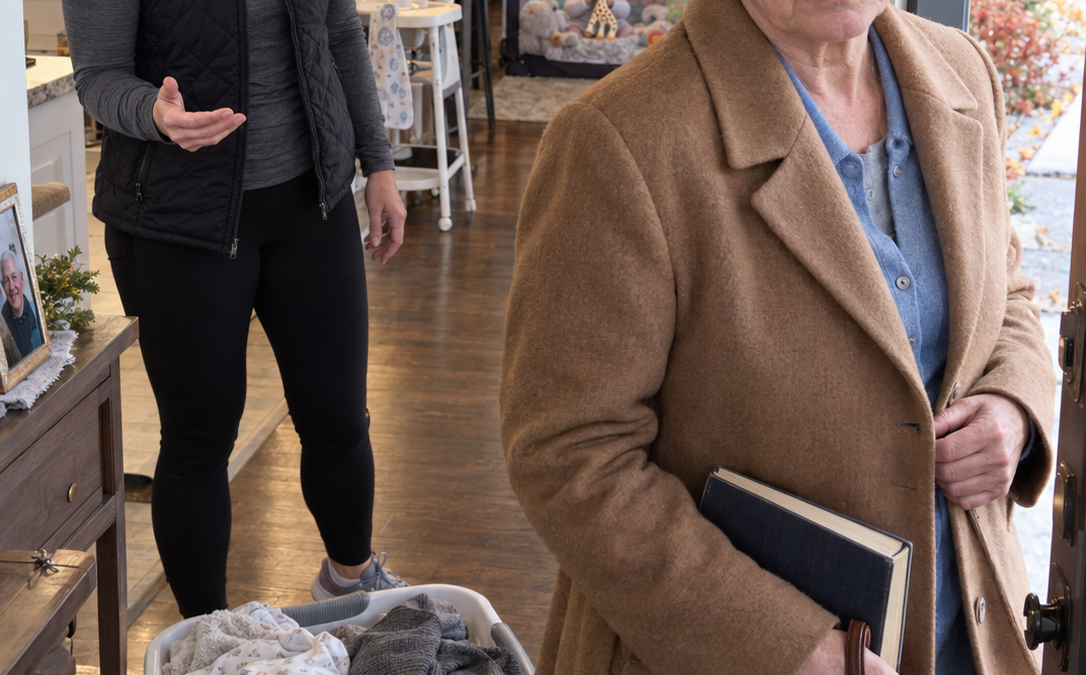
My daughter told me, “You’re here to help, not to be waited on,” while I was holding a basket of her family’s clean laundry.
I remember the warmth of the towels more clearly than I remember her face.
Two tiny sleepers lay on top. Beneath them was Caleb’s gray sweater, tangled inside a fitted crib sheet. One of Nora’s miniature socks had somehow attached itself to a dish towel.
I had been awake since six that morning.
By the time Erin came through the front door in black leggings and a quilted vest, I had fed her ten-month-old daughter breakfast, changed her twice, given her an emergency bath after an oatmeal incident, sterilized bottles, emptied the dishwasher, started another load of laundry, wiped the kitchen counters, and put a pot of vegetable soup on the stove.
I had not yet eaten.
Erin had been at a workout class.
Caleb, her husband, had come downstairs fifteen minutes earlier between video meetings.
“Dorothy, is my gray sweater clean?”
“I haven’t folded it yet.”
He checked his watch.
“Could you do that one first? I need it before noon.”
He was not rude.
That was almost worse.
The request came with the unconscious confidence of a man asking the refrigerator to keep something cold. He did not see an exhausted sixty-eight-year-old woman holding his household together. He saw a task still waiting to be completed.
I told him I would see what I could do.
Then I went upstairs, packed my medications, my half-read library book, and the few clothes I had brought for what was supposed to be a six-week stay.
My handbag was beside the front door when Erin came home.
She noticed immediately.
“Where are you going?”
“Home.”
She stopped removing her gloves.
“Right now?”
“Yes.”
“I have a call in twenty minutes.”
“Nora has eaten. She’s changed. She’ll probably nap around ten.”
Erin stared at me.
“Mom, what is going on?”
“I’m tired.”
Her expression tightened.
“We’re all tired.”
“I know.”
“You said you were coming here to help.”
“I did.”
“Then why are you leaving when there’s still all this stuff to do?”
She gestured toward the basket.
That was when I understood something I should have understood weeks earlier.
To Erin, the work no longer represented help.
It represented my role.
The difference mattered.
I bent and set the basket carefully on the hallway floor.
Nothing fell out.
That seemed important somehow.
“I’m going home.”
Her eyes followed me toward the coat closet.
Then she said it.
“You’re here to help, not to be waited on.”
I turned.
For nearly two months, I had not asked Erin to make me breakfast once.
I had not asked Caleb to carry laundry.
I had not asked them to cook for me, drive me anywhere, wash my dishes, or rearrange a single plan because I was there.
I had slept on a pullout sofa in their office-flex room.
I bought my own tea because they did not drink it.
Half the groceries I used to feed them came from my bank card because asking for reimbursement seemed petty.
And somehow, stopping had been translated into expecting service.
“I know why I came,” I said.
Then I put on my coat.
Erin followed me.
“Mom.”
I picked up my handbag.
My medication pouch.
The book I had been trying to finish since September.
“Are you seriously doing this?”
I opened the door.
Cold Wisconsin air moved into the hallway.
“I’m going home.”
Then I walked down the steps.
My name is Dorothy Hale.
I had spent thirty-one years as a public librarian in Madison. By the time I retired, I could tell which patrons would return overdue books from the way they held them at checkout.
I had been widowed for four years.
My husband, George, died after an illness short enough to feel unfair and long enough to make us understand what was coming.
He left behind a garage full of hand tools labeled in black marker, nearly seven hundred vinyl records organized according to a system no other human being could decipher, and a quiet house I spent years learning not to fear.
At first, grief kept me busy.
Insurance forms.
Accounts.
Closets.
Casseroles.
Thank-you cards.
People stopping by because death makes everyone briefly attentive.
Then they returned to their lives.
The rooms stayed.
George did not.
Eventually, I began leaving public radio on during breakfast because I liked hearing another voice in the kitchen.
So when Erin called near the end of August and said, “Mom, we need help,” I answered yes before she explained.
Erin was thirty-six. Caleb was thirty-eight. Their daughter Nora was eight months old.
Caleb’s mother had stayed after Nora’s birth, but she had returned to Arizona. Their daycare opening would not be available until November. Erin had resumed full-time work at a medical-device company. Caleb worked in software account management, often from home.
“Six weeks,” Erin said.
“Maybe eight.”
“Just until daycare.”
I was standing in my backyard wearing gardening gloves.
Something in her voice sounded cautious.
Not I miss you.
More We have run out of options.
I heard it.
Then I ignored it.
Parents become very skilled at disregarding information that might interfere with being needed.
I packed sweaters, walking shoes, medications, three books, and a framed photograph of George and me in Door County.
Caleb picked me up.
The guest room was really an office with a pullout sofa. I did not mind.
The first evening felt warm.
Erin was feeding Nora when I arrived.
“Mom, could you start dinner? Groceries are on the counter.”
“Of course.”
I roasted vegetables and made pasta.
Caleb opened wine.
Nora threw zucchini on the floor.
We laughed.
Nobody was doing anything wrong.
That is how these things begin.
Not with villains.
With gratitude.
Then routine.
Then entitlement.
The first week, if I unloaded the dishwasher, Erin said, “You didn’t need to do that.”
By the fifth week, she opened the cabinet expecting the glasses to be there.
Nora woke around six most mornings.
At first, I waited.
I heard Erin and Caleb whispering through the baby monitor about whose turn it was.
Then one morning, I simply got up.
After that, I kept getting up.
Change Nora.
Bottle.
Oatmeal.
Coffee.
Dishwasher.
By seven-thirty, when Erin came downstairs, the hard part of morning had already happened.
She used to kiss my cheek.
Eventually, she went straight for coffee.
I do not say that because she became cruel.
Familiar labor becomes invisible faster than almost anything else.
My days slowly filled with tasks nobody had assigned because nobody needed to assign them anymore.
Laundry.
Bottle washing.
Baby-food prep.
Grocery pickup.
Pediatrician calls.
Dinner.
Packages.
Pharmacy runs.
Dry cleaning.
Nora’s nap schedule.
I learned my granddaughter’s signals better than anyone because I was the person watching her most daylight hours.
She rubbed her left ear when tired.
She kicked both heels when excited.
She hated peas unless they were mixed with sweet potato.
She could stand at the front window for fifteen minutes watching delivery trucks.
I adored every minute with her.
Nora was never the problem.
It was everything that accumulated around loving her.
One Saturday, Erin put on earrings while saying, “Caleb and I are going to dinner.”
I was feeding Nora.
“You’re okay with her, right?”
She was already dressed.
It was not really a question.
“Of course.”
Another evening, Erin arrived home long enough to change clothes.
“My team is getting drinks.”
“Caleb has soccer.”
“You don’t mind?”
She was holding her coat.
I said yes again.
Every yes seemed small.
Together they created a new household rule:
Dorothy is available.
The strange thing is, I helped write it.
I believed keeping everyone comfortable was generosity.
What I was actually doing was teaching them that my time had no edges.
I bought a blue spiral notebook during my second week there because Erin constantly needed information about Nora.
When did she eat?
How long was her nap?
Did she take vitamin drops?
So I started recording things.
September 12: awake 6:05. Bottle 6:20. Oatmeal and banana 7:10. Nap 8:45. Pediatrician called back 11:30. Laundry x2. Grocery pickup. Soup.
September 19: awake 5:50. Sterilizer cleaned. Crib sheet changed. Caleb dry cleaning. Erin pharmacy refill. Nap 9:15–10:40. Dishwasher. Dinner prep.
There were no feelings in the notebook.
That would matter later.
Just facts.
Beside the notebook, I slipped receipts.
Diapers.
Wipes.
Dishwasher tablets.
Milk.
Chicken.
Vegetables.
The oat crackers I liked.
Sometimes Erin reimbursed me.
Mostly everyone forgot.
So did I, deliberately.
The first moment I should have said something happened three weeks into my stay.
Nora was asleep.
Kitchen finished.
Laundry running.
I made tea and opened a novel at the table.
Erin came in, saw me, and said, “Oh.”
I looked up.
“You’re just relaxing.”
Just.
The word landed strangely.
“The baby’s asleep.”
“I know.”
She opened the refrigerator.
Nothing else happened.
But I remember that moment because the most revealing sentence is not always the cruelest.
Sometimes it simply tells you which category someone has placed you in.
My rest had become noticeable.
My work had not.
A month later, Erin invited friends to dinner.
“Don’t do anything tonight,” she told me.
Around five, she found me playing with Nora.
“Mom, could you take her upstairs while everyone’s here?”
“Sure.”
Then, almost as an afterthought:
“There are lunch dishes in the sink. Could you do those first?”
I washed them.
Then I carried Nora upstairs.
At seven, she fell asleep against my chest.
Downstairs, people laughed.
I could smell rosemary chicken.
I sat on the pullout sofa in the guest room and realized that I had spent weeks cooking, cleaning, shopping, and providing childcare in a house where I was now being kept upstairs so I would not inconvenience dinner.
I asked myself why I had allowed it.
The answer was difficult.
I was afraid that if I stopped being useful, there might be less reason to want me there.
Older parents do not always admit that fear.
Our children grow up.
They build homes and marriages and schedules.
Then some of us begin bargaining quietly for relevance.
Need me.
Call me.
Give me something to fix.
Utility starts to feel like proof of love.
I had confused being needed with being secure.
The morning Erin told me I was there to help, that bargain finally became visible.
I waited for a cab at the end of her driveway.
A squirrel dug beneath a maple tree across the street.
My hands shook for several minutes.
Then they stopped.
The driver barely spoke.
We passed the grocery store.
My old library branch.
The reservoir path where my walking group met every Wednesday.
Then my street.
My maple tree had turned gold while I was gone.
I had missed autumn.
That almost made me cry.
I unlocked my front door.
The house smelled like books, cedar sachets, and the cinnamon air freshener I always forgot I owned.
I put the kettle on.
Made my tea.
Oat milk.
No one in my family understood why tea required oat milk.
No one needed to.
I sat at my own kitchen table.
For nearly an hour, I did nothing.
No dryer buzzing.
No baby monitor.
No one looking for a sweater.
The silence I had once feared felt different now.
Not empty.
Returned.
Erin called twice that evening.
I let voicemail answer.
“Mom, I hope you’re okay.”
Then:
“I don’t really know what happened.”
That was how I knew she had not understood yet.
I did not call back.
The next morning, she began to.
Part 2
Nora woke at 5:47.
That was the first thing Erin told me later.
Caleb had an eight o’clock client presentation.
Erin had a nine o’clock video meeting.
At six-fifteen, Nora overturned oatmeal across the high chair, her pajamas, and the floor.
While Erin cleaned it, the bottle warmer beeped.
She opened the dishwasher for a clean cup.
It was full.
Nobody had emptied it the day before.
She opened the drawer for a bib.
Empty.
The laundry basket was still in the hallway where I had placed it.
The load inside the dryer was damp because I had intended to restart it.
Caleb came downstairs.
“Is my gray sweater dry?”
Erin looked at him.
Apparently his survival instincts activated quickly.
“Never mind.”
At 6:40, Nora began rubbing her left ear.
Erin did not know what that meant.
She tried playing with her.
Nora cried harder.
She tried food.
No.
She changed the diaper.
Still crying.
By seven, Erin was crying too.
Not dramatically.
Just tears moving down her face while she held an exhausted baby and tried to remember whether the coffee maker had been filled.
At 7:20, Caleb opened the refrigerator.
“We’re out of eggs.”
Erin said nothing.
At 7:47, the pediatrician’s office called to confirm an appointment Erin had forgotten I scheduled.
At 8:03, Nora finally fell asleep.
Erin placed her in the crib.
The doorbell rang.
Grocery delivery.
Except nobody had placed an order.
At 8:15, Caleb moved his presentation upstairs because the kitchen was too noisy.
At 8:35, Nora woke again.
Nothing terrible happened.
That was the revelation.
Nobody went to the emergency room.
No crisis.
No broken appliance.
No catastrophe.
Just a dozen small household demands arriving close together.
The same demands I had absorbed quietly every morning before Erin came downstairs.
Sometime after nine, she found the blue notebook beside the coffee maker.
She opened it.
Page after page.
Bottles.
Naps.
Laundry.
Groceries.
Medication pickups.
Doctor calls.
Dinner plans.
One entry read:
Erin exhausted. Took Nora 4:30–8:00 so she could sleep.
Erin told me later she did not remember that night until she read it.
Then she found the receipts tucked into the back.
$147.83.
$92.16.
$64.09.
There were more.
Household supplies.
Baby food.
Diapers.
Groceries.
The money was not the point.
Volume was.
Proof of all the tiny decisions she no longer had to make because somebody else had been making them.
Caleb came downstairs after his presentation.
He found Erin at the island with the notebook open.
“I think we messed up,” he said.
For once, she did not defend herself.
“Yes.”
She did not drive to my house immediately.
I remain grateful for that.
Guilt often wants instant absolution.
Understanding needs more time.
She came Saturday afternoon.
Alone.
She rang the bell.
That detail mattered.
For years, Erin had let herself in with a key.
This time she knocked.
I opened the door.
Her hair was tied up badly. She looked tired.
“Can I come in?”
“Yes.”
We sat at my kitchen table.
I made tea because I wanted tea.
I made her coffee because I knew she wanted coffee.
Doing something by choice felt different already.
For a while, she held the mug between both hands.
Then she said, “I found your notebook.”
“I figured.”
“I didn’t know how much you were doing.”
I looked at her.
“You didn’t know because you stopped noticing.”
She nodded.
No defense.
That made me soften slightly.
“Friday morning was awful.”
“Nora cried for most of it. Caleb was stressed. I forgot her appointment. The dishwasher was full. We had no clean bibs. I couldn’t find anything.”
She took a breath.
“Then I opened that notebook.”
Her eyes filled.
“I didn’t even know you were buying groceries.”
“I should have kept better track.”
“No.”
She spoke sharply enough that I looked at her.
“No, Mom. That’s exactly what I’ve been realizing. You should not have needed to invoice your own daughter before she noticed she was using you.”
The words stayed between us.
Then she said, “I’m sorry.”
I waited.
“For what?”
She knew why I asked.
Not to punish her.
Because I needed specificity.
“For telling you that you were here to help instead of being waited on.”
I nodded.
“You never asked us to wait on you.”
“No.”
“You barely asked us for anything.”
“No.”
“And because you kept doing things without asking for anything back, I started acting like you didn’t have needs.”
I looked toward the window.
“That can happen when a person works very hard at being easy.”
She wiped at her face.
“I made you into staff.”
The sentence hurt because it was true.
“I don’t think you meant to.”
“I didn’t.”
“That doesn’t undo it.”
“I know.”
Then came the question I expected.
“Will you come back?”
“No.”
Her face fell.
“I love Nora.”
“I know.”
“I love you.”
“I know.”
“But I’m not moving back into your office and running your house until daycare starts.”
She nodded slowly.
“I’ll visit.”
“I’ll babysit sometimes.”
“You can ask me.”
“Sometimes I’ll say yes.”
“Sometimes I won’t.”
Another nod.
“I understand.”
“You understand today.”
I reached across and touched her hand.
“Living differently takes longer.”
She cried then.
Not because I refused.
Because I think she understood what she had almost damaged.
At the door, she hugged me.
“I’m going to fix this.”
“Don’t fix it.”
She pulled back.
“What?”
“Change it.”
That difference became important.
Caleb called three days later.
“Dorothy, can I apologize?”
“You can.”
“I’m sorry for treating you like unpaid household help.”
Specific again.
Good.
“I keep hearing myself ask about that sweater.”
I smiled despite myself.
“It was a very important sweater.”
He groaned.
“I deserved that.”
“You didn’t sound cruel, Caleb.”
“I know.”
“That was the problem.”
He was quiet.
“I sounded entitled.”
“Yes.”
Then he told me what they had done.
A cleaner every other week.
A temporary babysitter two mornings a week until daycare opened.
Morning shifts divided between them.
Meal delivery twice a week during the transition.
Nobody had collapsed.
The work simply had a price now.
I did not gloat.
Much.
The following Wednesday, I returned to my walking group.
Four retired women around the reservoir discussing grandkids, bad knees, grocery prices, and whether decorative pillows exist primarily to make couches unusable.
I had missed them.
Thursday, I volunteered at the library branch where I had worked years before.
A man named William Greene was shelving donated mysteries when I arrived.
He was seventy-one, retired from insurance, widowed, and new enough to volunteering that he still alphabetized with unnecessary intensity.
He looked up.
“Good to see you, Dorothy.”
That was all.
No explanation demanded.
No usefulness requested.
Good to see you.
The sentence almost embarrassed me with how good it felt.
I began cooking again.
For myself.
Roasted squash soup.
Lentil stew.
A blueberry crumble I ate for breakfast twice because no one could stop me.
I read whole chapters.
Took baths in the middle of the afternoon.
Went to the hardware store and replaced the porch light that had annoyed me for six months.
None of this was dramatic.
That was why it mattered.
My time became mine again in ordinary increments.
I also reviewed practical things I had neglected.
My attorney updated my medical directive.
I changed emergency contacts on several accounts.
Not because Erin had misused them.
Because I wanted every arrangement in my life to be deliberate rather than inherited from habit.
My financial adviser and I created a small education trust for Nora.
Protected for her future.
Independent of whatever happened between her mother and me.
Children should not be financially rewarded or punished according to adult closeness.
Three weeks after I left, Erin invited me to Sunday lunch.
Invited.
“Would you like to come?”
Not:
Can you come help?
I checked my calendar.
Again, not because I had plans.
Because I wanted both of us to remember I had one.
“Yes.”
Caleb opened the door when I arrived.
“Tea or coffee?”
“Tea.”
He opened the refrigerator.
“We bought oat milk.”
A tiny carton sat inside.
Mine.
Purchased because someone remembered I existed before arriving.
I nearly laughed.
Nora crawled toward me with such enthusiasm that she almost face-planted.
I lifted her.
She immediately grabbed my glasses.
Nothing about my love for her had changed.
That relieved me.
I had worried boundaries might make affection feel conditional.
Instead they separated the love from the labor that had begun poisoning it.
After lunch, dishes accumulated.
My body stood before my mind decided anything.
Erin saw.
“Mom.”
I stopped.
“Sit.”
“I can help.”
“I know.”
She smiled.
“You’re visiting.”
Caleb started carrying plates to the kitchen.
I sat back down.
Nobody else in the room understood why that moment nearly made me cry.
I was inside my daughter’s home.
And no one expected me to earn my chair.
Later, Erin asked if I would watch Nora the following Friday while she and Caleb went out for their anniversary.
I checked my calendar.
This time, I actually had plans Saturday morning but nothing Friday evening.
“Yes.”
“Thank you.”
Not:
Perfect.
Not:
Great, we already booked it.
Thank you.
Small words can rebuild a relationship if behavior lives underneath them.
Months later, while we walked around the reservoir with Nora asleep in the stroller, Erin admitted something harder.
“I resented you.”
I looked at her.
“While I was doing everything?”
“Yes.”
“Why?”
She pushed the stroller.
“You were better with Nora than I was.”
“I wasn’t.”
“That’s how it felt.”
She stared ahead.
“You knew when she needed sleep. You knew what every cry meant. You could get her to eat. You never seemed overwhelmed.”
“I was a mother thirty-six years before you were.”
“I know that now.”
She swallowed.
“At the time, I think making you the helper made me feel less threatened by how much I needed you.”
That was painful.
Also honest.
I considered my own behavior.
“I probably made part of that harder.”
She looked at me.
“How?”
“I arrived and fixed everything I saw.”
“That was the point.”
“Was it?”
I thought for a moment.
“You asked for help with childcare. I reorganized the house.”
Erin almost smiled.
“True.”
“I never asked what help you actually wanted. I just filled every gap.”
“Because you love us.”
“Yes.”
“And because being useful made me feel safe.”
That was harder to say.
Erin was quiet.
“Mom.”
“I’m not saying we did the same thing.”
“We didn’t.”
“But over-functioning was mine.”
She nodded.
“I turned it into entitlement.”
“That part was yours.”
Accountability did not have to be equal to be shared accurately.
By spring, Nora was in daycare.
Erin and Caleb developed routines that were messy and entirely survivable.
Laundry sometimes piled up.
Dinner was occasionally frozen pizza.
Nobody died.
Caleb learned that fatherhood did not respect his Teams status.
Erin learned Nora could cry without it meaning she was failing.
And they stopped needing me.
That gave us the chance to discover whether they wanted me.
They did.
That changed everything.
Part 3
William and I started having coffee after library shifts.
Then lunches.
Then walks.
Eventually he asked whether I wanted to attend a university lecture about Wisconsin labor history.
“I cannot think of anything more romantic,” I told him.
“Excellent. I was afraid I’d oversold it.”
He never assumed my time.
That was what I noticed first.
“Dinner Tuesday?”
“I’m busy Tuesday.”
“All right. Thursday?”
No sigh.
No disappointment deployed as leverage.
No expectation that I should cancel because he had asked.
It is astonishing how romantic ordinary respect can feel once you have spent years rewarding people for needing you.
Neither of us wanted marriage.
We were two older people who liked books, strong coffee, long walks, and leaving each other’s houses before either of us became irritated.
Enough.
At Nora’s first birthday, Erin hosted twelve people.
When I arrived, there was a card beside one chair.
GRANDMA DOROTHY.
I picked it up.
Erin saw me.
“I know place cards for twelve people are ridiculous.”
“They are.”
Her face fell slightly.
“I love it.”
She laughed.
During cake, she thanked everyone who had helped them survive the first year.
Then she looked at me.
I braced myself.
I did not want sainthood.
“Especially Mom,” she said. “Not because she owed us any of it. Because she chose to give it.”
Choice.
That word had disappeared during my stay.
Now it was back.
Before I left, Erin handed me the blue notebook.
“You kept this?”
“Yes.”
“Why?”
She opened to the last page.
There was new handwriting beneath my final entry.
Mom did not leave because she stopped loving us. She left because we stopped seeing the love inside what she was doing.
I read it twice.
Then closed the notebook.
“You don’t have to punish yourself forever.”
“I’m not.”
Erin shook her head.
“I’m trying to remember accurately.”
A librarian could hardly object.
Her apology became meaningful over the years because she kept behaving differently after the emotion faded.
That was the real test.
When she needed childcare, she asked.
“Are you free Saturday afternoon?”
Sometimes I said yes.
Sometimes I said no.
The first time I declined because William and I had tickets to a play, Erin paused.
Just briefly.
Old reflex.
Then:
“Have fun.”
She meant it.
I smiled for an hour afterward.
Caleb began folding his own clothes.
I have never allowed him to forget this achievement.
One Christmas, I bought him a gray sweater.
He opened the box.
Looked at the sweater.
Then at me.
“Seriously?”
Everyone started laughing.
Nora laughed too, though she had no idea why.
Caleb wore it.
He is a good man.
Good people can become thoughtless.
That is uncomfortable because we prefer simpler categories.
Cruel people exploit you.
Kind people appreciate you.
Real life is messier.
Kind people get accustomed.
Loving children become entitled adults.
Generous parents become resentful martyrs.
Then, if everyone is willing, people learn.
My own role took longer for me to understand.
For most of my life, I had believed being a good mother meant noticing needs before they became requests.
There is love in that.
There is also danger.
When you anticipate everything, others never have to develop the muscles required to notice.
Then you become angry that they cannot see the invisible system you worked so hard to keep invisible.
I had to stop doing that too.
Now when I visit Erin, I do not immediately scan the kitchen.
I sit.
Drink tea.
Hold Nora.
If dishes are in the sink, they can remain there.
Sometimes I wash them because I genuinely want to.
That feels different.
Choice changes the weight of a dish towel.
Nora is in elementary school now.
She knows only pieces of the story.
Grandma stayed when she was a baby.
Grandma made soup.
Grandma walked her around the neighborhood.
That is enough for now.
Someday I may give her a letter I wrote and never mailed.
In it I tell her something I wish I had learned earlier:
Do not build your value entirely around being useful.
You are allowed to enter a room carrying nothing.
You are allowed to rest while work remains unfinished.
You are allowed to ask, “Do you want me here?” instead of, “Do you need me?”
Those questions are not the same.
My house is still quiet.
But quiet stopped feeling like proof of abandonment.
My reading chair sits beside the front window. There is a small table beside it, just large enough for tea and a book.
Sometimes William sits across from me.
Sometimes nobody does.
Both are peaceful.
One photograph sits on the bookshelf.
Caleb took it during my first week at Erin’s house.
I am asleep on the sofa with Nora on my chest.
Her tiny hand rests near my collarbone.
Years later, Erin wrote on the back:
You came as my mother. I’m sorry I forgot that.
I framed it.
Not because an apology erased anything.
Because it reminds me people can forget and still learn to remember.
Families can survive no.
Mothers can go home without ceasing to love their children.
Grandmothers can adore grandchildren without becoming employees.
And relationships can be rearranged without being abandoned.
The laundry basket remained in Erin’s hallway after I left.
Caleb finished folding it that evening.
His gray sweater was still damp before his meeting.
He wore a blue one instead.
Nothing collapsed.
That may be my favorite part of the entire story.
The household survived.
The meeting happened.
The baby grew.
The laundry eventually dried.
The only thing that truly changed was that everyone had to see the work again once Dorothy stopped doing it.
For a while, I believed setting down that basket meant I was walking away from my daughter.
I understand now that I was walking away from a role that had begun replacing our relationship.
Leaving was not the ending.
The ending was learning how to return.
As Erin’s mother.
As Nora’s grandmother.
As a woman with her own books, plans, tea, friendships, and time.
A woman who can help because she wants to.
And stop when she is tired.
The basket I put down that morning was full of their things.
What I picked up on the way out was mine.
