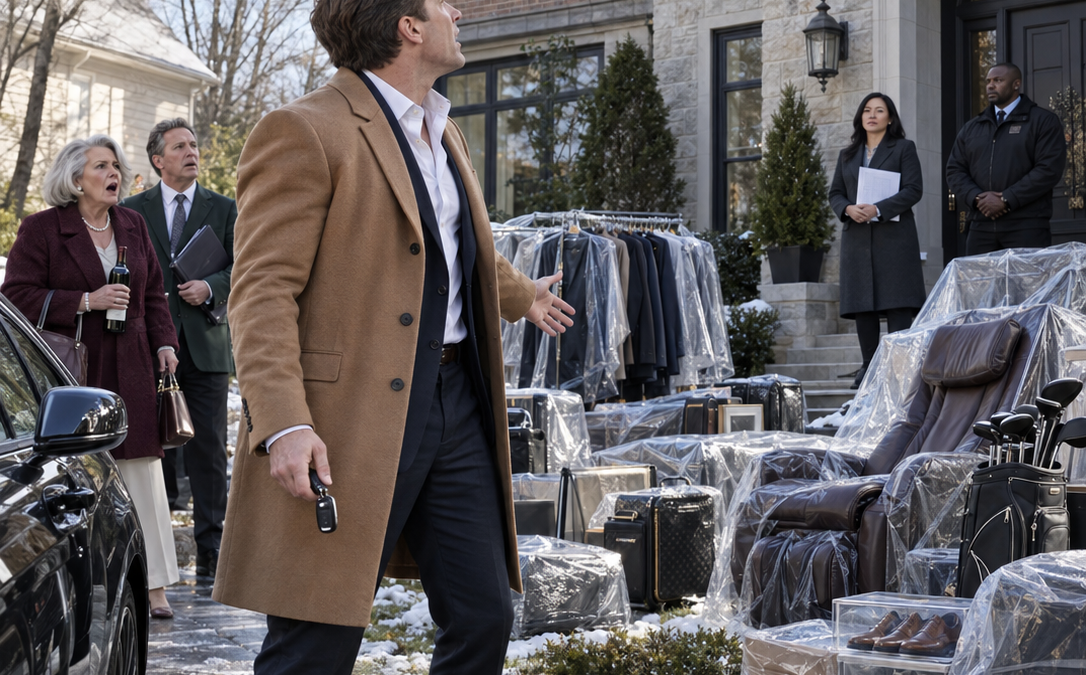
OM-At 7 A.M., He Set A Makeup Bag Beside My Coffee And Said, “My Mother’s Coming For Lunch. Freshen Up And Smile.” The Night Before, Daniel Had Lost His Temper Because I Refused To Let Her Move Into Our House—and he never apologized. So after he left, I made one call. By noon, he returned with his mother and a realtor, expecting lunch. Instead, every suit, shoe, and golf club he owned was lined across the garden beneath waterproof covers. He pounded on the newly changed lock. “Claire! Open this door!” Then my attorney stepped onto the porch holding one document Daniel had never bothered to read…
PART 1
The first time my husband hit me, his mother was pounding on my front door with two suitcases beside her.
The sound Daniel made was quieter than I expected.
One sharp crack.
Then silence.
My cheek burned.
My shoulder struck the hallway wall hard enough to knock a framed photograph sideways.
For one strange second, all three of us stopped making noise.
Daniel stared at me.
I stared back.
And from the porch, Gloria shouted:
“Daniel! Open this door!”
He pointed toward the lock.
“Let her in.”
I touched the corner of my mouth.
“No.”
His expression changed again.
Not surprise that he had hit me.
Disbelief that I was still refusing him.
My name is Claire Whitmore.
I was forty-one years old, had been married to Daniel Whitmore for six years, and had owned that house for nine.
Three years before I met him.
That detail was legally important.
It had never felt emotionally important until that night.
The house was an old brick Colonial outside Washington, D.C., with a slate roof, four bedrooms, a narrow library, and a back garden my father had helped me restore before he died.
I bought it after selling my first company.
Not inherited.
Not gifted by Daniel.
Not jointly purchased.
Mine.
When Daniel moved in after our wedding, I tried not to make ownership part of the marriage.
I did not say:
My kitchen.
My bedroom.
My mortgage.
My house.
I said:
Home.
Our home.
That was what marriage meant to me.
Somewhere along the way, Daniel and Gloria heard something different.
Gloria called it:
“Daniel’s house.”
At first, I corrected her.
“Actually, I bought it before we met.”
She laughed.
“Oh, Claire. You know what I mean.”
There was that phrase.
The verbal eraser.
You know what I mean.
When she rearranged my pantry while I was at work:
“You know what I mean. Daniel likes things organized.”
When she opened mail addressed to me because:
“It looked financial.”
You know what I mean.
When she replaced curtains in the guest room without asking:
“I thought something warmer would suit Daniel.”
You know what I mean.
When she told me the dining table my father had refinished was:
“Too provincial for Daniel’s position.”
You know what I mean.
And whenever I complained, Daniel gave me his own sentence.
“She means well.”
Between those two phrases, my boundaries spent six years being translated into something less urgent.
The week before Gloria arrived with the suitcases, she and I had finally stopped pretending.
Daniel and I had been going through a difficult year.
Not an affair.
Not some cinematic betrayal.
Something slower.
His consulting business had grown unstable after losing two major clients.
He became more irritable.
More defensive about money.
More dependent on Gloria’s advice.
And Gloria, who had always believed marriage made me part of an organization she chaired, began spending more time at our house.
One Tuesday, she stood in my kitchen and said:
“You know, if Daniel had married someone warmer, he might not be so unhappy.”
I looked up from my laptop.
“Excuse me?”
She continued slicing an apple.
“You two never had children.”
There it was.
The subject she liked best because it contained the most places to hurt me.
Daniel and I had tried.
Two miscarriages.
One failed round of IVF.
Then I stopped.
Not because Daniel was done.
Because I was.
Gloria never forgave me for ending a project she considered partly hers.
“You have no idea what our fertility history has to do with his business stress.”
She smiled.
“I’m saying a man needs something to come home to.”
“He comes home to me.”
“Exactly.”
I closed the laptop.
“Leave.”
Her smile disappeared.
“What?”
“You heard me.”
“You don’t throw family out.”
“I’m asking you to leave my house.”
She looked around the kitchen.
Then laughed.
“Your house.”
“Yes.”
That was the first time in years I had said it that plainly.
She leaned closer.
“You should be very careful how much you enjoy saying that.”
“Why?”
“Because Daniel won’t tolerate being treated like a guest forever.”
“He isn’t a guest.”
“No.”
Her voice became softer.
“You are.”
That sentence stayed with me.
Before leaving, she said:
“I can make him understand exactly what kind of woman he married.”
Then:
“If I were you, I’d start thinking about what happens when he finally decides he’s had enough.”
I told Daniel that night.
All of it.
He rubbed his forehead.
“Mom gets dramatic.”
“She threatened me.”
“She said something stupid.”
“She told me she would make you divorce me.”
“She can’t make me divorce you.”
“Then tell her she is not welcome here until she apologizes.”
He looked at me.
“Come on.”
“No.”
“Claire.”
“No.”
“You really want to ban my mother from my own house?”
Our own.
He corrected himself quickly.
But I had heard it.
“What did you say?”
“You know what I meant.”
There it was.
Again.
I said:
“She is not coming inside until we deal with this.”
Daniel became angry.
Not violent.
Not then.
He slept in the guest room.
Two nights later, we barely spoke.
Then Friday, at eight-fifteen, Gloria arrived dragging luggage toward the porch.
I saw her through the security camera.
Two large suitcases.
One smaller case.
Not lunch.
Not a visit.
A move.
Daniel was upstairs.
“Your mother’s here.”
He came down.
Looked through the sidelight.
Then:
“Good.”
My stomach tightened.
“What does good mean?”
“She’s staying for a while.”
“No.”
He turned.
“Her condo is being renovated.”
“She has a hotel.”
“She hates hotels.”
“I don’t care.”
His face hardened.
“She is my mother.”
“And she threatened me in this house last week.”
“She apologized.”
“To you?”
“Yes.”
“Not to me.”
“Why does every little thing have to become a tribunal with you?”
“Because the little things keep arriving with suitcases.”
Gloria began knocking.
Then ringing.
Then knocking again.
“Daniel!”
He reached for the deadbolt.
I used my phone to engage the secondary smart lock before he could open it.
He stared.
“Unlock that.”
“No.”
“Claire.”
“No.”
“She is standing outside.”
“Yes.”
“Open the door.”
“No.”
He stepped toward me.
I had seen Daniel angry before.
Slamming cabinets.
Walking out.
Sharp words.
Never this.
He grabbed my wrist.
“Stop humiliating me.”
“Let go.”
“Open the door.”
“No.”
Then he hit me.
Afterward, I would spend too much time trying to decide whether it was a slap or a backhand.
As though terminology could change the fact that my husband’s hand had struck my face because I would not let his mother into my house.
My shoulder hit the wall.
The picture frame fell.
Gloria shouted from outside:
“What happened?”
Daniel froze.
Then whispered:
“You will not embarrass my mother again.”
That sentence did something the hit had not.
It made the moment larger than temper.
This was enforcement.
Not a lost second.
A belief.
He expected obedience.
He went to the door again.
I held up the phone.
“If you unlock it, I’m calling the police.”
He stared at me.
“You’re threatening me now?”
“No.”
I surprised myself with how steady my voice sounded.
“I’m telling you what I will do.”
We remained like that for several seconds.
Then he cursed.
Grabbed his coat.
Went out through the garage.
He drove Gloria to a hotel.
I should have called 911 immediately.
I know that.
I tell the story differently now than I behaved in it.
Shock does not always produce the wisest sequence.
I locked myself inside my office instead.
When Daniel returned after midnight, I heard him move around downstairs.
Ice.
Glass.
Cabinet.
Whiskey.
Then he stood outside the office door.
“You coming to bed?”
“No.”
Silence.
“Claire.”
No answer.
“You pushed me too far.”
There it was.
Not apology.
Cause assigned.
“You’ve been antagonizing my mother for months.”
I looked at the door.
My cheek still hurt.
He said:
“I’m not talking through a locked door.”
Then walked away.
I waited until I heard the bedroom door close.
At one-thirty in the morning, I photographed my face.
My wrist.
My shoulder.
The damaged frame.
The mark on the wall.
Then I remembered the camera.
Three years earlier, after a package theft, I had installed a small indoor security camera covering the front hallway and entry.
Daniel hated it.
Eventually forgot it existed.
I opened the app.
There it was.
Audio.
Video.
Gloria pounding outside.
Daniel demanding I open the door.
My refusal.
His hand.
My body hitting the wall.
His words afterward.
I watched it once.
Then stopped.
Saved the file to two locations.
Emailed a copy to myself.
At two-thirty, I opened the fireproof cabinet in my office.
Deed.
Prenuptial agreement.
Insurance records.
My father’s estate documents.
The house had been purchased before Daniel and I met.
The down payment and early mortgage payments came from the proceeds of a company I had sold before marriage.
The mortgage itself had been paid off four years earlier.
Daniel had contributed toward household expenses.
Renovations too.
That did not automatically make him an owner.
But neither the deed nor our prenup allowed me to snap my fingers and legally eject a spouse from his residence before a court order.
I knew enough law to know that.
The house was mine.
Occupancy was more complicated.
At three-seventeen, I stood in the bedroom doorway.
Daniel was asleep.
One arm stretched across the empty side of the bed.
Then he mumbled:
“Mom likes the chicken with rosemary.”
Even asleep.
Lunch.
Gloria.
Plans.
I looked at him and realized the marriage had ended before either of us had said the word.
At five-forty, I called my attorney.
Mara Chen answered on the fourth ring.
Not because lawyers answer at dawn as a lifestyle.
Because Mara had been my friend for fifteen years and knew I would not call at five-forty for a property-tax question.
“Claire?”
“He hit me.”
Her voice changed instantly.
“Are you safe right now?”
“He’s asleep upstairs.”
“Do you have somewhere you can go?”
“Yes.”
“Any weapons in the house?”
“No firearms. Kitchen knives. Normal things.”
“Children?”
“No.”
Mara paused.
Daniel and I had no children.
That mattered practically.
Emotionally, the silence around that answer hurt.
“Do you have evidence?”
“Yes.”
“Video?”
“Yes.”
“Visible injury?”
“Yes.”
“Okay.”
She took a breath.
“Listen to me. Ownership of the house is not the first issue this morning. Safety is.”
“I know.”
“You need to report the assault.”
“Yes.”
“And we need to seek an emergency protective order that addresses contact and temporary possession of the residence.”
“Yes.”
“You do not change locks while he is still legally allowed to occupy the property unless law enforcement or the court tells us you can.”
“I know.”
“And you do not put his clothes on the lawn.”
That made me laugh.
A short, broken sound.
“I wasn’t planning to.”
“Good.”
I looked toward the bedroom.
“I want him out.”
“I know.”
“Before lunch.”
Mara became quiet.
“That depends on what police and the court do.”
“I understand.”
“Are you prepared to leave instead if we can’t get the order quickly enough?”
“Yes.”
That answer surprised me.
Not because I lacked options.
Because I had spent years thinking leaving my own house would mean losing.
Safety is not surrender.
I learned that at forty-one.
“Call police now,” Mara said.
“I’m coming.”
I hung up.
Did not move for almost a minute.
Then Daniel came downstairs at seven.
Fresh shirt.
Showered.
Casual.
As though I had imagined Friday night.
He set something beside my coffee.
A makeup bag.
Mine.
The one I kept upstairs.
“My mother is coming for lunch.”
I looked at the bag.
Then at him.
“Freshen up.”
I said nothing.
“And wear the blue dress.”
Still nothing.
“She likes that one.”
My cheek was bruised beneath the kitchen light.
He could see it.
“Daniel.”
He leaned toward the counter.
“What?”
“You see my face.”
His jaw tightened.
“I said I’m sorry things got out of control.”
“You never said sorry.”
“Fine.”
He exhaled.
“I’m sorry I lost my temper.”
I waited.
“But you need to understand—”
There.
The apology died exactly where I expected.
He picked up his keys.
“Lunch at noon.”
He pointed toward the makeup bag.
“Please don’t make today worse.”
Then he left.
The front door closed.
I looked at the makeup bag for a long time.
Concealer.
Powder.
Lipstick.
Tools for converting evidence into hospitality.
At seven-eleven, I called police.
PART 2
Two officers arrived first.
Mara arrived twenty minutes later.
I told the story once.
Then again because one officer needed clarification.
I showed them the video.
I watched their faces change.
That helped in a way I wish it hadn’t.
Some part of me still needed witnesses to confirm:
Yes.
That happened.
Yes.
It was wrong.
The officers photographed the injury and damage.
Took my statement.
Asked whether I wanted medical evaluation.
I did.
A clinic documented the bruising and shoulder strain later that morning.
The criminal side did not resolve instantly.
The report would be reviewed.
Charging decisions belonged elsewhere.
The immediate issue was protection.
With Mara’s help, I went through the local emergency process and requested a temporary order.
The judge did not ask whether my house had marble counters.
Did not care that the deed predated the marriage except insofar as residence and possession mattered.
The questions were simpler.
What happened?
Do you fear further violence?
Does he live there?
What contact is necessary?
What evidence exists?
The video mattered.
The injury mattered.
Daniel’s words mattered.
The temporary order prohibited him from contacting me except through counsel about necessary logistics and granted me temporary exclusive use of the residence pending a fuller hearing.
Not forever.
Not a divorce judgment.
Immediate safety.
That was enough.
Law enforcement served Daniel late that morning.
Only after confirmation of service did the locksmith change the exterior locks.
Mara arranged movers.
Not to dump his belongings in the garden.
To inventory and pack enough clothing, medication, work equipment, and personal necessities for collection under a supervised arrangement.
Everything else remained inside pending agreement between counsel.
I stood in the dressing room while two movers placed Daniel’s suits into garment boxes.
Gray.
Navy.
Charcoal.
Eleven years compressed into labels.
DANIEL — CLOTHING 1
DANIEL — SHOES
DANIEL — OFFICE PERSONAL
His golf clubs.
Watch case.
Toiletries.
Laptop dock.
The oversized massage chair Gloria gave him two Christmases earlier.
That one stayed.
The movers refused to move it without special equipment.
I considered that evidence of divine judgment.
By ten-thirty, several labeled boxes and garment bags had been staged beneath the covered rear terrace for Daniel’s supervised pickup.
From the front garden, they were visible through the side gate.
Orderly.
Protected.
Not damaged.
Still dramatic enough.
Gloria called at ten-forty-two.
I almost did not answer.
Mara shook her head.
“You don’t need to.”
“I know.”
I answered anyway.
“Claire.”
Her tone suggested she was calling catering staff.
“Is lunch ready?”
“No.”
Pause.
“Excuse me?”
“Lunch is canceled.”
She gave a small laugh.
“Daniel told me you had another episode.”
I looked at Mara.
“An episode?”
“You’ve been under stress.”
“Yes.”
“Your fertility issues, your father, the business—”
“Stop.”
She did.
“That is the last time you use private medical history as an insult.”
“I was expressing concern.”
“No.”
Silence.
Then:
“Where is Daniel?”
“You need to ask his lawyer.”
Her tone sharpened.
“What have you done?”
“I reported what happened.”
“Oh, Claire.”
Not horror.
Annoyance.
“He lost his temper.”
“He hit me.”
“Because you were locking his mother out of his own home.”
There it was.
I wrote the sentence down rather than secretly record the call.
Mara watched.
I asked:
“Whose name do you think is on the deed?”
Gloria laughed.
“Oh, please.”
“I’m asking.”
“You bought it before the wedding. Everybody knows that.”
That surprised me.
“So you know.”
“Of course.”
“Then why call it Daniel’s house?”
“Because marriage means something.”
“Yes.”
“It means you don’t wave paperwork every time you want power.”
Interesting.
She knew.
Not ignorance.
Philosophy.
“What was your plan for moving in?”
“I was going to stay temporarily.”
“Daniel said indefinitely.”
“He exaggerates.”
“And the realtor?”
Silence.
There.
“What realtor?”
“You tell me.”
Gloria’s voice changed.
“Daniel said he mentioned that?”
“No.”
“He shouldn’t have.”
I sat straighter.
“What were you planning?”
“Nothing was decided.”
“What?”
“The house is too large for two people.”
“Who are the two?”
“You and Daniel.”
“You were moving in.”
“Temporarily.”
“And then?”
“Why are you interrogating me?”
“Because you have been discussing my property.”
She exhaled.
“Daniel’s business needs liquidity. You have an asset sitting there doing nothing.”
The house.
Doing nothing.
I looked around the kitchen.
My father’s photograph.
The table where he taught me to calculate payroll when I was nineteen.
The window I chose because the morning sun reached the floor.
Asset.
“You planned to ask me to sell.”
“Discuss.”
“Did Daniel agree?”
“He understands family priorities.”
Not an answer.
Then:
“Come at noon.”
Mara looked at me sharply.
I continued.
“If you want to discuss it, come.”
Gloria hesitated.
“Daniel is picking me up.”
“No.”
“What?”
“He may not enter the property.”
Silence.
Then:
“What have you done?”
“You’ll find out.”
I ended the call.
Mara stared.
“That was reckless.”
“Probably.”
“Why invite her?”
“Because I’m tired of people discussing my house where I’m not present.”
Mara sighed.
“Then she stays outside.”
“Agreed.”
An hour later, my accountant called about something unrelated and stumbled into something that was not.
“Claire, did you sign a personal financial statement for Whitmore Advisory last month?”
“No.”
Pause.
“Are you sure?”
I almost laughed.
“Yes.”
Daniel’s company bank had requested updated guarantor information during a credit-line review.
The financial statement listed:
Primary Residence — Estimated Value $2.1 million
under Daniel’s household assets.
Not pledged collateral.
Not a mortgage.
Still misleading if presented as property available to support his obligations.
Attached was a schedule describing the house as:
Spousal-held family residence; anticipated available equity subject to consent.
Subject to consent.
That phrase saved the document from being an outright claim of ownership.
It also revealed the plan.
Daniel had been presenting my eventual agreement as part of his financial future.
“Did he sign it?”
“Yes.”
“My signature?”
“No.”
Good.
No forgery.
Not yet.
“Send it to Mara.”
At eleven-forty-seven, Daniel’s car turned into the driveway.
He was not driving.
Gloria was.
Behind them came a gray sedan.
A man stepped out carrying a leather portfolio.
Realtor.
Of course.
Daniel got out first.
He saw the boxes through the side gate.
Stopped.
Then walked toward the front door.
A uniformed officer assigned for the property exchange stepped forward.
“Mr. Whitmore?”
Daniel looked at him.
“Yes.”
“You’ve been served with a temporary protective order. You may not enter the residence.”
Daniel stared.
Then looked toward the house.
“Claire!”
I was inside the front window.
Not upstairs smiling triumphantly.
Downstairs.
Phone in hand.
Attorney beside me.
The officer explained the order again.
Daniel’s face went from anger to disbelief.
“This is my home.”
The officer did not debate ownership.
“This order addresses possession for now.”
Gloria marched forward.
“This is outrageous.”
The officer turned.
“Ma’am, please stay back.”
The realtor had stopped near his car.
He was reading the atmosphere correctly.
Daniel pointed toward the side garden.
“What are my clothes doing out there?”
“Packed for supervised collection,” Mara said as she stepped onto the porch.
Daniel stared.
“Mara?”
They had met.
Once.
At our wedding.
“This is between me and my wife.”
Mara’s face remained neutral.
“Your wife is my client.”
“My wife does not need a lawyer.”
That sentence ended any remaining doubt that separation was necessary.
Mara said:
“She disagrees.”
Gloria looked toward me through the glass.
“Claire, stop hiding.”
I opened the door but remained behind the threshold.
My face was uncovered.
No makeup.
Gloria saw the bruise.
For one second, she stopped.
Then:
“You bruised easily as a child too.”
I almost laughed.
Wrong family history.
She was improvising now.
Daniel looked at my face.
His expression changed.
Shame.
Then anger at being ashamed.
“This doesn’t need to happen in front of everyone.”
I looked at the realtor.
“Who told you Daniel owned this property?”
The man looked horrified to be addressed.
“Mrs. Whitmore—”
“Which one?”
He glanced at Gloria.
There.
“Ms. Gloria Whitmore contacted me regarding a possible valuation.”
“Valuation or listing?”
“Preliminary market consultation only.”
“Did you search title?”
“I did this morning.”
“And?”
He looked at Daniel.
Then me.
“Title is solely in Claire Whitmore’s name.”
Daniel already knew that.
His mother did too.
The realtor continued:
“I told Mrs. Whitmore I could not discuss listing authority without the owner’s participation.”
Gloria snapped:
“No one said we were listing today.”
Exactly.
The realtor closed his portfolio.
“I think I should leave.”
Mara said:
“That would be sensible.”
He left.
No license investigation.
No crime.
A professional who had been given an incomplete story and recognized when to exit it.
Daniel looked at me.
“You called the police on me.”
“Yes.”
“Over one mistake.”
“You hit me.”
“I lost my temper.”
“You blamed me afterward.”
His eyes moved toward Gloria.
Then back.
“I’m sorry.”
“Not here.”
“What?”
“Do not apologize because there’s an officer standing next to you.”
His jaw tightened.
“I’m trying.”
“No.”
I looked at the boxes.
“You are trying to make this stop.”
He stared.
“That is not the same thing.”
Gloria said:
“Daniel, don’t beg.”
He turned on her.
“Stop.”
She froze.
It was the first time in six years I had heard him say that word to his mother.
Too late for the marriage.
Still important.
The officer supervised while Daniel took clothing, medication, work equipment, and several boxes.
When he reached for the old brass key on his ring, he looked at it.
Then at the new lock.
Useless.
He removed it.
Held it toward me.
The officer took it and passed it over.
I closed my hand around the key.
Metal still warm from Daniel’s palm.
At noon, instead of serving roast chicken, I stood inside the house I had owned for nine years and watched my husband leave with three garment bags.
No victory music.
No neighbors applauding.
Just a car door closing.
Then silence.
I went into the kitchen.
The makeup bag was still beside my coffee.
I threw it into a drawer.
I was not ready to throw it away.
PART 3
The fuller protective-order hearing happened the following week.
Daniel had counsel by then.
So did I.
He did not deny striking me.
The video made denial impractical.
His lawyer argued the incident was isolated.
That he had no prior history of physical violence.
That was true.
Mine argued that the assault, his refusal to accept responsibility afterward, and his attempt to normalize contact immediately the next morning created a legitimate safety concern.
Also true.
The court extended protective conditions for a defined period and maintained exclusive use of the residence while the family-law case proceeded, subject to later modification.
Daniel was also charged separately in connection with the assault.
He eventually resolved the criminal case through a plea to a misdemeanor domestic-assault offense.
No dramatic prison sentence.
Probation.
Required intervention counseling.
No unlawful contact.
Compliance conditions.
It was serious enough to change his life.
Not enough to erase it.
Gloria faced no criminal charge for wanting me to sell a house.
Bad family behavior is not automatically conspiracy.
That distinction disappointed several relatives.
I did not care.
The more consequential financial issue was Daniel’s business.
The bank questioned the personal financial statement.
Daniel had technically described the home as spousal property requiring my consent, so he had not claimed title outright.
But the lender had clearly interpreted the residence as a likely source of future liquidity.
Once I notified them through counsel that I would not pledge, sell, guarantee, or contribute the house to Daniel’s obligations, their underwriting changed.
His credit line was reduced.
A planned expansion died.
Daniel blamed me at first.
Through lawyers.
Not directly.
Mara showed me one message from his attorney:
Mr. Whitmore believes Mrs. Whitmore’s sudden withdrawal of anticipated household support is creating unnecessary business hardship.
I read it twice.
Then laughed.
“Anticipated.”
Mara nodded.
“Useful word.”
“He anticipated money I never promised.”
“Yes.”
That was our marriage financially.
Assumption converted into expectation.
Expectation converted into grievance.
Daniel’s company did not collapse.
It shrank.
He sold an office lease.
Laid off two contractors.
Ended a marketing contract.
Took on more client work himself.
That was uncomfortable.
Not catastrophic.
I did not rescue him.
I did not sabotage him.
Neutrality felt unnatural after six years of marriage.
I had spent so long either helping Daniel or resenting helping Daniel that simply saying:
Not mine,
felt almost cruel.
Therapy taught me otherwise.
My therapist was Dr. Leila Grant.
At our third session, she asked:
“Why did you let Gloria call it Daniel’s house?”
“I corrected her.”
“For how long?”
“Years.”
“And then?”
“I stopped.”
“Why?”
“Because it was exhausting.”
“Anything else?”
I knew.
“Because I liked knowing she was wrong.”
Leila waited.
“I had the deed.”
“Yes.”
“The prenup.”
“Yes.”
“She thought she had power.”
“And?”
I looked down.
“I knew I had an exit.”
There.
Secret superiority.
Another kind of silence.
Gloria used control openly.
Daniel used anger and avoidance.
I used private knowledge.
No, not equivalent.
But unhealthy does not need to be equally harmful before you admit it.
I had spent years telling myself:
If it gets bad enough, this is my house.
As though ownership absolved me from deciding whether the marriage itself was good.
“Why didn’t you tell Daniel how close you were to leaving?”
“I did.”
“Those exact words?”
No.
I had said:
I can’t keep doing this.
I’m exhausted.
Your mother is destroying us.
We need counseling.
All true.
I had not said:
I have imagined you no longer living here.
I bought myself emotional security by keeping the final possibility private.
That mattered.
The divorce filing went in three weeks after the assault.
Daniel did not contest that the house was my premarital property.
Our prenup was clear.
He had independent counsel before signing it.
Full financial disclosures.
No surprise.
Still, divorce was not as simple as:
My deed, my everything.
There were jointly purchased furnishings.
Marital savings.
Retirement contributions.
A vacation property interest we had bought together.
Vehicles.
Business valuations.
Household improvements.
My attorney spent months doing what internet revenge stories never show.
Statements.
Receipts.
Schedules.
Tracing.
Negotiation.
At one meeting, Daniel’s lawyer argued he should receive reimbursement for substantial improvements made to my house during marriage.
Some of that claim was legitimate.
Daniel had helped pay for the kitchen renovation.
New HVAC.
A portion of the roof.
I wanted to say:
He lived there too.
Mara said:
“Wanting to say it and having it resolve the accounting are different.”
Annoying.
We negotiated.
Daniel received a financial credit within the overall settlement for certain documented marital contributions.
The house stayed mine.
Not because a prenup punished him for hitting me.
Because I owned it before marriage and the agreement preserved it, subject to the real financial adjustments our shared years required.
That distinction mattered.
The antique dining table remained mine too.
My father had given it to me.
The massage chair went to Daniel.
Justice.
Gloria did not accept the divorce quietly.
At first she emailed.
Then mailed letters.
Then sent messages through Daniel’s cousin.
I told everyone once:
“Do not carry messages for Gloria.”
Some respected it.
Some did not.
The ones who did not stopped receiving replies.
One letter from Gloria was eighteen pages.
I read six.
Then gave it to Mara.
Years of grievances.
I had looked down on her.
I used property ownership to humiliate Daniel.
I had never truly accepted their family.
I cared more about independence than marriage.
Again:
Not everything was false.
That is what makes difficult people difficult.
If they were wrong about every point, leaving emotionally would be much easier.
Near page five she wrote:
You always kept one foot outside the family because you wanted to know you could survive without us.
I stopped.
That was true.
Then:
Women who enter marriage expecting an exit usually create one.
That was not fully true.
But it hurt because it touched the question I already carried.
Did having the house make me stay longer because leaving seemed always available?
Maybe.
Safety can become postponement.
Still, none of that justified violence.
I had to learn to hold two ideas without letting one erase the other.
I had flaws in the marriage.
Daniel hit me.
Both true.
My secrecy hurt intimacy.
Daniel’s violence ended safety.
Not equal.
Both true.
The old house changed after Daniel left.
At first, I changed too much too fast.
New bedding.
Guest room paint.
Office chairs.
Lamps.
I moved the sofa three times.
One afternoon I found myself standing in the hardware store with twelve paint swatches and realized I was trying to prove the house belonged to me by making it unrecognizable.
So I stopped.
The hallway stayed the same color.
The faint indentation where the picture frame struck the wall remained until the next year.
Not shrine.
Not evidence.
I simply stopped needing every surface to declare freedom.
The damaged frame held a photograph of my father and me.
I repaired it.
Put it back.
Crooked at first.
Then straight.
The makeup bag remained in the kitchen drawer.
For months.
I do not know why.
I wore makeup.
Bought new products.
But not those.
That bag had become the object Daniel placed beside my coffee while my face showed what he had done.
Freshen up and smile.
Four words.
A complete family philosophy.
Hide discomfort.
Prepare food.
Protect the appearance.
Eventually Leila asked:
“Why keep it?”
“Evidence.”
“Is it evidence in any case?”
“No.”
“Then evidence of what?”
I hated the question.
Finally:
“That I didn’t imagine who he was that morning.”
“Do you still doubt that?”
“No.”
“Then maybe the object has finished its job.”
I threw it away that afternoon.
Not ceremonially.
Kitchen trash.
Then took the trash outside because apparently growth still has logistics.
Daniel and I did not speak directly for almost five months.
Then he requested, through counsel, one conversation about our remaining personal property.
Public place.
Attorneys nearby, not at the table.
I agreed.
He looked different.
Lost weight.
No wedding ring.
He began:
“I’m not asking you to forgive me.”
Good.
“I don’t know what I thought would happen after that night.”
I waited.
“I knew I hit you.”
“Yes.”
“I spent days calling it losing my temper because saying ‘I hit my wife’ sounded like somebody else.”
That was honest.
“I told myself you humiliated Mom.”
“Yes.”
“I told myself you controlled the house.”
“Yes.”
“I told myself you had been waiting to throw me out.”
I looked at him.
“Had I?”
“No.”
He swallowed.
“I know that now.”
Then:
“I think I needed you to be the controlling one because otherwise I had to look at how much of our marriage I had handed to Mom.”
There.
Daniel’s wound.
Not excuse.
Truth.
“Why?”
He looked down.
“She made everything easier.”
I almost laughed.
“What?”
“When Dad died, she handled everything.”
His father had died when Daniel was twenty-seven.
Before we met.
“Estate. Bills. Business. Funeral. Everything.”
He continued.
“After that, whenever life got difficult, Mom took over.”
“And you liked it.”
“Yes.”
“Then married me.”
“Yes.”
“And expected me to tolerate a third person running parts of our marriage.”
“Yes.”
No defense.
That helped.
Then he said:
“I’m sorry.”
I waited.
“For hitting you.”
Good.
“For telling you it was your fault.”
Better.
“For putting that makeup bag next to you.”
My throat tightened.
He remembered.
“I don’t know why that part makes me feel sick.”
“I do.”
He looked at me.
“It meant you knew exactly what you had done and your next concern was whether other people could see it.”
His eyes filled.
“Yes.”
There.
The deepest apology.
No mother.
No stress.
His action.
We did not reconcile.
That matters.
An apology can be real and the marriage still over.
Daniel’s relationship with Gloria changed after the divorce.
I knew only what he later told me once or twice.
He stopped letting her handle business paperwork.
Moved her off several informal company roles.
Did not give her a key to his new apartment.
When she showed up without calling, he did not open the door.
That detail made me unexpectedly sad.
Not because I wanted him back.
Because he was learning the boundary our marriage had needed after it was gone.
People sometimes become better too late for a specific relationship.
That is still better than never.
Gloria called me once, almost a year after the divorce.
Different number.
I answered before recognizing her voice.
“Claire.”
I almost hung up.
“Wait.”
I waited.
“I owe you an apology.”
That was new.
“I should never have come with suitcases.”
Silence.
“I should never have treated your home like something my son’s marriage entitled me to.”
Better.
“I said terrible things about you not having children.”
My throat tightened.
“Yes.”
“I knew it hurt you.”
There.
Not ignorance.
“I am sorry.”
I said:
“Thank you.”
She exhaled.
Then:
“Can we meet?”
“No.”
Immediate.
Her silence was long.
“I understand.”
And she did.
No second argument.
That was the only conversation we had for years.
I did not need more.
Three years after Daniel left, I finally renovated the back garden.
Not because his clothes had once been staged nearby.
Because the old boxwoods were dying.
I planted lavender along the stone path.
My father loved lavender.
Daniel hated it.
That fact almost made me choose something else because I did not want the plant to become revenge.
Then I realized that was still organizing the garden around Daniel.
So I planted lavender because I liked lavender.
Roses near the fence.
A Japanese maple near the terrace.
The first year, the maple barely changed.
Second year, it spread.
Slowly.
Ordinary.
One evening Mara sat with me on the porch.
Lemonade.
Shoes off.
The divorce had been final eighteen months.
She looked toward the maple.
“Do you miss him?”
I thought.
“Yes.”
She turned.
“Really?”
“Sometimes.”
“What part?”
“The person I thought the marriage could become.”
She nodded.
“Different from missing the marriage.”
“Yes.”
Then:
“Do you miss who you were?”
That question took longer.
“I don’t hate her.”
“Good.”
“She tolerated too much.”
“Yes.”
“She was also trying to keep something she loved.”
“Yes.”
“I used to talk about her like she was weak.”
Mara smiled.
“You?”
“In my head.”
“Rude.”
“I know.”
The woman I had been survived by adapting.
That skill had kept peace.
Built a career.
Cared for a dying father.
Managed grief.
It simply stopped serving me in my marriage.
We do not have to despise old versions of ourselves to outgrow them.
Years later, I sold the house.
That surprises people.
They expect the final image to be me guarding it forever because:
It was mine.
But eventually the stairs annoyed me.
The commute became stupid.
The garden demanded more time than I wanted.
I was fifty-one.
The house had stopped needing to prove anything.
I listed it.
My decision.
Signed every document myself.
At closing, the buyer asked why I was moving.
“Time.”
That was all.
No story.
The brass key Daniel returned during the protective-order exchange sat in my desk for years.
When I packed, I found it.
Old lock.
Opened nothing.
I nearly kept it.
Then laughed.
Why?
I gave it to the locksmith who was collecting obsolete hardware.
“Does this go to something?”
“Not anymore.”
Perfect.
My new home was smaller.
One level.
Big windows.
A garden I could manage without hiring a teenager.
The first week, I hosted dinner.
Mara came.
My sister.
Two friends.
No Daniel.
No Gloria.
Nothing symbolic.
We ate roast chicken.
I noticed only after serving it.
Rosemary.
Exactly the way Gloria liked it.
I laughed so hard everyone stared.
“What?”
Mara asked.
“Nothing.”
And for once, nothing really meant nothing.
The recipe no longer belonged to the old marriage.
Neither did I.
Daniel remarried eventually.
I heard through a mutual friend.
I was glad.
Not because everything was forgiven.
Because his future continuing did not threaten mine.
Gloria lived another decade.
We never became family again.
That was appropriate.
My father’s photograph came with me to the new house.
So did the dining table.
The makeup bag did not.
The old key did not.
Most things do not need to become relics.
The story people prefer is simple.
My husband hit me.
The next morning he told me to cover the bruise and prepare lunch for his mother.
Then he returned and discovered the house was mine.
His clothes were waiting.
His key did not work.
Power reversed.
That version has satisfaction.
I understand why.
But it leaves out the most important fact.
The house had always been mine.
That did not stop me from spending six years being diminished inside it.
Ownership is not the same thing as agency.
A deed cannot speak for you.
A prenup cannot tell your mother-in-law no.
Money cannot make a marriage respectful.
An extra lock does not matter if you keep opening the emotional door because someone tells you family is waiting outside.
The documents helped when I finally acted.
I am grateful for them.
But paperwork was not the reason I left.
The reason was much smaller.
A bruise.
A makeup bag.
A man looking directly at the evidence of what he had done and saying:
“Freshen up and smile.”
That was when I understood the smile mattered more to him than the injury.
And once I understood that, the question was no longer:
Can I make him leave my house?
It was:
Why have I spent so long making room for this?
Years later, a friend asked what I would do differently if I could go back to the first year of the marriage.
I expected some grand answer.
Change the locks earlier.
Enforce the prenup.
Ban Gloria.
Instead I said:
“I would stop correcting people silently.”
“What does that mean?”
“When Gloria said ‘Daniel’s house,’ I would say ‘Claire’s house’ every time until she understood.”
My friend laughed.
“That sounds exhausting.”
“It would have been.”
“Worth it?”
“Yes.”
Not because property language mattered more than marriage.
Because clarity is expensive early and devastating late.
I spent years avoiding a small conflict until the conflict had a police report attached.
That is not wisdom.
Now, when someone crosses a boundary, I try to say it while the issue is still boring.
Please call before coming.
Do not open my mail.
No.
That doesn’t work for me.
I disagree.
Leave.
Small sentences.
They save enormous stories.
The hallway where Daniel hit me belonged to a different owner eventually.
The new couple probably painted it.
Maybe the photograph nail disappeared.
Maybe they changed the floor.
Good.
A house should be allowed to become ordinary again.
So should a person.
I do not wake up thinking about Daniel.
I do not touch my face and remember the bruise.
I do not look at roast chicken and think of Gloria unless rosemary catches me on an unusually reflective evening.
My life is not the aftermath anymore.
That may be the best ending.
Not triumph.
Not revenge.
Ordinary peace.
No one pounding on the door.
No one ordering me to unlock it.
And no makeup bag waiting beside my coffee because somebody else has decided what my face should hide.
THE END
