om-My daughter-in-law stood in my kitchen and calmly announced her mother was moving into my guest room, because my four-bedroom house was “wasted space” with only me living there. My son stared at his plate while she described rearranging my late husband’s study. I said one word: no. So she sent movers, used a spare key, and tried to charge her mother’s hotel to my emergency credit card. What Sarah forgot was that the house, the locks, the monthly $800 transfer, and the card all belonged to me — and I could cut every invisible string in one afternoon.
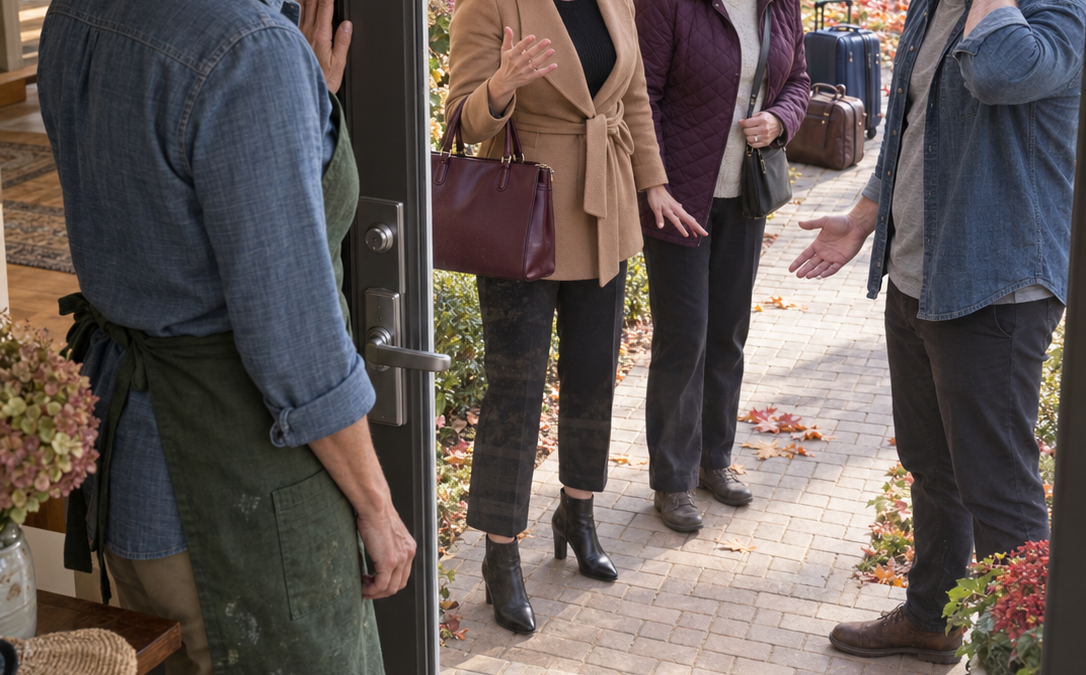
PART 1
“What a stunning kitchen,” my daughter-in-law said, running one manicured hand across the granite island.
Then she smiled at me and added:
“My mother is going to love waking up to this view.”
I was halfway through cutting my roasted chicken.
My son stopped chewing.
That was how I knew he already knew.
Sarah took a sip of sparkling water.
“She’ll use the guest room. And honestly, Dad’s old study is perfect for her sewing machine.”
I set down my knife.
My name is Jessica Dean.
I was sixty-four years old that autumn, widowed for five years, and had lived in that house for thirty-two.
My husband Arthur and I bought it when David was nine.
We spent decades turning it from a badly insulated four-bedroom colonial into the house Sarah was admiring.
Arthur refinished the oak floors himself.
I tiled the upstairs bathroom twice because the first attempt was so bad he called it “abstract masonry.”
We replaced windows one at a time when we could afford them.
Saved for the kitchen renovation.
Paid the mortgage off six years before Arthur died.
The house was not an investment strategy to me.
It was where my life had happened.
Which was why I wanted to make sure I had heard Sarah correctly.
“Your mother is moving where?”
Sarah’s smile barely changed.
“Here.”
David stared at his plate.
I looked at him.
He became fascinated with potatoes.
Sarah continued.
“Brenda already gave notice on her apartment. Her lease ends next Friday.”
I folded my napkin once.
“Why would she give notice?”
“Because we figured this makes the most sense.”
“Who is we?”
A tiny silence.
Sarah glanced at David.
There it was.
“We’ve talked about it,” she said.
“I see.”
My son finally cleared his throat.
“Mom, Brenda’s rent went up again.”
“That is unfortunate.”
“She’s on a fixed income.”
“I know.”
“And you have all this space.”
I looked around my dining room.
All this space.
The phrase people use when they have already mentally redistributed something belonging to someone else.
Sarah leaned forward.
“Jessica, it’s four bedrooms.”
“Yes.”
“One is a guest room.”
“Yes.”
“One is basically storage.”
“Arthur’s study.”
“He’s been gone five years.”
The sentence was not shouted.
That almost made it worse.
David looked up sharply.
“Sarah.”
“What? I’m not being disrespectful. I’m being practical.”
Practical.
People often use that word when they mean the inconvenience has been assigned to somebody else.
Sarah continued.
“Mom would contribute. She wouldn’t be a burden.”
“That isn’t the issue.”
“What is?”
“That nobody asked me.”
Her expression tightened.
“We’re asking now.”
“No.”
The word landed more heavily than I expected.
Sarah blinked.
Then smiled again as though I had misunderstood a question on a form.
“I don’t think you understand. Her lease is already ending.”
“I understand perfectly.”
“But she has nowhere else lined up.”
“Then she needs to line something up.”
David sighed.
“Mom.”
I looked at him.
“Did you tell Brenda she could move here?”
His silence answered first.
Then:
“We told her it was basically settled.”
“You told her my house was available?”
“I thought you’d say yes.”
“Why?”
He looked toward Sarah.
Wrong direction.
I waited until he looked back.
“Why?”
“Because you have room.”
“That is not an answer.”
Sarah put her glass down harder than necessary.
“You would seriously let family struggle just to keep empty bedrooms?”
“This house is not empty.”
“You know what I mean.”
“I live here.”
“No one said you don’t.”
“You are discussing relocating another adult into my home as though I’m one of the logistics.”
Her face changed.
The pleasant dinner voice disappeared.
“She’s my mother.”
“Yes.”
“And David is your son.”
“Yes.”
“So we’re family.”
“That still does not give you authority over my house.”
David rubbed his forehead.
“Can everyone calm down?”
I almost laughed.
I was perfectly calm.
That was apparently the problem.
“David, I am not angry.”
“You sound angry.”
“I sound clear.”
Sarah pushed her chair back.
“You know what? Fine. We’ll figure something out.”
“Good.”
“But I think this is incredibly selfish.”
That one hurt.
I did not show it.
Arthur used to say I was dangerous when I got quiet.
He was wrong.
Quiet Jessica was usually the one trying not to say something she would regret.
I collected our plates.
Sarah stood.
“I can do that.”
“I’ve got it.”
“You always say that.”
I looked at her.
“What?”
“Nothing.”
“No. Say it.”
She picked up her purse.
“You complain that everyone expects you to do things, but then every time somebody offers, you say you have it.”
That was annoying because there was truth in it.
Not enough to make her mother my roommate.
Enough to stay with me.
David stood.
“Mom, we’ll talk later.”
“No. We won’t.”
He frowned.
“I mean about Brenda.”
“There’s nothing left to discuss.”
Sarah stared at me.
Then the two of them left.
I washed the dishes.
Wiped the counters.
Locked the front door.
Then stood in Arthur’s old study.
His leather chair remained beside the window.
The room still held three shelves of books, a drafting lamp, my sewing basket, and boxes I kept promising myself I would sort.
Maybe Sarah saw wasted space.
I saw the room where Arthur paid bills on Sunday nights and listened to baseball too loudly.
I sat in his chair.
On the desk was an old brass house key.
Not functional anymore.
Arthur had changed one lock years ago and kept the old key because he never threw out hardware.
I picked it up.
Heavy.
Worn smooth.
A house key should be a small thing.
In our family, it had never been small.
When David was seventeen, he lost his twice.
When he married Sarah, I gave them an emergency spare.
Not for daily use.
For emergencies.
I remembered putting it in David’s hand.
“Only if I’m stuck somewhere or there’s a real problem.”
He laughed.
“Mom, I’m not moving back in.”
Apparently I should have defined more terms.
The following Tuesday, I was drinking coffee on my back patio when a delivery truck turned into my driveway.
I heard the diesel before I saw it.
Two movers climbed out.
Then Sarah’s SUV pulled in behind them.
I set down my mug.
By the time I reached the front of the house, one mover was lifting a box marked:
BRENDA — KITCHEN
Sarah stood on the walkway holding a clipboard.
“Right inside the foyer for now.”
I stopped.
“No.”
The mover froze.
Sarah turned.
Her face immediately hardened.
“Jessica.”
“Put the box down.”
The mover looked from her to me.
“Ma’am, is this your residence?”
“Yes.”
Sarah interrupted.
“She knows what this is.”
“I know exactly what it is. I did not authorize delivery.”
The second mover lowered his dolly.
Sarah walked toward me.
“We’re not moving Mom in today. We’re storing some things.”
“Not here.”
“It’s three boxes.”
“Then three boxes need another address.”
She lowered her voice.
“Why are you making this impossible?”
“I said no last week.”
“She has to be out Friday.”
“Then every day since our dinner was available for you to solve that.”
The taller mover cleared his throat.
“We can reload them.”
Sarah spun.
“No. Leave them.”
“Not inside.”
“Fine. Driveway.”
I looked at her.
“You’re leaving your mother’s belongings in my driveway?”
“Temporarily.”
“No.”
She stared at me.
I pointed toward the covered side passage between the house and garage.
“They can be placed there until tonight. David can collect them.”
“I don’t need your permission to—”
“Yes, Sarah. Here, you do.”
The movers exchanged the look workers develop when they realize they have been hired into somebody else’s family problem.
They set the boxes under cover.
Sarah signed whatever she needed to sign.
Then turned toward me.
“Unbelievable.”
“You’re welcome to take them with you.”
“My car is full.”
“That sounds inconvenient.”
Her eyes narrowed.
“You’re enjoying this.”
I was not.
That surprised me too.
I had imagined a boundary would feel satisfying.
Mostly it felt sad.
“No.”
She walked back to her SUV.
Before getting in, she said:
“David is going to be furious.”
That sentence told me more than she intended.
My son had become enforcement.
Not partner.
Not mediator.
Enforcement.
I waited until she drove away.
Then texted David.
Sarah had movers bring Brenda’s belongings here after I said no. Three boxes are under the covered side passage. Please collect them tonight.
His reply came two minutes later.
Mom, please. Can we not turn this into a war?
I stared.
Then wrote:
I’m not at war. I’m telling you where the boxes are.
He collected them at nine that evening.
I watched from the living room window.
He loaded each one into his pickup by himself.
Before leaving, he looked toward the house.
For a second, I considered opening the door.
I didn’t.
Not because I wanted to punish him.
Because I knew what would happen.
He would say:
Mom, six months.
I would explain no again.
He would tell me Brenda was desperate.
I would start feeling cruel.
And the boxes would somehow remain.
Sometimes you have to stop a conversation before you volunteer yourself out of your own answer.
The next morning, I was upstairs sorting winter clothes when I heard the front door open.
Not knock.
Open.
My body went still.
I walked to the landing.
Sarah stood in the foyer holding two grocery bags.
And a brass key.
“Morning,” she said.
I stared at her hand.
“Where did you get that?”
She glanced at the key.
“David gave it to me years ago.”
“That is the emergency key.”
“I know.”
“Is there an emergency?”
She set the groceries down.
“I’m trying to be nice.”
“By letting yourself into my house?”
“Mom is going to be spending a lot of time nearby once we find her a place. I thought I’d stock some things she likes.”
I descended the stairs.
“Hand me the key.”
Sarah laughed.
“No.”
“I’m not asking twice.”
“David is your son.”
“Yes.”
“This is his childhood home.”
“Yes.”
“And I’m his wife.”
“Yes.”
“So stop acting like we’re strangers.”
“You are not strangers. You are also not owners.”
She tightened her grip on the key.
“You need someone checking on you anyway.”
That sentence stopped me.
“Excuse me?”
“You’re alone in this giant house.”
“I am sixty-four.”
“I didn’t say you were helpless.”
“You just implied I require unscheduled supervision.”
She rolled her eyes.
“I’m keeping the key.”
“No, you’re not.”
“What are you going to do?”
I looked at her.
Then at the key.
“Nothing.”
That seemed to surprise her.
She grabbed the grocery bags again.
“Good.”
“No, Sarah. You misunderstood me.”
She stopped.
“I’m not going to fight you for a piece of metal.”
I opened the door.
“You can go.”
She left furious.
I closed the door behind her.
Then called a locksmith.
Not because I feared Sarah would break in and hurt me.
Because permission had been revoked and she had explicitly said she would ignore that.
The locksmith changed the cylinders on the exterior doors that afternoon.
He handed me four new silver keys.
I gave one to my neighbor Gail.
One stayed on my ring.
One went into my safe.
The fourth remained unassigned.
I did not give it to David.
Not yet.
Then I sat in Arthur’s chair again.
New key in one hand.
Old brass key in the other.
I thought about how Sarah had reached the point where walking into my home without permission felt reasonable to her.
That had not started with a bedroom.
It had started with access.
Small access.
Money too.
Five years earlier, after Arthur died, David and Sarah were struggling with preschool tuition for Leo.
I offered $800 a month temporarily.
“Until kindergarten,” I said.
They thanked me.
Leo entered public kindergarten.
The transfer continued.
I noticed.
Asked David once.
He said expenses were still tight.
Soccer.
After-school care.
Car payment.
I let it continue.
Then second grade.
Still $800.
By then, the original purpose had disappeared.
The money had simply become part of their household budget.
Again:
Nobody forced me.
That mattered.
Sarah could be entitled.
David could be passive.
But I had been maintaining a financial arrangement long after its stated reason ended because ending it required a conversation.
I opened my banking app.
Found the recurring transfer.
$800 — monthly — David Dean
My thumb hovered over cancel.
I was angry.
That made me cautious.
Arthur had taught me never to make large money decisions in the same hour as an argument.
I closed the app.
Then called my financial adviser.
Not because canceling $800 required professional permission.
Because I wanted to hear myself explain why.
“I originally intended it for Leo’s preschool.”
“And now?”
“He’s eight.”
“Do David and Sarah rely on it?”
“Apparently.”
“Have you told them it was temporary?”
“Yes. Years ago.”
“Do you want to continue helping them?”
I thought.
“I want to help Leo.”
“Those aren’t necessarily the same thing.”
Exactly.
We discussed options.
Not a custodial account that became legally his at eighteen regardless of maturity.
I decided on a 529 education account with me as owner and Leo as beneficiary.
I could contribute regularly.
The money would remain directed toward his education rather than blending into his parents’ household spending.
The next morning, after sleeping on it, I canceled the $800 transfer.
Then started a smaller monthly contribution to the 529.
Not $800.
$500.
I kept the other $300 in my own budget.
I had retirement expenses too.
That felt strangely radical.
Three days passed.
Then the first of the month arrived.
David called.
I was outside watering hydrangeas.
I let it ring because my hands were muddy.
Then a text:
Mom, did something happen with the transfer?
A second message followed.
It didn’t come through.
No mention of Sarah’s salon card.
Reality did not need that kind of convenient punch line.
I finished watering.
Washed my hands.
Made tea.
Then called.
David answered immediately.
“Mom.”
“I canceled the transfer.”
Silence.
“What?”
“The $800.”
“Why?”
“Because I started it for Leo’s preschool. He has been out of preschool for years.”
“We use it for him.”
“Some of it, I’m sure.”
“What does that mean?”
“It means I never asked for an accounting and I’m not asking now.”
His voice tightened.
“So you’re punishing us.”
“No.”
“This happens right after the house fight and it’s not punishment?”
“The timing is connected.”
“Then it is.”
“No. The house situation made me review where I have left old arrangements running because I don’t want uncomfortable conversations.”
He was silent.
I continued.
“I opened a 529 for Leo. I’ll contribute there.”
“You can’t just change things without warning.”
That hurt.
Not because he was wrong.
Because he was partly right.
“I could have given you more notice.”
“Yes.”
“You’re right.”
He seemed thrown off.
I continued.
“I’m still not reinstating it.”
I heard Sarah in the background.
“What did she say?”
Then louder:
“Ask her if she knows the SUV payment is due.”
I closed my eyes.
There it was.
Not theft.
Not fraud.
Simply my gift woven into an expense I had never agreed to support.
David lowered his voice.
“We budget around that money.”
“Then your budget needs to change.”
“That’s easy for you to say.”
“No. It’s easy for me to say because I’m not the person who has to change it.”
He went quiet.
I thought of my daughter-in-law using the word practical.
My turn.
“But that doesn’t make my money part of your permanent income.”
Sarah grabbed the phone.
I heard the movement.
Then:
“Jessica.”
“Sarah.”
“This is unbelievable.”
“I disagree.”
“You’re retaliating because I tried to help my mother.”
“You tried to move your mother into my house after I said no.”
“She has nowhere to go!”
“Then you and David need to help her find somewhere.”
“You have four bedrooms.”
“Yes.”
“You have money.”
“Yes.”
“You’re alone.”
“Yes.”
Every fact accurate.
None created obligation.
“Those are facts about my life, Sarah. They are not resources you get to allocate.”
Silence.
Then:
“Family helps family.”
“I agree.”
“Apparently not.”
“Help that can’t be refused isn’t help. It’s control.”
She hung up.
That evening, David came alone.
He sat in his truck for several minutes before approaching the porch.
I opened the inner door but left the storm door latched.
Not as theater.
Because I wasn’t ready to invite him in.
He stopped.
“You changed the locks.”
“Yes.”
“You couldn’t just ask for the key?”
“I did.”
He looked ashamed.
“Sarah told me.”
“She refused.”
“I know.”
“Then yes, I changed the locks.”
He rubbed both hands over his face.
“Everything is a disaster.”
“How is Brenda?”
“Her lease ends Friday.”
“Where is she going?”
“We’re trying to find somewhere.”
“Good.”
“We can’t find anything she likes in her price range.”
Different problem.
Not nowhere.
Nothing she liked.
That mattered.
Then David said:
“If you let her use the room six months, we could save enough to get her situated.”
“No.”
He looked at me.
“Just six months.”
“No.”
“Mom.”
“David.”
“She would pay something.”
“No.”
“You don’t even use the room.”
I stared.
He stopped.
“Sorry.”
“Thank you.”
He sat on the porch step.
“Sarah says I’m supposed to fix this.”
I waited.
“I don’t know how.”
“You don’t have to fix everything she is upset about.”
He laughed bitterly.
“That sounds easy.”
“It isn’t.”
I thought of my own fifty years of avoiding discomfort.
Then:
“But it is learnable.”
He looked at me.
After a while:
“She wants to put Brenda in a hotel for a few weeks.”
“That sounds reasonable if they can afford it.”
His expression changed.
“About that.”
I waited.
“She said if our card gets tight, we can use the emergency card.”
I frowned.
“What emergency card?”
Then I remembered.
Ten years earlier, when David and Sarah took Leo to Florida, I had added David as an authorized user to one of my credit cards.
Emergency use.
Hospital.
Travel disruption.
Unexpected car repair.
He had used it once for a rental-car deposit and reimbursed me.
Then never again.
I had forgotten the card still existed.
Apparently Sarah had not.
“Do you still have it?”
“I think Sarah does.”
My voice became very quiet.
“Did you tell her she could use it for a hotel?”
“No.”
“Did she ask?”
“She said it was an emergency.”
“That wasn’t my question.”
“No.”
I nodded.
“Thank you for telling me.”
He looked up.
“Mom, don’t—”
“I am going to remove you as an authorized user.”
His shoulders sagged.
“I knew it.”
“You just told me your wife intends to use my card without asking.”
“I can stop her.”
“Then stop her with your own card.”
He looked hurt.
I hated that.
But hurt is not always evidence that a boundary is wrong.
He stood.
“You really think Sarah is some kind of thief now?”
“No.”
“What do you think?”
“I think she has started treating access as consent.”
House key.
Bedroom.
Monthly transfer.
Credit card.
Different forms of the same assumption.
“If she uses my card believing she has permission because you are an authorized user, that creates a mess none of us needs.”
He stared toward his truck.
Then whispered:
“I’m tired.”
“I know.”
“I don’t know how everything got like this.”
I did.
One unspoken yes at a time.
PART 2
I removed David as an authorized user that night.
I texted him first.
I’m canceling the old emergency card tonight so there is no misunderstanding. Please destroy the physical card if you still have it.
His answer:
Okay.
No argument.
That mattered.
The next afternoon, I received a fraud-alert notification.
Not a dramatic $2,400 declined charge.
A hotel authorization attempt for a little over six hundred dollars.
Card ending in David’s old secondary number.
The issuer declined it because the card had been closed.
My stomach sank anyway.
A few minutes later, David called.
I answered.
“Did Sarah try to use the card?”
Silence.
“Yes.”
“Did she know I canceled it?”
“I told her.”
That was worse.
“What happened?”
“She thought you were bluffing.”
I closed my eyes.
There it was again.
No did not mean no.
It meant obstacle.
Then a local number appeared on my other line.
I let David go.
The caller was Brenda.
Sarah’s mother.
“Jessica?”
“Hello, Brenda.”
Her voice shook.
“I’m sorry to bother you.”
“You’re not.”
“I’m at a hotel near David’s.”
I sat down.
“Are you all right?”
“Yes. Embarrassed.”
“What happened?”
“Sarah said there was an issue with the reservation.”
I waited.
Then Brenda asked:
“Did you ever offer me your guest room?”
The entire conflict narrowed into that question.
“No.”
Silence.
“She said you had.”
“I’m sorry.”
“She told me you agreed and then changed your mind after some argument.”
“No.”
I heard her inhale.
“Did David tell you I agreed?”
“No.”
Brenda became very quiet.
Then:
“I gave notice because she said everything was settled.”
“I know.”
“How?”
“She told me after you had already given notice.”
“Oh God.”
I felt sorry for her immediately.
Not because she had done nothing wrong.
She had accepted a housing arrangement without speaking to the homeowner.
But Sarah had presented my consent as fact.
That changed the weight of it.
“Brenda, do you have somewhere safe tonight?”
“Yes. I can pay for this hotel myself.”
“Good.”
“I’m not asking you for a room.”
“I know.”
“I want that clear.”
“It is.”
She started crying.
Not loudly.
“I feel like such a fool.”
“Don’t.”
“I should have called you.”
“Yes.”
That was kinder than pretending otherwise.
She laughed through the tears.
“I deserved that.”
“No. You deserved accurate information.”
We agreed to meet the next morning at a café.
Not my house.
That mattered.
I did not want Sarah showing up behind her and turning my porch into a courtroom.
Brenda arrived early.
She was sixty-six.
Widowed.
Retired from a dental office.
Fixed income, yes.
But not destitute.
Her old apartment had raised rent by nearly three hundred dollars.
She could still afford housing if she downsized or moved farther from Sarah and David.
She simply disliked the available options.
When Sarah offered my guest room, Brenda heard an opportunity to save money and live near her daughter.
She did not ask enough questions because the answer suited her.
Again:
Human.
Not villainous.
She stirred her coffee.
“I’m angry with Sarah.”
“I understand.”
“I’m also angry with myself.”
“Also understandable.”
“She said you were lonely.”
I laughed once.
“Sarah has a very active imagination about my emotional condition.”
“She said you’d be grateful for company.”
“Did that sound like me?”
Brenda smiled weakly.
“No.”
We sat quietly.
Then:
“She worries about money constantly.”
“Sarah?”
“Yes.”
I knew they lived well.
Leased SUV.
Large house.
Trips.
Private soccer camps for Leo.
Not extravagant by wealthy standards.
Expensive enough to create pressure.
Brenda continued.
“She wants everybody to believe they’re doing better than they are.”
That was familiar.
Different generation.
Different costume.
Same hunger.
“What are you going to do?”
“I found a one-bedroom in Maple Glen.”
“Do you like it?”
“No.”
I smiled.
“Can you afford it?”
“Yes.”
“Then you have time to find something you like better later.”
She laughed.
“That sounds like something I used to tell Sarah.”
We paid separately.
Before leaving, Brenda said:
“I’m sorry about the boxes.”
“Thank you.”
“And the groceries.”
“I kept the crackers.”
She laughed harder.
Good.
The conflict between David and Sarah did not end on my porch that week.
It stretched across months.
That is how marriages actually fracture.
Not one speech.
Accumulation.
David started saying no.
Sarah hated it.
At first, she blamed me.
“You’ve turned him against me.”
Then Brenda.
“You embarrassed me by calling Jessica.”
Then money.
“Everything would be fine if people would stop making this so hard.”
But people had stopped making it easy.
There is a difference.
David and Sarah began counseling after Brenda moved into the Maple Glen apartment.
I learned that from David.
I did not ask for details.
Then, three months later, he called.
“Can I come over?”
“Yes.”
He knocked.
Also progress.
I opened the door.
He looked at the lock.
Then at me.
“Still weird that my old key doesn’t work.”
“You lived here until twenty-two.”
“I know.”
“That is a long time to expect lifetime access.”
He smiled slightly.
We sat in the kitchen.
He looked tired.
“Sarah and I are separating for a while.”
I did not say I was sorry immediately.
That surprised me.
Instead:
“How do you feel?”
“Terrible.”
Then I was sorry.
He had loved her for twelve years.
Entitlement did not erase marriage.
“I’m sorry.”
“She says I changed.”
“You did.”
“Thanks.”
“I mean that neutrally.”
“No, you don’t.”
Fair.
He stared at the table.
“Our counselor asked how many decisions in our marriage I agreed to because saying no felt harder.”
I waited.
“How many?”
He laughed.
“A lot.”
Then:
“She asked Sarah how many decisions she made assuming I would eventually agree.”
I smiled despite myself.
“And?”
“Also a lot.”
“That sounds expensive.”
“It is.”
He looked toward Arthur’s old study.
“Dad really said I had a soft spine?”
I had mentioned it once on the porch.
I regretted that.
“Arthur said many things.”
“Mom.”
“Yes.”
“He said you had a good heart and a soft spine.”
David nodded.
“That hurt.”
“I’m sorry.”
“You meant it.”
“I meant I saw you avoiding conflict. I should not have used your father’s memory to strengthen the point.”
He looked at me.
“Thank you.”
There.
An apology without self-erasure.
I was learning too.
PART 3
David and Sarah did not divorce immediately.
They spent six months apart.
He rented a small duplex.
Leo divided time between them.
They attended counseling separately and together.
Brenda stayed out of it after I told her she was at risk of becoming the other side’s version of me.
She laughed.
Then realized I was serious.
Sarah eventually called me.
Not text.
Called.
I almost ignored it.
Then answered.
“Jessica.”
“Sarah.”
“I owe you an apology.”
I waited.
She continued.
“I told my mother you agreed because I was afraid if I asked you directly, you would say no.”
That was brutally clear.
“You were correct.”
“I know.”
“So you removed the question.”
“Yes.”
She started crying.
“I thought once her things were there, you’d adjust.”
“That is not consent.”
“I know.”
“You used the emergency key after I told you not to.”
“I know.”
“You tried to use the card after David told you it was canceled.”
Her voice cracked.
“Yes.”
“Why?”
“Because I was panicking.”
I believed her.
It did not excuse anything.
But fear explained some of the speed.
Brenda’s lease.
Housing costs.
Sarah’s household budget.
Her own sense that every problem required immediate control.
She continued.
“I told myself I was solving problems.”
I looked around my kitchen.
“That sounds familiar.”
“What?”
“Nothing.”
Actually, not nothing.
I had spent much of my life solving problems before people asked.
Sending money.
Offering access.
Absorbing inconvenience.
I disliked Sarah’s entitlement.
But I had also taught my family that resources flowed outward from me with little discussion.
That did not give her permission to take.
It did explain why limits surprised them.
“I’m sorry,” Sarah said.
“I accept the apology.”
She was quiet.
“You do?”
“Yes.”
“Does that mean—”
“No.”
Another pause.
“I’m not giving the key back.”
“I know.”
“The monthly transfer is not restarting.”
“I know.”
“My credit card access is permanently closed.”
“Yes.”
“And Brenda is not moving here.”
Sarah laughed weakly.
“I know that one.”
“Good.”
Apology did not restore access.
That was an important lesson for both of us.
David and Sarah eventually reconciled.
Not because the separation scared her into obedience.
Not because David suddenly became dominant.
Because both changed enough that the marriage no longer required one person pushing and the other yielding.
They downsized their lifestyle.
Sarah returned to full-time work after years of part-time consulting.
They traded the leased SUV for a used crossover.
David stopped hiding financial stress from me while also stopping himself from asking me to fix it.
That distinction made our relationship much healthier.
The first time he called and said:
“We had a rough month,”
I immediately asked:
“How much do you need?”
He sighed.
“Mom.”
“What?”
“I didn’t ask for money.”
“Oh.”
“I’m venting.”
This was new.
“How does one respond to venting?”
He laughed.
“Maybe say that sounds hard.”
“That sounds hard.”
“Very natural.”
I was learning.
The $500 monthly contribution to Leo’s 529 continued.
I told David and Sarah exactly what it was.
My account.
My contribution.
Education purpose.
No household offset assumed.
When Leo turned ten, I showed him the account statement—not the balance, just the idea.
“Grandma puts money here for school later.”
“College?”
“Maybe.”
“What if I don’t go?”
“Then we’ll look at the rules and options.”
“Can I use it for a gaming computer?”
“No.”
“Then this account is flawed.”
Children keep ego in proportion.
Brenda and I became unexpectedly friendly.
Not best friends.
That would have been too tidy.
Coffee once every few months.
A phone call.
Sometimes dinner.
She decorated the Maple Glen apartment beautifully.
Her sewing machine fit beside a bedroom window.
One afternoon she invited me over to see new curtains.
I looked around.
“You hate this apartment less.”
“I’ve downgraded to mildly resentful.”
“Excellent.”
She handed me tea.
Then:
“Sarah says I leaned on her too much after her father died.”
“Do you think you did?”
“Yes.”
That sounded familiar.
Different family.
Same emotional physics.
“When you lose a husband,” Brenda said, “people tell you not to make big decisions for a year.”
I nodded.
“No one tells you how easy it is to make your adult child your emergency contact for every feeling.”
That sentence stayed with me.
After Arthur died, I had gone the opposite direction.
I tried to need David as little as possible.
Sent money instead.
Solved myself.
One widow grasped.
One withdrew.
Neither extreme was healthy.
The house remained mine.
Large.
Four bedrooms.
I did not sell because Sarah had made me defensive about it.
I also did not keep every room frozen in Arthur’s memory.
That came later.
Arthur’s study was the hardest.
For five years, I treated it almost like a small museum.
Leather chair.
Old desk.
Baseball radio.
Stacks of books.
One winter morning, I sat there and realized I barely used the room because I was preserving it for a man who would have hated that.
Arthur believed rooms should work.
So I changed it.
Not into Brenda’s sewing room.
Mine.
I kept the leather chair.
Kept the desk.
Moved half the old books to David.
Turned one wall into shelves for my gardening notebooks and travel photographs.
Added a lamp bright enough to read by.
Then I put the old brass key in the top drawer.
The useless one Arthur saved years earlier.
For a long time, I thought the key represented what Sarah had tried to take.
Access.
Authority.
My home.
Eventually it meant something else.
Keys do not create belonging.
Permission does.
I could give someone a key and still not give them control.
I could refuse a key without rejecting a relationship.
That distinction took me sixty-four years.
David received a new spare almost two years after the lock change.
Not automatically.
I asked.
“Would you like an emergency key again?”
He looked surprised.
“Really?”
“Yes.”
“What counts as an emergency?”
I smiled.
“Progress.”
He laughed.
Then:
“Fire. Water leak. You call from a hospital. You specifically ask me to enter.”
“Excellent.”
“Mom forgot her glasses and wants me to drop them off?”
“Knock.”
“Sarah wants to stock your pantry?”
“Absolutely not.”
He took the silver key.
Not brass.
Different key.
Different terms.
That mattered more than it should have.
Sarah did not receive a copy.
She did not ask.
Also progress.
Our first family Thanksgiving after the worst of it was at my house.
I invited them.
Those three words mattered.
I invited them.
David.
Sarah.
Leo.
Brenda too.
Sarah called before bringing her mother.
“Is it really okay?”
“Yes.”
“Are you sure?”
“Yes.”
“Do you want me to bring anything?”
“Pie.”
“One pie?”
“One.”
She laughed.
“Understood.”
Brenda arrived with a sewing bag.
I stared.
She held up both hands.
“Table runner. Gift. It leaves with you.”
Inside was a long linen runner she had stitched with small branches and leaves.
Beautiful.
“I made it for this table.”
I touched the fabric.
“Thank you.”
No one moved into the guest room.
No one discussed bedrooms.
Dinner was ordinary.
That was the achievement.
Halfway through, Leo asked:
“Grandma, why do you have so many bedrooms?”
I looked at Sarah.
Her eyes widened in horror.
I nearly laughed.
“For guests,” I said.
“Can I sleep here?”
“Sometimes.”
“Can Grandma Brenda?”
Brenda choked on water.
Sarah covered her face.
I said:
“If I invite her.”
Leo nodded.
“Okay.”
The entire conflict summarized by a ten-year-old in one sentence.
If I invite her.
That was all it had ever required.
Sarah whispered later while we loaded the dishwasher:
“I deserved that.”
“Yes.”
“You enjoyed it.”
“A little.”
She smiled.
So did I.
Our relationship never became effortless.
Sarah remained decisive.
I remained protective of my independence.
Sometimes those traits rubbed hard against each other.
The difference was that we started naming the friction before converting it into policy.
When she wanted to host Leo’s birthday at my house because their yard was under construction, she asked.
I said yes.
Then added:
“Thirty children?”
“Twelve.”
“Still terrible.”
She handled setup.
Cleanup.
Food.
She returned the house to me better than she found it.
Before leaving, she placed the spare garage remote on the counter.
“I didn’t know if you wanted me keeping it.”
There.
That was repair.
Not an apology.
A changed assumption.
I said:
“Leave it.”
She did.
The $800 story changed too.
At first, David was embarrassed by how dependent their budget had become on my transfer.
Then angry at himself.
Then practical.
They cut expenses.
Sarah increased work hours.
David refinanced one car loan.
No disaster.
No bankruptcy.
No children deprived.
I had believed my support was holding up more than it actually was.
That was useful to learn.
Helpers exaggerate their own structural importance too.
Years earlier, after Arthur died, I told myself David needed the $800.
Maybe he did initially.
Then I kept sending it because money was easier than asking:
Are you okay?
What do you need?
What can you handle yourselves?
I had converted love into recurring payment.
Then became resentful when the payment became expected.
Again:
My part.
When Leo turned twelve, I reduced the 529 contribution to $300 a month because my own travel and healthcare costs had increased.
I told David.
He said:
“Okay.”
That was it.
No panic.
No accusation.
I almost asked whether he wanted to know why.
Then stopped.
Healthy people do not require every boundary to become a seminar.
I traveled more after sixty-five.
Not dramatically.
Savannah with my sister.
Maine with Brenda, unexpectedly.
Italy with an old school friend.
I left the house empty sometimes.
The first trip, I almost gave David a detailed list of instructions.
Then remembered he was not the caretaker of my identity.
I gave Gail next door my itinerary.
David had the emergency key.
That was enough.
When I returned from Maine, there was a text from Sarah:
Hope you had fun. Didn’t enter house. Didn’t move anyone in. Please admire my growth.
I laughed for ten minutes.
Then replied:
Minimum standard achieved. Proud.
She sent a laughing emoji.
Five years after the original dinner, Arthur’s leather chair finally needed reupholstering.
The old leather cracked along one arm.
I called a local upholstery shop.
The owner asked:
“Sentimental piece?”
“Yes.”
“You want exact match?”
I looked at the faded brown.
For years, I would have said yes.
Keep it the same.
Preserve.
Instead:
“Do you have green?”
He smiled.
“What kind?”
I chose deep olive.
When the chair came back, it looked like Arthur’s and not Arthur’s.
Mine now.
I placed it beside the study window.
The old brass key remained in the drawer.
One afternoon, Leo found it.
He was thirteen.
“What does this open?”
“Nothing.”
“Why keep it?”
I smiled.
Children and keys.
Apparently a family theme.
“Your grandfather kept it.”
“Why?”
“He kept everything.”
“Can I have it?”
I thought.
Then handed it over.
“Sure.”
He added it to some collection of coins, old keys, and objects teenage boys apparently consider treasure.
I did not feel anything dramatic watching it leave.
That was how I knew the symbol had finished its work.
Years later, when people heard a shortened version of the story, they liked the moment I changed the locks.
Of course they did.
Clean.
Visual.
Entitled daughter-in-law holds old key.
Widow changes lock.
Boundary.
But the lock was easy.
A locksmith needed two hours.
The harder part was changing all the invisible access.
Money given because I felt guilty.
Silence offered because I feared conflict.
Rooms left untouched because grief had become habit.
A son allowed to make me the easy solution because I liked being needed.
A daughter-in-law allowed to mistake repeated generosity for permanent consent.
None of those had cylinders you could drill out.
They changed through conversations.
Sometimes ugly ones.
Sometimes awkward.
Sometimes delayed.
David and Sarah stayed married.
That may disappoint people who want consequences to arrive in the form of divorce papers.
Their marriage did not need punishment.
It needed repair.
For a while, they nearly failed.
Then both learned something.
Sarah learned that solving another adult’s problem without consent is still control.
David learned that avoiding conflict does not create peace. It merely sends the cost to the person least likely to refuse.
I learned something less flattering.
I had spent decades proud of being generous when some of my generosity was actually fear.
Fear of saying:
No.
Fear of being called selfish.
Fear that David would visit less if I stopped helping.
Fear that after Arthur died, I needed to remain useful to stay central in my son’s life.
That fear made me easy to lean on.
Then resentful when people leaned.
At sixty-four, I began changing that.
Slowly.
I still help.
That matters.
I paid half of Leo’s orthodontics when David asked.
Asked.
I gave Brenda a ride after cataract surgery.
She asked.
Sarah used my dining room for a work presentation when her internet failed.
Asked.
David borrowed my truck for a weekend project.
Asked.
The word became almost sacred.
Ask.
Then accept the answer.
Sometimes yes.
Sometimes no.
No guilt invoice afterward.
That became our family’s new system.
On my seventieth birthday, everyone came to dinner.
Sarah cooked.
Brenda brought cake.
David grilled salmon.
Leo, sixteen by then, arrived carrying a small wooden box.
“What is this?”
“Open it.”
Inside was the old brass key.
Mounted on a small piece of walnut.
Under it, engraved:
ASK FIRST.
I stared.
Then laughed so hard I cried.
“Your grandfather would hate this.”
“Dad helped.”
I looked at David.
He lifted both hands.
“Just the wood.”
Sarah looked suspiciously innocent.
Brenda was openly delighted.
I hung it inside Arthur’s old study.
Not by the front door.
Not as a warning.
As a family joke that had finally become safe enough to laugh about.
The house is still mine.
I still live there alone.
People used to say that sentence sadly.
Alone.
As though solitude were a diagnosis.
I am not lonely.
That is different.
Some mornings I drink coffee on the back patio and hear absolutely nothing except birds and somebody starting a lawn mower three houses away.
I love it.
Other mornings Leo sleeps in the guest room because he stayed late.
Brenda sometimes comes for dinner.
Sarah calls before arriving.
David knocks even though he has an emergency key.
Especially because he has one.
That may be my favorite part.
He knocks.
Years ago, Sarah told me:
“You have a right to access your own home, not mine.”
Actually, I told her that.
At the time, I meant property.
Now I understand it more broadly.
Love does not give permanent access to another adult’s money.
Marriage does not give access to a mother-in-law’s house.
Parenthood does not give adult children unlimited entry into a parent’s retirement.
Generosity does not create an eternal contract.
And being family does not mean every closed door is rejection.
Sometimes a closed door is simply a door.
You knock.
Someone answers.
Then they decide whether to let you in.
The Sunday after my seventieth birthday, David came over alone.
He knocked.
I opened the door.
He smiled.
“Emergency.”
“What happened?”
“I need coffee.”
“Denied.”
He held up a bakery bag.
“Bribery.”
“Approved.”
We sat in the kitchen.
For a while, he talked about Leo learning to drive.
Sarah’s work.
Nothing serious.
Then he looked toward the study.
“I still think about that first night.”
“What first night?”
“Brenda.”
I smiled.
“That narrows nothing.”
“The dinner. When you said no.”
“Oh.”
“I thought you were being stubborn.”
“I was a little.”
He laughed.
“Sarah thought you’d cave.”
“I know.”
“So did I.”
That one still hurt slightly.
“Why?”
He looked into his coffee.
“Because you always had.”
There it was.
Not accusation.
History.
“You’re right.”
He looked surprised.
“I am?”
“Yes.”
“I don’t like this.”
“You should enjoy it while it lasts.”
He smiled.
Then:
“I’m sorry I made your kindness look like consent.”
My throat tightened.
That was the sentence.
Not soft spine.
Not Sarah.
Not money.
Kindness became consent because nobody paused long enough to ask whether the yes was still active.
“I’m sorry I kept saying yes when I meant later, maybe, or I’m afraid you’ll be angry.”
He looked up.
“Fair.”
We sat quietly.
Then David pointed toward the refrigerator.
“Do you still have those crackers Sarah bought that day?”
“David, that was six years ago.”
“So no?”
“I ate them.”
He laughed.
“Traitor.”
We finished coffee.
At the door, he picked up his keys.
The silver emergency key was still on his ring.
He touched it.
Then looked at me.
“Still okay?”
I knew exactly what he meant.
“Yes.”
“Good.”
He put it back in his pocket.
Then knocked once on the open doorframe before stepping outside.
Idiot.
I laughed.
He drove away.
I closed the door.
Locked it.
Not because I was afraid of anyone entering.
Because it was evening.
Normal lock.
Normal house.
Normal boundary.
The little walnut plaque with the brass key hung in the study.
ASK FIRST.
For years, I believed the lesson was that I had finally learned to say no.
That was only half.
The real lesson was that a good relationship does not depend on hearing yes.
It depends on being safe enough to ask.
And strong enough to hear the answer.
THE END
